Table of Contents
ARTICLE 02 | CERAMIC BUYING GUIDES
CORE KEYWORD wholesale scented candles in bulk
Wholesale scented candles in bulk appeal to retailers because a single purchase can fill an entire seasonal display. The commercial risk is that a large order multiplies every weak assumption: an unpopular fragrance, a fragile ceramic vessel, unclear labeling, or a carton that breaks in distribution. For a resale program, the buyer needs a manageable assortment, comparable landed cost, product evidence, and a replenishment path. This guide looks at the decisions after a candle concept has been chosen and before a wholesale purchase order is placed.
Daye Porcelain’s documented role is custom ceramic manufacturing. It can help a home-fragrance brand develop the porcelain vessel that gives a collection its shape and shelf identity. The wax, fragrance, wick, filling, burn testing, and finished-product labeling must be supplied and approved by the responsible candle specialist or program owner. Treat a Daye vessel quote as one component of the finished retail cost unless a broader scope is explicitly confirmed.
Key takeaways
- Plan bulk quantities by sellable SKU and forecast, not by a single aggregate order number.
- Calculate landed cost from vessel, fill, fragrance, label, pack, tests, freight and expected damage, then compare against the actual retail channel.
- Reduce complexity by sharing an approved vessel across scents while keeping each finished candle’s evidence and stock code distinct.
- Use a small pilot and replenishment rules before committing to a large seasonal buy.
Define the assortment customers can understand
A retailer may be tempted to offer every fragrance family and vessel color in one launch. Each combination creates a new SKU, artwork file, box label, production quantity, inventory position, and possible burn-test variation. Start with a lead vessel and a concise scent architecture. For example, a fresh, a floral and a warm woody option may give shoppers meaningful choice without requiring three different ceramic tools. The actual scent names should follow the brand’s own fragrance development and legal review.
Choose variants for a sales reason. A second vessel size may target a higher gift price, a travel format, or a different burn experience; it should not merely repeat the same offer with a new label. A matte glaze and a gloss glaze can look like distinct collections, but both need approved physical references and may have different pack protection. Keep a line sheet that records each SKU’s vessel, wax fill, wick count, fragrance, lid, label, box, master carton and target channel.
Resale buyers also need accurate photographs and copy. Show the finished candle that will ship, including the actual vessel color and pack. State the net wax quantity and physical dimensions correctly. Avoid general claims such as “non-toxic,” “clean-burning,” or a fixed burn duration without product-specific evidence and a clear basis. If a retailer requires online catalog data, include barcode, country-of-origin information appropriate to the finished product, carton dimensions, care instructions and safety information.
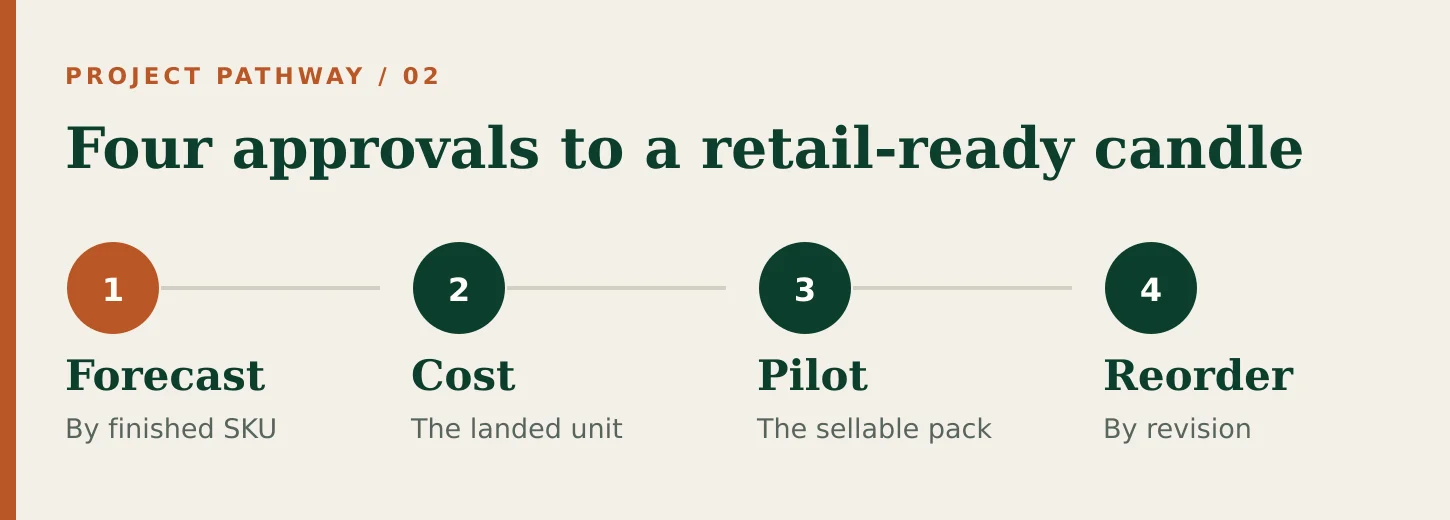
Illustrative approval sequence for the buyer, ceramic maker and finished-candle specialist.
Work backward from a target retail price
Begin with the channel’s expected retail price and margin structure, then calculate the cost the product can support. The relevant cost is not simply the candle factory’s quoted unit. Include ceramic tooling amortization where appropriate, vessel production, glaze and decoration, transport to the filler, wax, fragrance, wick, filling, lids, dust covers, warning labels, retail box, inspection, testing, outer cartons, freight, duties where applicable, and a reserve for damage or returns. The actual tax and import treatment depends on destination and contract terms, so model it with the buyer’s finance or customs team.
Ask every supplier to state exactly what its price includes. One may quote an empty fired vessel packed in bulk; another may quote a poured candle without gift box; a third may quote a complete retail unit delivered to a warehouse. Converting these into a common cost sheet prevents a “cheap wholesale scented candles” result from winning only because major services were excluded. Price per item can fall at higher volume, but slow-moving stock, warehouse fees and discounting can erase the apparent saving.
Create a sensitivity table for the variables the brand can actually change: number of vessel forms, fragrance count, box design, order quantity, local versus overseas filling, and freight method. The goal is not to publish a universal price; it is to see which design decision drives cost. A shared porcelain vessel might allow more scent variety without separate molds. A custom rigid gift box may add perceived value but also storage space and shipping weight. The buyer should validate those tradeoffs with real quotations.
|
Cost layer |
Ask for separately |
Decision it changes |
|---|---|---|
|
Porcelain vessel |
Tooling, unit finish, lid, protection |
Form ownership and reorder stability |
|
Candle fill |
Wax, fragrance, wick, pour, burn test |
Performance and scent range |
|
Retail unit |
Label, box, insert, barcode |
Shelf presentation and compliance |
|
Delivery |
Carton, inspection, freight, damages |
Landed margin and availability |
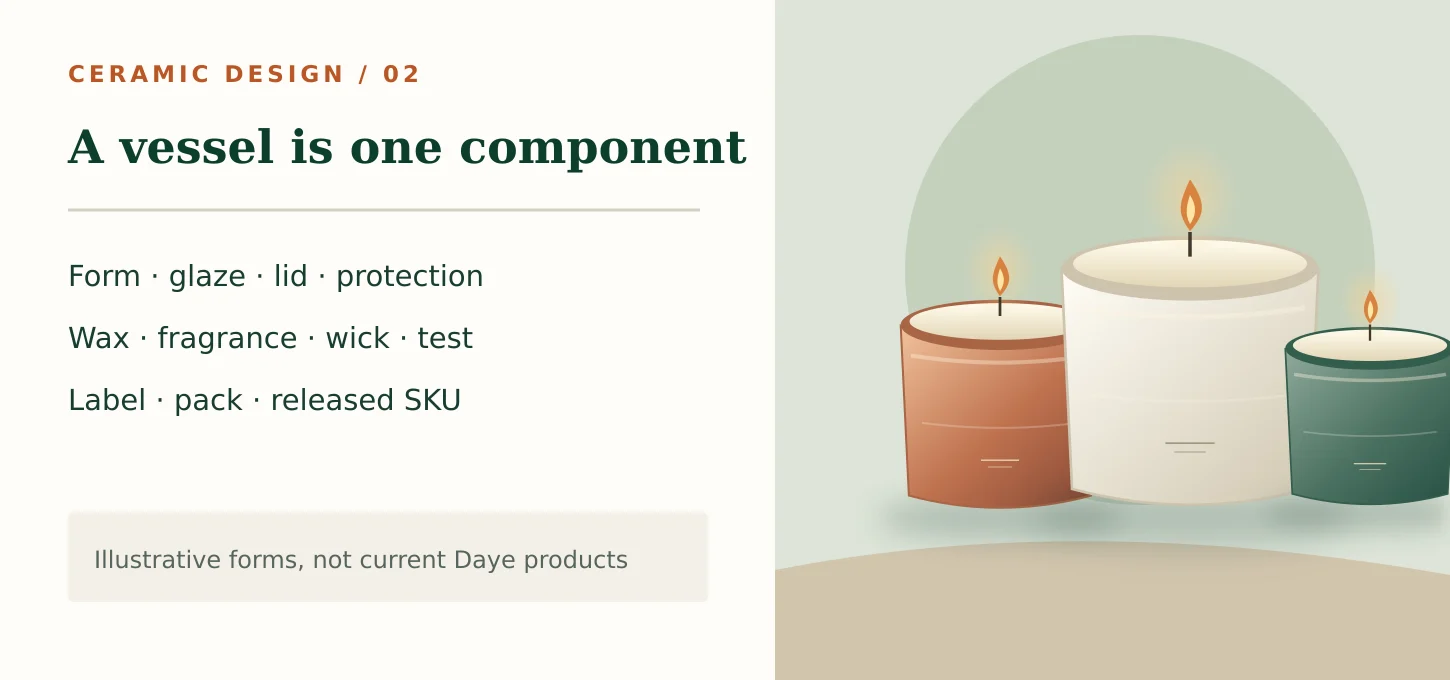
Conceptual porcelain candle-vessel illustration. These are not current Daye products.
Set minimums at the component level
“MOQ” can mean a vessel forming minimum, a glaze-color minimum, a fragrance blending quantity, a box print run, or the total number of finished candles. Ask the program owner to break these out. A buyer who orders 2,000 candles across eight scents may find that the ceramic vessel is efficient but the labels, fragrance batches or burn-test matrix are not. Conversely, one vessel in two finishes with three fragrances may be manageable if components can be shared and stock coded correctly.
Consider lead time as a sequence rather than one number. A new ceramic tool and fired master must be approved before a filler can optimize the wick. The approved fill then informs labels and retail copy. Boxes can be sampled in parallel once dimensions are stable, but final inserts must fit real production variation. Build a calendar with decision dates, sample transit, testing, bulk production, packing and delivery. Seasonal wholesale accounts often have a fixed shelf date; missing that date can be more expensive than paying for a better pack.
Reorders should be planned before launch. Confirm whether Daye will retain the tool and approved glaze reference for the vessel, and how the filler will retain the fragrance and wick records. State how substitutions will be communicated. If a preferred fragrance oil becomes unavailable, a new oil cannot simply be poured into the old SKU without re-evaluation. A retailer also needs an agreed route for replacement units and complaints by lot.
Inspect a bulk order as a sellable product
An approved sample proves design direction, while a pilot run tests repeatability. Ask for a representative set of finished candles from the proposed production route. Compare vessel shape and shade against a retained sample, check fill level, wick centering, clean tops, label registration, lid fit, box assembly and barcode scan. A physically attractive candle that arrives with a crooked warning label is not retail-ready.
For ceramic vessels, Daye’s manufacturing and quality control resources describe forming, firing, inspection and packing. Agree on accepted and rejected examples for rim, glaze, foot and lid. The final candle manufacturer then needs its own controls for wax fill, fragrance formula, wick placement, finished burn testing and final pack. A useful inspection report records the lot, sample plan, defects, corrective action and release decision; “QC passed” without criteria provides little protection.
Test shipping packs for the intended route. A ceramic jar can be sound at the factory and break when retail cartons are stacked without adequate dividers. An inner gift box should be assessed inside the master carton, and a direct-to-consumer program may require another parcel configuration. Check the packed candle for scuffs, loose lids, wax smearing, and label damage after a representative transit trial. Packaging cost is part of product quality, not an afterthought.
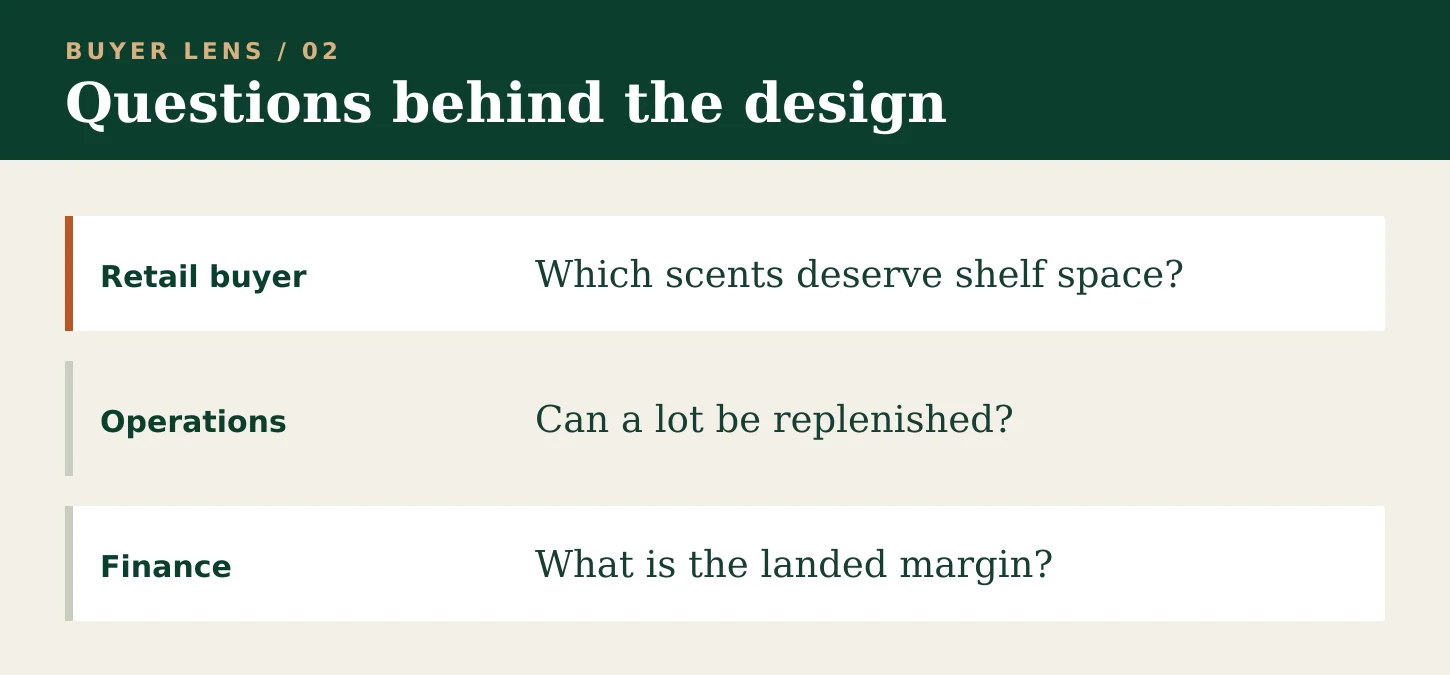
Buyer questions that guide scope, quality evidence and replenishment.
Match supply model to the resale channel
There are several legitimate ways to buy wholesale scented candles for resale. A retailer may purchase an established manufacturer’s branded range, commission private-label finished candles from a specialist, or coordinate a custom ceramic vessel with a local or overseas filler. The first route can be fast but offers limited ownership; the second simplifies accountability if scope is clear; the third can create a distinctive porcelain-led brand but requires project management and a defined responsible party for the finished candle.
“Wholesale scented candles near me” often signals that the buyer values local availability or shorter replenishment. A local distributor may hold finished stock close to the store, while a custom vessel may still be manufactured overseas. Compare actual delivery commitments, stock visibility and landed cost rather than assuming geographic proximity guarantees either quality or speed. For a UK or U.S. retailer, local filling can offer flexibility in fragrance and labels, provided the program owner validates the full system.
Luxury and value ranges have different economics. A lower-priced program can use a simple shared vessel, restrained decoration and efficient box. It should never save money by skipping burn tests, truthful labeling or adequate protection. A premium program can justify a sculpted lid or glaze, but it must still show why the higher ticket is believable in a customer’s hand. Both benefit from a concise assortment and a repeatable master specification.
A practical first purchase order
Issue a purchase order that identifies every finished SKU, quantities by scent, approved vessel and decorated master, formula or fill reference held by the responsible party, packaging revision, labels, tests, inspection, shipping terms, and delivery window. Attach an exception process: what happens if a color falls outside the sample range, a lot fails a burn check, or a carton test reveals damage. The responsible supplier should not substitute materials silently to meet a ship date.
For the porcelain component, send Daye a project brief with drawings, forecast, finish, lid, pack and filling partner’s technical requirements. The finished-candle specialist should review the ceramic sample early and sign off the integrated pilot. A wholesale order becomes safer when each supplier knows its scope and the buyer can connect an approved sample to the goods ultimately placed on the shelf.
Keep the stock file connected to customer feedback
After launch, record sales and returns by scent, vessel finish, channel and production lot. Separate a fragrance that sells slowly from a shipment with packaging damage; they call for different action. Share factual feedback with the filler and ceramic supplier before reordering. A clear lot history can show whether a glaze shade change, loose lid or wick issue belongs to one batch or to the product specification. Wholesale planning improves when replenishment uses this evidence instead of assuming the first assortment will remain the right one indefinitely.
The purchasing team should document a reorder trigger for each scent rather than waiting until all stock is low. Include expected sell-through, forecast lead time, inspection allowance, and any holiday delivery cutoff. If one fragrance runs faster than another, replenishing only the successful SKU can protect margin, provided the ceramic vessel and pack remain available in suitable minimum quantities. Review the actual order plan with the candle specialist and Daye before the first launch. A shared vessel is helpful only when the component supply terms allow the buyer to use it flexibly across the approved filled variants. Record who pays for excess components if the demand mix changes.
FAQ
How do I buy scented candles in bulk for resale without overstocking?
Start with a small, coherent set of scents and one or two vessel formats. Order against realistic sell-through and an agreed reorder lead time. A pilot can test customer reaction and the supply chain before a larger seasonal commitment.
Is the lowest wholesale unit price the best deal?
Only after all offers cover the same finished sales unit, testing, label, pack, freight and damage assumptions. A low empty-vessel quote cannot be compared directly with a fully filled and boxed candle.
Can multiple scents share one porcelain vessel?
Yes, a common vessel can simplify tooling and shelf identity. Each finished scent-wax-wick combination still needs an appropriate review and its own stock identification, label and production record.
What makes a wholesale candle suitable for online resale?
Clear product data, compliant and legible labeling, consistent photography, a parcel-ready pack where needed, traceable lots, and a documented response to damage and consumer complaints. Test the actual e-commerce shipping configuration.
Can Daye quote the entire finished candle?
Its published information supports custom porcelain manufacturing. Ask Daye to confirm any broader commercial scope directly. Until then, budget Daye as a vessel supplier and assign the wax, fill, fragrance, burn testing and finished-product responsibility separately.