COFFEE CUPS & SAUCERS
Designed for the drink.
Made for daily service.
Coffee service porcelain for roasters, café groups and hospitality buyers, with coordinated form, finish and repeat-order requirements.

WHAT YOUR BUYING TEAM NEEDS TO KNOW
The menu, the service
and the repeat order.
01
Beverage range
Define the drinks, working volumes and serving presentation so the cup family reflects the menu.
02
Cup & saucer fit
Review the base, saucer well, handle access and proportions as one service combination.
03
Daily operation
Discuss storage, washing, handling and replacement needs when defining the product specification.
01 / PRODUCT DEVELOPMENT
A coordinated range.
A consistent service.
A coffee range can span several volumes while retaining a shared design language. The purchasing brief should identify which cups share saucers and how the full set will be used.
The CLUB HOUSE references in the profile show long-term coffee collaboration and collection development. Use them as a starting point for discussing your own operational and visual requirements.

02 / MANUFACTURING DETAIL
The finish changes
the experience.
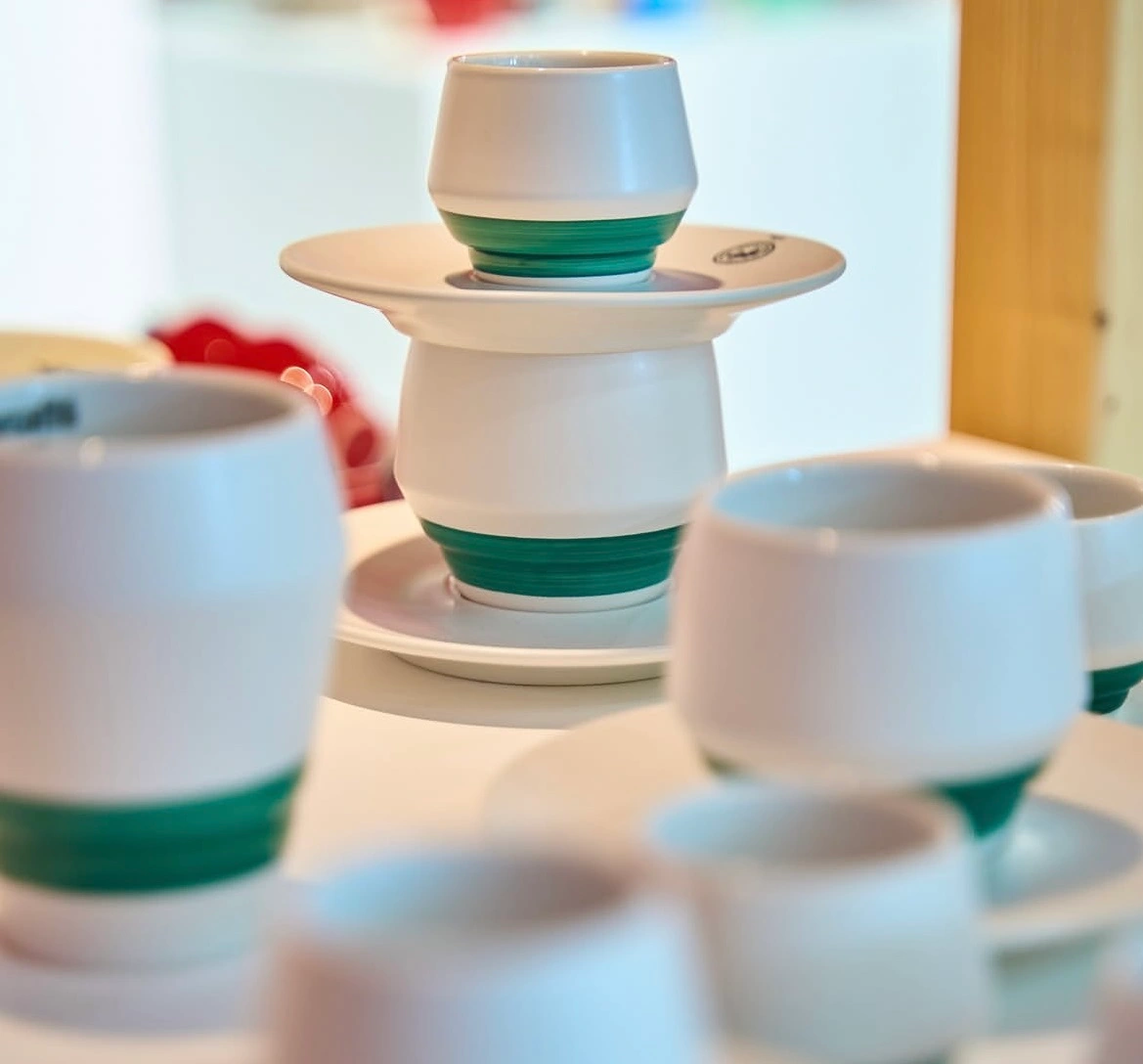
Matte colors and hand-painted finishes create different visual effects and approval needs. Review glaze feel, color variation and the finish around the rim and handle on physical samples.
For daily service, connect the chosen appearance with the washing, handling and performance requirements of your operation.
BUYER’S WORKING CHECKLIST
A brief with fewer unknowns.
| Decision | What to define | Why it matters |
|---|---|---|
| Drink size | Working volume for each beverage | Aligns the cup family with the menu. |
| Pairing | Cup base and saucer well dimensions | Supports stable coordinated service. |
| Handling | Handle access, storage and stacking goals | Reflects the café’s operational needs. |
| Finish | Glaze references and variation expectations | Defines the approved collection appearance. |
| Repeat supply | SKU forecast and replacement quantities | Gives recurring orders a consistent reference. |
FROM REVIEW TO RELEASE
A clear route to approval.
01
Define the family
List the required forms, variants, quantities and use conditions.
02
Develop the sample
Review dimensions, structure, finish and decoration on a physical product.
03
Confirm acceptance
Agree the reference sample, test scope and packing configuration.
04
Plan production
Review the order mix, release requirements and production schedule.
03 / BEFORE THE FIRST ORDER
Approve the product.
Plan the delivery.
A product specification should connect the approved sample with the order: artwork revision, variant quantities, packing arrangement and labeling all need to agree.
Share your destination market, required arrival window and any retailer or distribution requirements early. The quotation and schedule should reflect the complete scope.
The complete coffee set.
01 / Cup and saucer pairing
02 / Quantity by size and finish
03 / Protective inserts and carton layout
04 / Artwork, labels and delivery window
PROCUREMENT QUESTIONS
The details worth asking.
Can we develop a complete café range?
Yes. List the required beverage sizes, cup and saucer pairings, finishes and launch quantities for a coordinated review.
Can different sizes use one saucer?
That depends on the cup bases and saucer geometry. Confirm the intended combinations during sample development.
Are hand-painted pieces identical?
Hand-applied finishes can show variation. Agree a physical reference range and acceptance criteria suitable for the intended collection.
What should we send for a quotation?
Include the drawings or reference images, dimensions, target quantities, finish, packaging and intended market. Add the target launch date and any required test or inspection scope.
CONTINUE YOUR EVALUATION
Build the complete picture.
01
Manufacturing
Understand the production route and where consistency is controlled.
Explore manufacturing
03
Sampling & tooling
Resolve product details before production commitment.
Explore sampling & tooling
LET’S BUILD YOUR NEXT PROGRAM
A clearer brief.
A better starting point.
Send your design files, estimated quantities and target market. We will use your brief to define the development and production scope.