Table of Contents
ARTICLE 02 | MANUFACTURING & QUALITY
CORE KEYWORD ceramic machinery China
The phrase ceramic machinery China can lead a sourcing team to equipment vendors, tile-production lines, technical-ceramics tools, and factories that use machinery to make finished porcelain. Those are different suppliers. If the purchase order is for custom mugs, coffee cups, or gift tableware, the task is to audit a ceramic product manufacturer’s process. A brand needs evidence that the proposed forming, glazing, firing, inspection, and packaging route can deliver the exact design repeatedly. A brochure photograph of a large machine is useful context, but the approval decision belongs to the finished SKU.
Daye Porcelain works in Chaozhou as a custom porcelain OEM and ODM manufacturer. Its published production material describes casting, rolling, trimming, firing, glazing, decoration, testing, and inspection. It should be considered for porcelain product inquiries, not treated as a ceramic machinery exporter. This guide gives overseas brands, trading companies, and distributors a structured way to review a China factory without confusing equipment ownership with product capability.
Key takeaways
- Establish whether the supplier is selling machinery or finished ceramic goods before sending the RFQ.
- Trace one proposed product from drawing and mold through a production sample, checks, and packed carton.
- Use evidence for the exact SKU and destination market; avoid generic capacity or test claims.
- Keep a physical approval master and a change-control route for every repeat order.
Start with a scope-specific request for information
Many ceramic factories and machinery manufacturers use overlapping terms. A machine maker may supply jiggering, casting, glazing, and kiln systems to factories. A porcelain OEM may use some such processes to produce a finished mug. A trading company may coordinate production at one or more plants. Ask the first question in writing: who is the legal seller, who owns the factory operation, what is being supplied, and who is accountable for inspection and export documentation? A correct answer avoids weeks of irrelevant quotations.
|
If you are buying… |
Primary supplier type |
Evidence to request |
|---|---|---|
|
A production machine |
Equipment manufacturer or integrator |
Technical specification, installation, service, spares, acceptance test |
|
A custom porcelain mug |
Ceramic product OEM |
Fired sample, tooling plan, production route, quality criteria |
|
A decorated stock mug |
Product manufacturer or distributor |
Actual stock sample, decoration proof, repeat availability |
|
A coordinated multi-vendor program |
Named lead supplier |
Responsibility map for product, tests, packing, shipment |
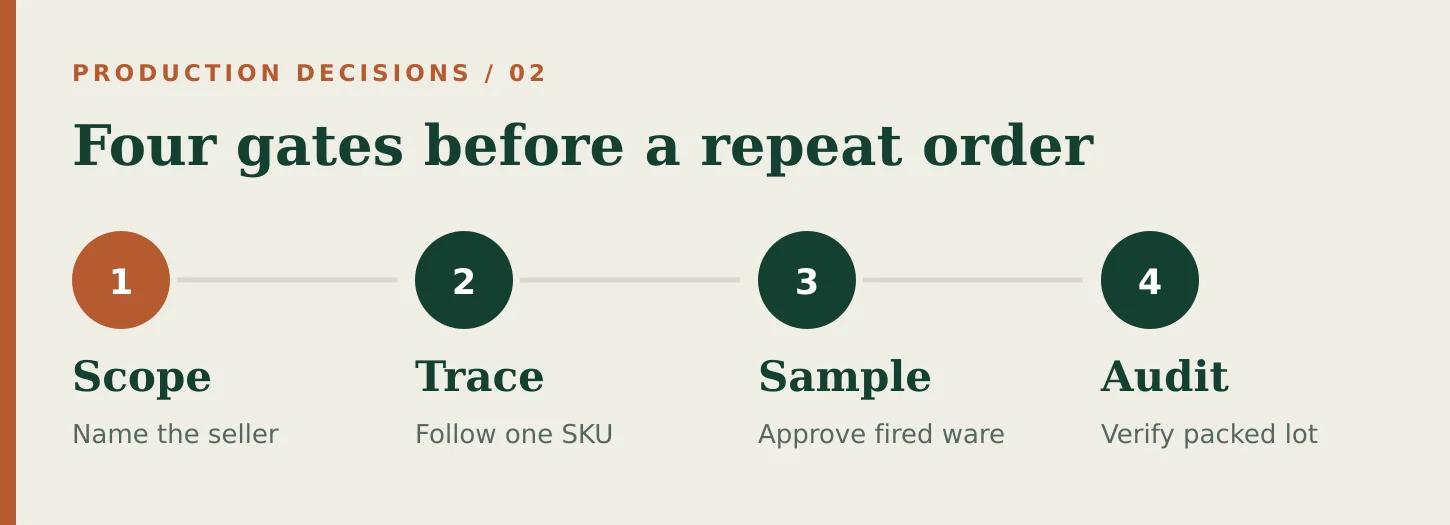
Illustrative decision sequence for product development and repeat-order control.
For a product inquiry, send a usable brief rather than only a mood board. Include dimensioned drawings or an existing sample, target capacity, body and glaze expectations, decoration artwork, color standards, forecast by variant, first PO quantity, packaging, destination, and use claims. State whether the item is for food contact and what care claims you want to make. Ask which requirements the factory can validate and which need independent testing. The response should identify unresolved technical questions before a price becomes final.
Audit the route, not the factory tour soundtrack
A live or recorded walkthrough is more useful when it follows a named product family. Ask to see where molds and work instructions are stored, how a forming operation is set up, when parts are trimmed and joined, and how a batch is tracked through drying, firing, glazing, decoration, inspection, and packing. Some footage may show another customer’s product; that is acceptable if the supplier explains which route would apply to yours. What matters is whether it can connect the example process to your proposed geometry.
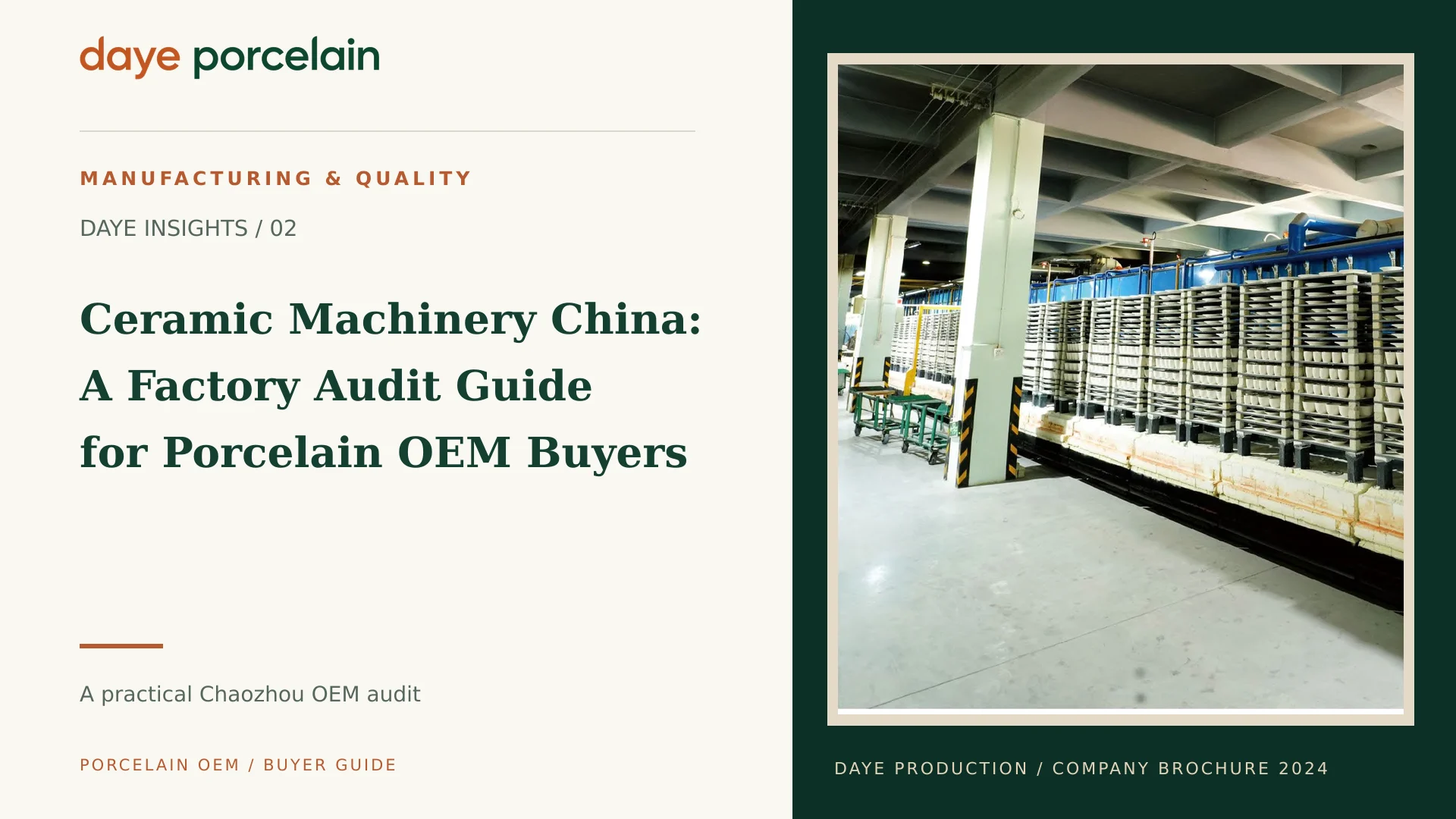
Daye’s 2024 company brochure shows a sequence from preparation to porcelain production, decoration, testing, and loading. It includes photos of rolling, casting, biscuit firing, glazing, glazing firing, and inspection. These are company-supplied illustrations of stages, not a public inventory of installed machinery with capacities. For a specific quote, ask Daye’s manufacturing team which stages apply, where they take place, and who approves the intermediate outputs.
Watch for the handoffs. A mug body may be well formed while a handle joint varies; a glaze may look good before a decoration firing and shift afterward; a final inspection may catch flaws but not explain why they recur. Request the decision rule at each handoff: what is checked, how nonconforming pieces are segregated, and who authorizes a correction. A supplier with a smaller line and clear controls can be a better fit for complex limited-run designs than an impressive high-volume line with no credible plan for variant changes.
Validate tooling and product development
An OEM mug often starts with a drawing, digital model, physical prototype, mold, and fired sample. Approval should follow the fired article because drying and firing change dimensions. Ask who develops the tool, who owns it after payment, how it is identified and stored, how many molds are needed for the plan, and what happens if one wears or breaks. State how revisions are named so the next order does not restart from an obsolete file.
Daye describes prototyping and mold development as part of its offer. For an unfamiliar design, ask it to review opening, capacity, wall, handle, base, lid relationship, logo method, and planned pack before fixing the tooling quote. A sample meeting should include marketing, procurement, and the person who will inspect incoming goods. The three groups may notice different faults: appearance, commercial terms, and functional variation.
Retain a signed fired master for every important colorway. Photograph it under controlled lighting, but do not replace it with a screen image for judging subtle color or glaze texture. Record dimensions and weight range, observable finish limits, graphic placement, carton configuration, and any tests already completed. If the manufacturer later changes the ceramic body, glaze, forming route, or decoration, decide whether a new sample and test are needed. This turns tooling from an upfront fee into a controlled production asset.
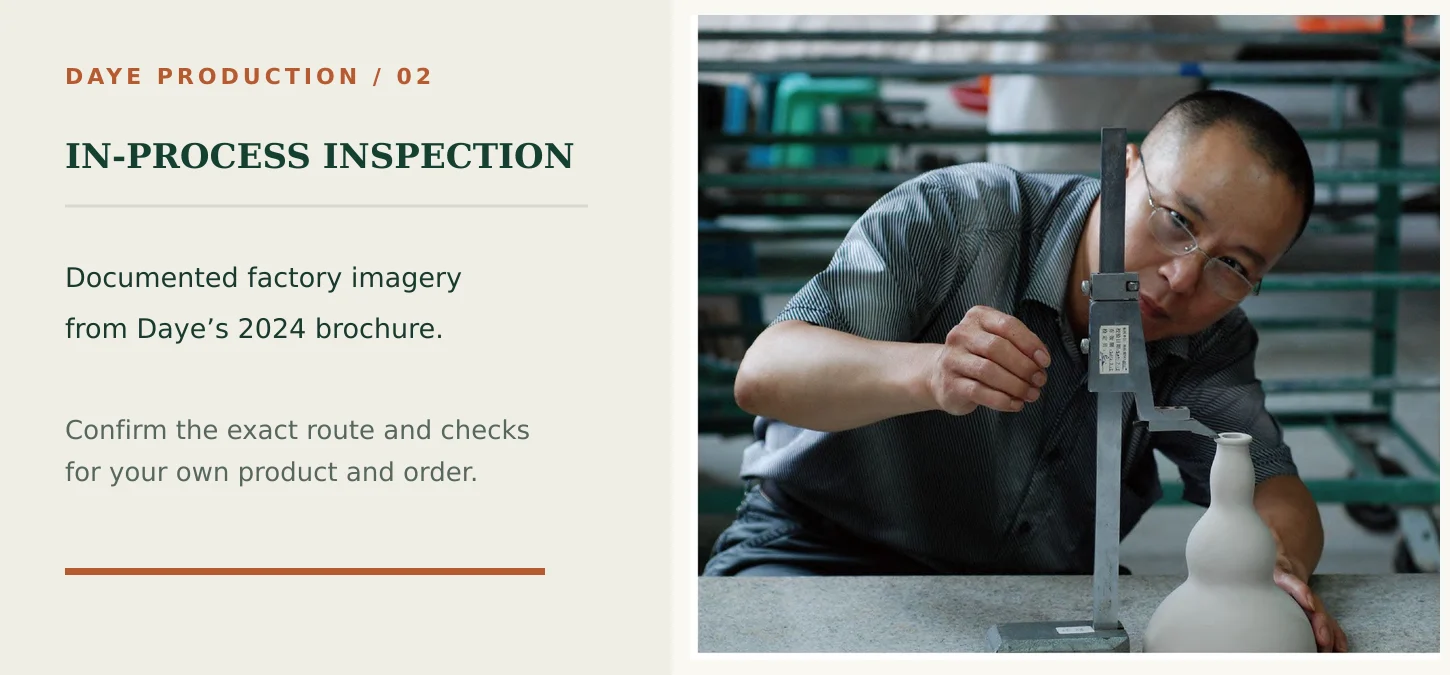
Factory photograph from Daye Porcelain’s 2024 company brochure. Confirm the production route for the specific order.
Ask what capacity means for your order mix
An advertised daily output may describe a simple product in one finish under favorable conditions. Your order may have four shapes, three glazes, a decal, and individual retail cartons. Ask for a capacity plan by SKU: mold count, forming and drying time, kiln allocation, decoration and inspection workload, minimum run or changeover constraints, and the timeline for a pilot and full order. Do not assume that a machine nameplate speed equals packed first-quality units per day.
Discuss reject allowance and the exact quantity to be shipped. If the PO needs 10,000 accepted units, the factory should plan production and inspection accordingly. Ask how rework and rejects are counted, and whether an on-time date refers to finishing production, final inspection, or loading. A buyer who needs a holiday delivery window should add time for sample revisions, testing, artwork approval, pack trial, freight, customs, and local receiving. The resulting plan is more valuable than a generic promise of fast output.
China sourcing also involves clear communication across teams. Agree on one English-language revision log for the drawing, finish, artwork, and packaging. Set a named contact for technical questions and a named person who can approve changes. A brand can use Daye’s project inquiry to provide the initial brief, then ask for milestones and evidence in a concise shared record. This is especially useful when a European or US team cannot visit every production run.
Inspect the finished product and the documentation
For a mug, the evidence package should match the intended market and claims. A factory’s general test list is not proof that your finished item meets every claim. Daye’s quality control page and brochure identify testing and inspection activities. Agree on the relevant protocol for food-contact materials, microwave or dishwasher claims, thermal shock, and any customer-specific durability requirement. Use qualified laboratories where needed, and keep the tested sample, report, and production revision linked.
Define defects before bulk work starts. Critical issues may include safety or material failures. Major issues may affect function or visible retail acceptance. Minor variation needs a stated tolerance, especially for handmade-looking finishes. Check handle strength, rim quality, base stability, capacity, decoration position, glaze coverage, sharpness, carton cushioning, and barcode accuracy as applicable. Decide the inspection sample plan and who may authorize deviations. A clear inspection standard protects both the buyer and manufacturer from arguments based on subjective adjectives.
Packaging is a process stage, not an afterthought. A beautiful cup can fail in parcel distribution if the insert allows movement or if the carton carries too much stacked load. Test an assembled retail unit and the master carton for the intended route. Ask for photos of the pack-out and a pre-shipment count by variant. If a distributor splits cartons or relabels locally, its handling should be included in the plan. The factory audit ends with sellable goods arriving at the buyer’s receiving point.
Compare proposals on total risk
Price per mug is meaningful only when quotations describe comparable products and obligations. Put tooling, samples, tests, artwork, retail packaging, inspection, spare units, shipment terms, and replacement procedure on the same comparison sheet. A lower unit price can become expensive if the approved glaze cannot be repeated or cartons need repacking. Conversely, a new mold or more deliberate inspection may be worth paying for if it protects a long-running branded range.
SACMI-SAMA’s tableware equipment catalog shows why machine lists differ across products: forming, glazing, firing, and finishing are separate technical decisions. Use such equipment information to ask better factory questions, not to infer that Daye has purchased any particular model. The final selection should rest on Daye’s actual sample and project proposal, documented controls, communication, and commercial fit. This is how a ceramic machinery China search becomes a practical porcelain OEM sourcing decision.
Make remote approval workable
For an overseas team, a remote audit needs more than a polished video call. Request a dated agenda and ask to see a comparable product move through a few named stages. Have the supplier show one work instruction, a mold or tool identifier, a sample inspection record with confidential details obscured, and a packed carton. Ask the same quality question of the commercial contact and the person supervising inspection; consistent answers suggest that the process is shared across departments. The aim is not to obtain trade secrets, but to confirm that the company can explain how it controls your future order.
Ship physical samples to decision makers rather than relying on photographs. One person should maintain the master set and the revision log, including what changed, who approved it, and which unit is current. If a team comments across different time zones, consolidate its decisions before sending them back; conflicting feedback can trigger avoidable mold or artwork changes. Name the final approver for dimensions, finish, pack, and care claims. The factory should receive one unambiguous release instruction for each stage.
After the first order, compare incoming goods with the master and capture breakage, cosmetic rejects, and customer complaints by lot. Review the findings with the supplier before a reorder. A factory audit is not a one-day pass-or-fail ceremony; it is the start of a documented relationship. The best evidence of capability is a supplier that responds to specific observations, corrects a problem, and then repeats the approved result under normal production conditions.
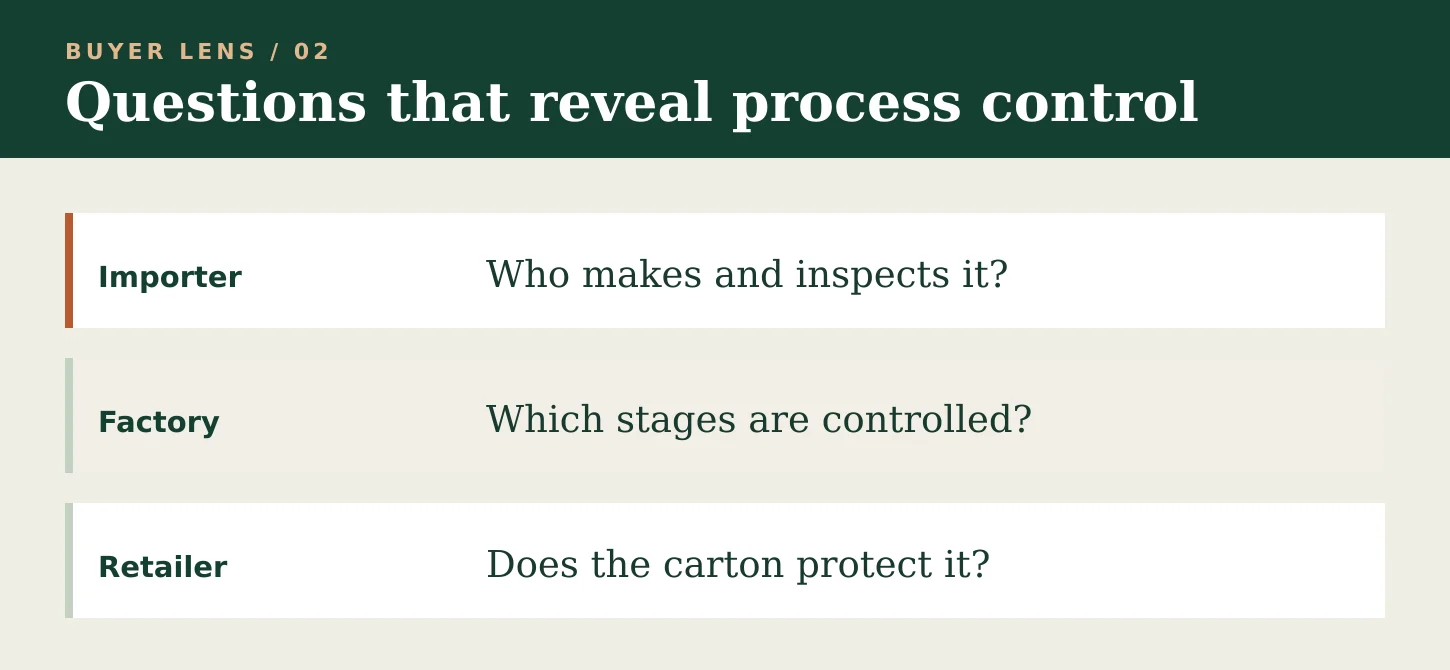
Buyer questions that connect process evidence to the approved ceramic product.
FAQ
Is a machinery exporter the same as a porcelain OEM?
No. The exporter sells equipment and may install or service it. A porcelain OEM sells finished ceramic products made through a production process. Ask for the deliverable and responsible legal entity at the outset.
Can a factory video replace a physical sample?
No. Video can show stages and communication, but the buyer needs a fired, decorated, packed sample to judge function, finish, and distribution protection.
What should a European or US brand send first?
Send a drawing or reference unit, dimensions and capacity, intended material and finish, artwork, quantity by variant, market, care claims, and packaging needs. Ask the supplier to identify assumptions and sampling steps.
Does Daye manufacture ceramic machinery in China?
Its public offer concerns custom porcelain products and related development. Treat a machinery purchase as a separate supplier search unless Daye specifically documents another scope.
What makes a reorder reliable?
A controlled revision, retained fired master, identified tooling and materials, agreed inspection criteria, and a process for approving changes before production.