Table of Contents
ARTICLE 05 | MANUFACTURING & QUALITY
CORE KEYWORD used ceramic machinery
Used ceramic machinery is common enough in industrial sourcing discussions that buyers sometimes treat equipment age as a shortcut for judging a factory. It is a poor shortcut. A maintained older line can make a consistent product; a recently installed line can still produce poor results if the material, mold, settings, or inspection plan are weak. For a brand buying porcelain mugs, the useful question is whether the actual production route can reproduce the approved design at the required volume and quality. For a company buying a used machine, the question is whether the equipment can be safely installed, serviced, and accepted under its own process conditions.
These are separate transactions. Daye Porcelain is a ceramic product OEM and ODM manufacturer according to its public materials. No source reviewed for this guide establishes that Daye sells used ceramic machinery or identifies the age of its installed equipment. This article explains how a porcelain buyer can evaluate a factory without guessing at machine history, and where an equipment buyer needs a different due-diligence path.
Key takeaways
- Judge the finished product and process controls before drawing conclusions from equipment age.
- Ask for sample and repeat-lot evidence from the route that will make your order.
- If buying a used machine, examine condition, records, missing parts, service support, and site acceptance separately.
- Require reapproval of the product when a refurbished or replacement line changes the output.
What a product buyer can and cannot infer
The equipment on a factory floor may have been bought new, refurbished, upgraded, or built into a mixed-age line. Photographs rarely establish its service condition. A machine’s serial number or brand can help an engineer investigate, but a consumer brand does not need to make a purchase decision from it. The brand needs evidence of sellable units, stable dimensions, acceptable glaze and decoration, relevant tests, and a delivery plan. Ask how the plant maintains and controls its route, then inspect the outcomes.
|
Observation |
Weak inference |
Better follow-up |
|---|---|---|
|
Older forming station |
“The mugs will be poor quality” |
Compare several fired pieces and key measurements |
|
New automated glazing line |
“The finish will be perfect” |
Inspect coverage, defects, and approved color range |
|
Refurbished kiln |
“Firing is unreliable” |
Review representative fired lots and process controls |
|
Mixed manual and machine work |
“The product cannot scale” |
Ask for capacity by SKU and operator/fixture controls |
|
Impressive factory video |
“The exact order is proven” |
Request a pilot from the proposed route and inspection plan |
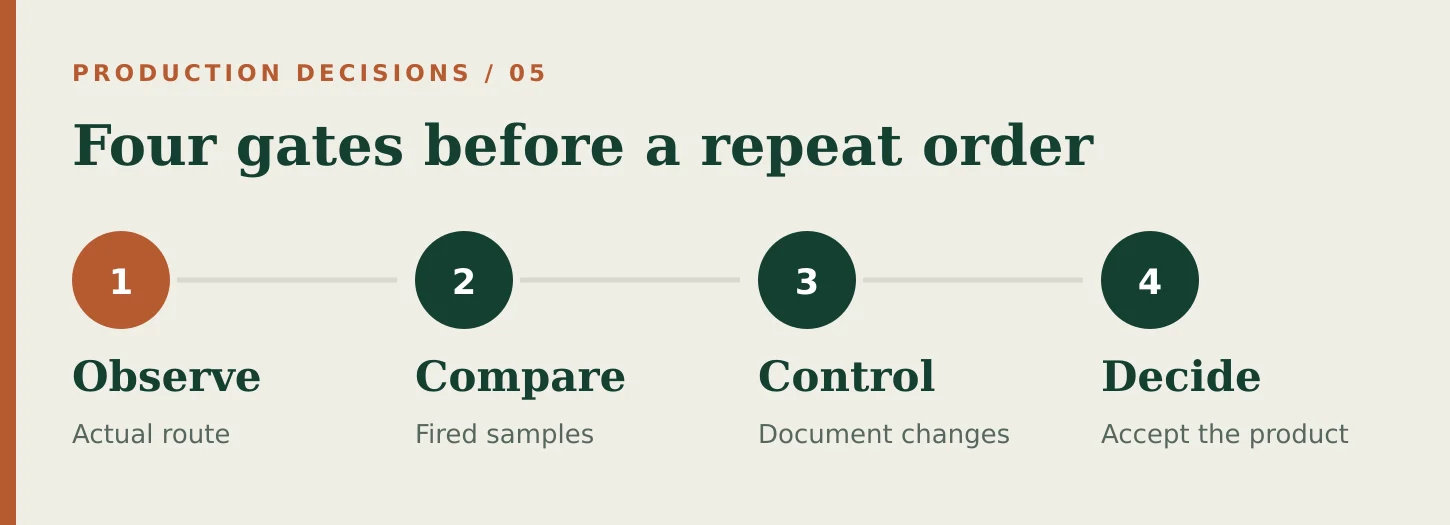
Illustrative decision sequence for product development and repeat-order control.
Equipment suppliers themselves distinguish process routes for different tableware shapes. SACMI-SAMA presents jiggering, casting, glazing, firing, and finishing as separate technologies, while its service offering covers preventive maintenance and upgrades. That is why a factory should be evaluated as a system, not by the apparent age of one device. The most important risk may sit at a mold, drying step, decoration handoff, or pack-out station that is not prominent in a tour video.
Audit the SKU’s production route
Begin with a clear specification: dimensions, useful capacity, body and glaze, decoration, handle, base, claims, destination, pack, and forecast. Ask the factory which route will make the item and whether a pilot or sample will be made on the same route as bulk production. A hand-thrown show sample does not validate an industrial line if the sold product will be cast or rolled. A sample made on one kiln route should not be treated as full proof of another without an agreed equivalence review.
Daye’s manufacturing information and 2024 brochure document stages including casting, rolling, trimming, biscuit firing, glazing, glazing firing, decoration, and inspection. They provide a useful discussion path, but do not disclose the installation date or condition of each piece of equipment. For your product, ask which stages and locations apply, what is checked at each stage, and when a physical production master is approved. The answer should connect Daye’s general capability to your precise design.
Examine variation, not only the best piece. Request several units from a representative run and compare height, opening, useful capacity, handle clearance, base stability, glaze, artwork, and lid fit where applicable. A buyer may accept a slight handmade variation if its range is deliberate and recorded. It may reject a subtle difference if a lid no longer fits or two shipments cannot sit together on a shelf. State which characteristics are critical, and keep a signed sample and revision record.
Maintenance and refurbishment as change events
Refurbishment can improve reliability, but it may change the process. Replacing a mold, controller, burner, glazing head, handling fixture, or kiln furniture can alter output or a process setting. A product buyer need not audit every maintenance invoice. It should require notification when a change might affect its approved characteristics and request first-off samples or checks from the changed route. If the material or use claim changes, determine whether further testing is needed.
Ask the supplier for a plain-language continuity plan: what happens if a critical station is unavailable; whether the order can move to another station; how equivalence will be shown; and who approves the release. An alternative route may be a sensible backup, but it should not be invisible to the brand. A factory can separate confidential engineering data from the product evidence required by its customer. A brief change log and retained samples often provide sufficient commercial traceability.
Daye’s quality control page can frame the inspection agreement. Define defect types and limits before the order: cracks, sharp edges, handle issues, unstable bases, glaze faults, artwork placement, shade variation, pack damage, and any applicable tests. State the sampling plan and disposition for nonconforming goods. If an older line produces acceptable units consistently under those rules, age alone does not create a product defect; if a new line fails them, its purchase date is no defense.
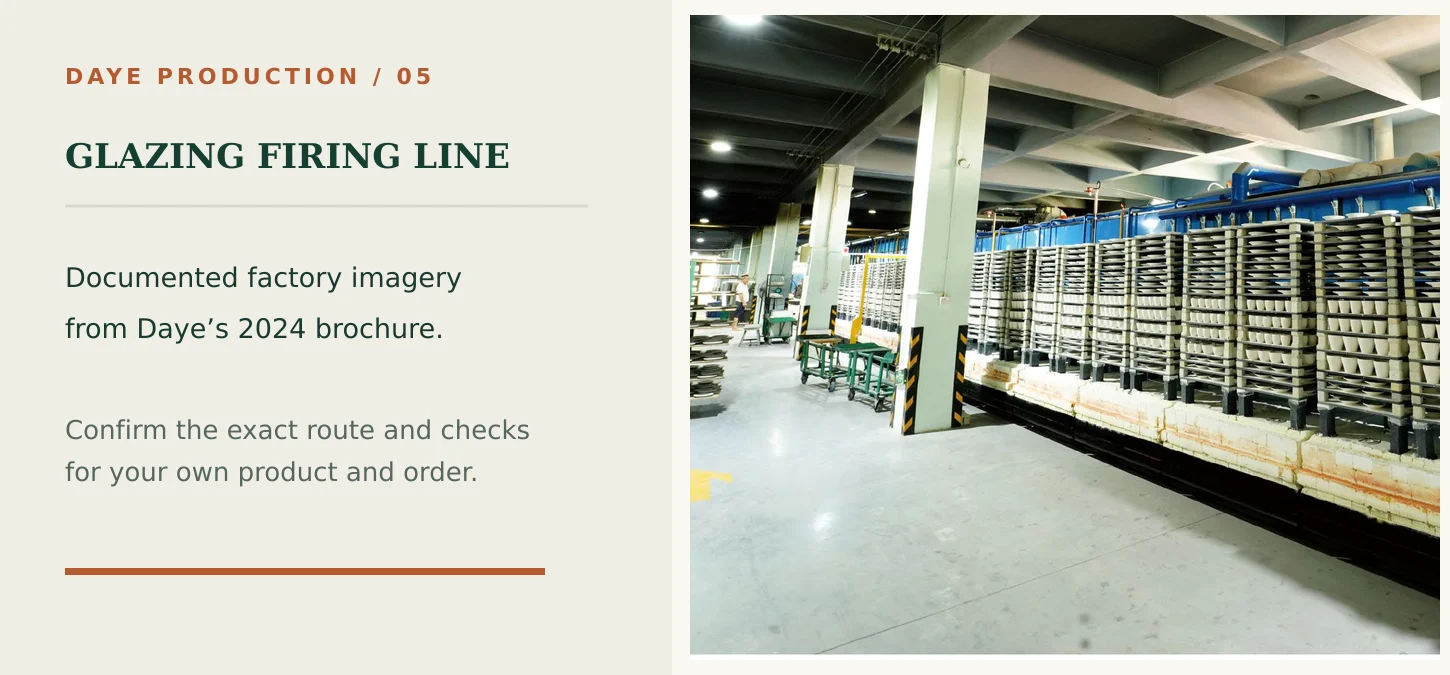
Factory photograph from Daye Porcelain’s 2024 company brochure. Confirm the production route for the specific order.
A separate due-diligence path for the used-machine buyer
Someone purchasing used ceramic machinery for their own plant faces risks a porcelain brand does not. Start with the machine’s identity, year and configuration as verified by records, operating hours where available, maintenance and repair history, manuals, electrical and safety documentation, software and control access, tooling, and parts availability. Inspect wear points and missing guards with a qualified engineer. Review whether the machine will fit the intended raw material, product geometry, throughput, utilities, layout, and operator capabilities.
Do not rely on a short video of a no-load cycle. Arrange a material trial or clearly specified functional inspection where feasible. Agree on what can be tested before dismantling and what must be demonstrated after installation. Define responsibilities for disassembly, lifting, packing, transport, import documentation, installation, commissioning, training, and repairs discovered on arrival. The total project cost can be materially higher than the advertised machine price; a buyer should budget for uncertain parts and downtime.
Ask the original equipment maker or a qualified service provider whether it supports the configuration and can supply critical spare parts. SACMI-SAMA’s service pages describe maintenance, upgrades, assistance, and spare-part supply for its own technologies, but that does not mean every historical model or third-party machine has identical support. Obtain a current, model-specific answer. If a vendor claims recent refurbishment, ask what work was done, by whom, with which components, and how the machine was tested afterward.
The equipment contract should identify the machine and included parts, condition standard, known defects, inspection opportunity, acceptance criteria, payment milestones, and remedies if essential functions are missing. Compliance and customs requirements depend on the actual machine and destination; consult the responsible technical and trade specialists. This is a machinery procurement task. A brand sourcing custom mugs from Daye should not confuse these checks with the qualification of a finished ceramic SKU.
Compare cost and delivery risk, not appearances
An older line with predictable maintenance may support a stable product at an attractive cost. A new line may increase throughput or flexibility, but the customer may still need to fund a new mold, approve the finish, and allow time for process stabilization. The buyer should compare accepted unit economics, quality trends, lead time, and ability to handle variants. Include rejected pieces, rework, testing, packaging, transit breakage, and replacement policy in the total cost view.
For an OEM launch, allocate time for prototyping and mold development, production sampling, artwork proof, test decisions, pack trial, bulk work, final inspection, and freight. Ask whether the target date depends on an equipment change or maintenance shutdown. A supplier that tells you about a schedule constraint early is more useful than one that promises an impossible ship date. If an alternate route becomes necessary, reapprove the sample rather than quietly changing the specification.
When comparing suppliers, request comparable products and repeat-order evidence, not a competition over who owns the newest machine. A factory that can show controlled revisions, samples from different runs, defect analysis, and a practical correction process gives the buyer a clearer risk picture. Daye can be asked for a project-specific plan through its inquiry page. If the request is for a second-hand machine, seek a machinery specialist and use a technical acceptance process instead.
Separate cosmetic confidence from process capability
A newly painted machine can look reassuring in a photograph while concealing wear or missing documentation; an older machine may look rough but be supported by a trained team and an effective maintenance schedule. For a product buyer, neither impression is a substitute for samples from the actual route. Ask whether the sample run used the same material, mold type, decoration, and planned inspection as bulk production. Request a few pieces from the beginning and end of a run when feasible. Look for a pattern rather than an isolated blemish, and define the criteria before the factory selects its best pieces to ship.
For a used-machine buyer, a more formal condition survey should look at mechanical, electrical, control, and safety systems. Confirm what is included in the sale: molds, spare tooling, conveyors, guards, software licenses, manuals, and specialist fixtures are not always part of the visible machine. Verify the voltage, utility demand, footprint, lifting points, and local installation requirements. If the seller cannot demonstrate a running cycle with relevant material, price the uncertainty openly and set a clear acceptance path after installation. The cheapest quoted machine may be the most expensive project once missing parts and commissioning delays are counted.
Use a qualified engineer for technical inspection and legal specialists for jurisdiction-specific duties. A porcelain brand does not need to perform those machine checks at its OEM’s factory, but it can ask how any line change will be communicated and validated. The distinction keeps the audit proportionate: evidence of machine condition for equipment ownership, evidence of finished product consistency for product purchasing.
For both paths, record the assumptions behind a quotation. Does the quoted used machine include removal and installation, or only collection at the seller’s site? Does the quoted mug price assume one glaze, one decoration, and standard packing, or the actual retail configuration? A written assumption list prevents a low headline price from winning by omitting expensive work. It also gives each supplier a fair chance to correct a misunderstanding before money and production time are committed.
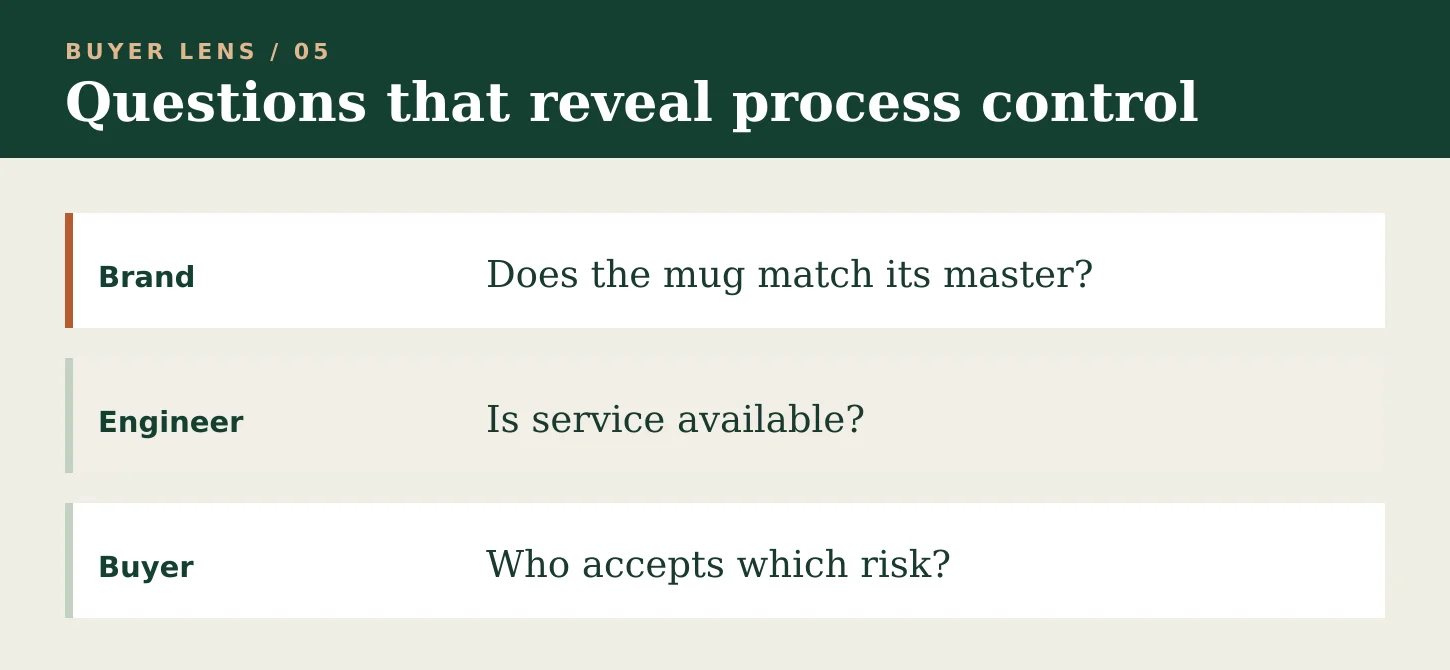
Buyer questions that connect process evidence to the approved ceramic product.
FAQ
Is used ceramic machinery always a warning sign?
No. Condition, maintenance, process control, and actual product output matter more than age alone. Check representative finished units and the factory’s change and inspection practices.
Can a new machine eliminate sampling?
No. A new machine still requires tooling, material, process settings, and product approval. Sample the finished fired and decorated article from the intended route.
What if a factory moves production to a backup line?
Ask which characteristics may change, compare new-route samples with the approved master, and agree on any measurements or tests before bulk release.
Does Daye offer used machinery for sale?
Its public materials present a porcelain OEM/ODM product business. No used-machine sales offer is established by those materials; direct equipment purchases to verified machinery sellers.
What should a brand ask instead of the age of every machine?
Ask for the route for its SKU, physical approval samples, critical dimensions, defect controls, maintenance-related change notification, capacity plan, and repeat-lot evidence.