Table of Contents
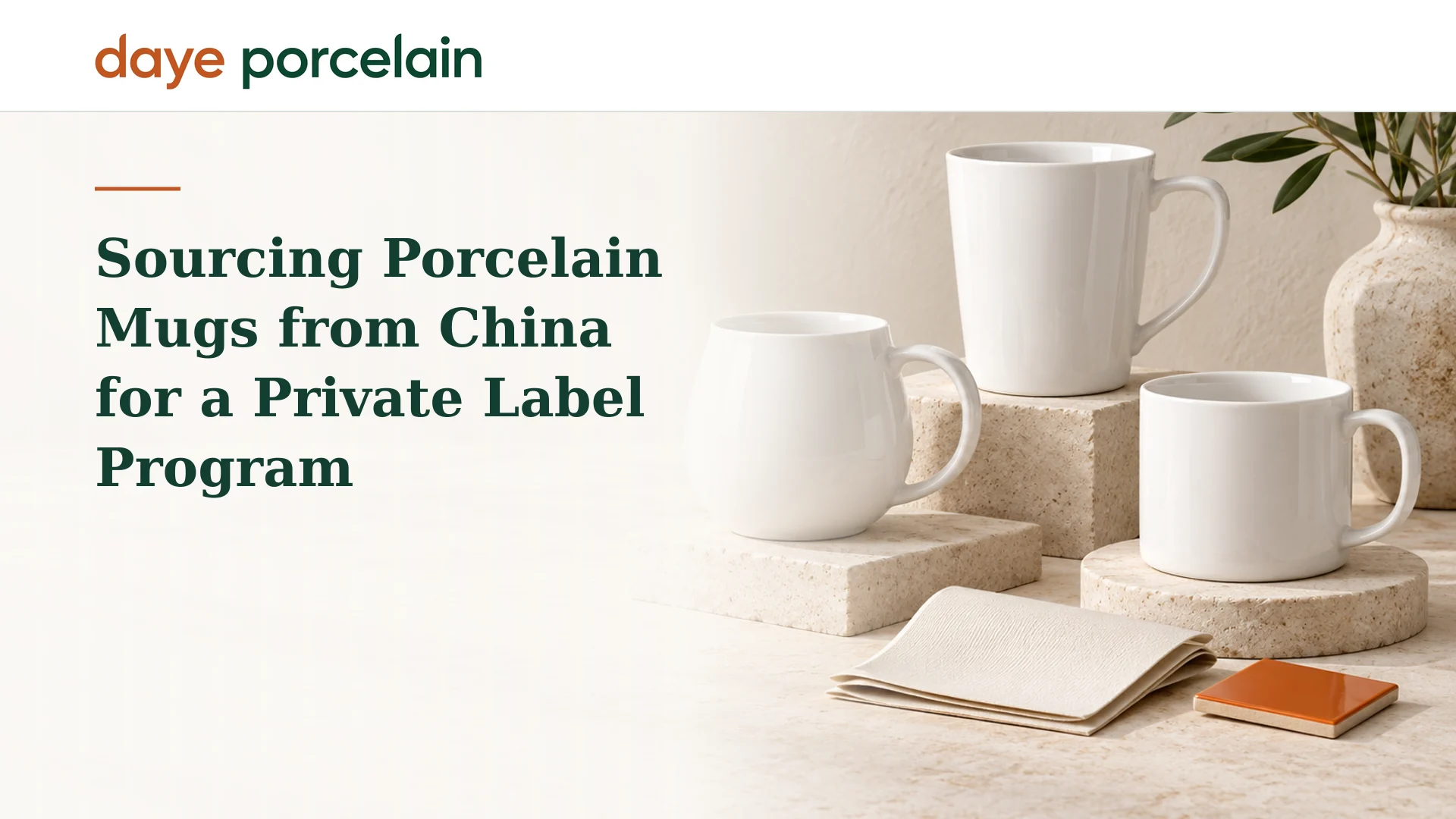
A factory search for porcelain mugs can produce hundreds of attractive listings in an afternoon. It is harder to establish whether any one supplier can repeat your approved shape, color, decoration, packing, and test result across a full order and a later reorder. For a brand buyer, that repeatability is the real sourcing decision.
This guide is for teams developing a mug under their own name for retail, coffee service, corporate gifting, or a licensed collection. It explains how to turn a reference image into a production brief, compare a trading company with a manufacturer, approve samples, and request evidence for the destination market. China is a place of manufacture, not a quality grade. The finished design and the evidence attached to its particular SKU matter more than a country label.
Key takeaways
- Define the finished mug, target market, and practical fill before comparing quotes.
- Identify who makes the body, who decorates it, and who controls the approved sample.
- Treat tooling rights, testing, packaging, and reorders as part of the total cost.
- Connect food-contact and care claims to the actual decorated SKU, not a factory profile.
Begin with the selling program, not a factory quotation
Before requesting a unit price, define where the mug will be sold and how it will be used. A 250 mL tea mug sold as a boxed gift, a 350 mL office coffee mug, and a large latte mug for a café have different geometry and handling requirements. Specify the intended drink, target fill volume, maximum outside dimensions, rim and handle preferences, decoration coverage, retail or foodservice packaging, and the countries of sale. If the design must match an existing dinnerware line, include that reference and an agreed color standard.
Separate what is fixed from what can change. A brand may insist on a particular silhouette and white tone but accept two handle designs after sampling. Another buyer may need an existing mold to meet a launch date but can invest in original artwork. This distinction lets a factory propose realistic options without silently substituting a different product. A useful request includes an annual forecast as well as the first order quantity; those numbers serve different purposes in tooling, purchasing, and repeat supply. They are planning inputs, not an invitation to assume a universal minimum order quantity.
The word porcelain also needs a product definition. Suppliers may use “ceramic” as an umbrella term and may list stoneware or bone china alongside porcelain. Ask the supplier to identify the body used for the quoted item and to describe any change in body, glaze, firing, or decoration between the sample and production. If a quotation offers “porcelain” with no material description or approved reference sample, the buyer has too little information to compare bids.
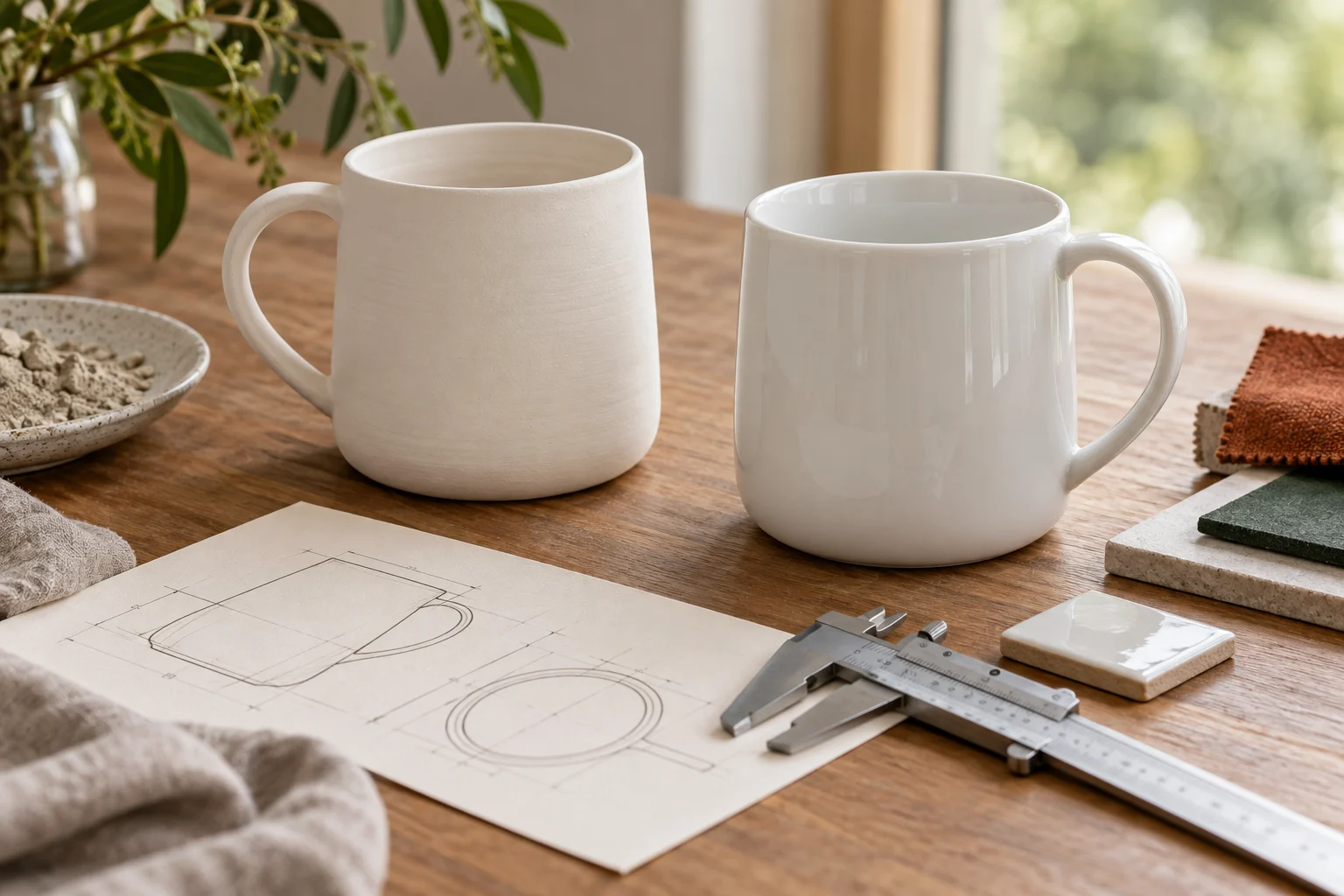
Illustrative sampling scene: compare shape and finish on physical prototypes.
Manufacturer, exporter, or trading company
There is no automatic winner between a factory and a trading firm. A manufacturer may give a brand direct access to molding, decoration, and inspection teams. A capable trading company can coordinate several plants, consolidate products, and manage shipping and communication. The procurement question is who controls the approved sample, who owns the mold, where production actually takes place, and who is accountable if a component or decoration changes.
Ask each bidder to identify the legal contracting entity, production site, and any subcontracted stages. Obtain the name of the plant making the mug body and the party applying artwork or assembling a lid. If a project includes a ceramic body plus silicone seal and printed gift box, one line on a supplier profile cannot prove control of every component. Put change approval, inspection rights, corrective actions, and replacement responsibilities in the purchase terms. The relationship should be clear before a failure, not reconstructed after one.
For a custom design, request the mold ownership and storage terms in writing. Who pays for tooling? Is the mold exclusive? Who maintains it and for how long? Can the buyer move it if production ends? A lower unit quote can become expensive if these questions are left open. For an existing shape with only logo decoration, the tooling discussion may be simpler, but the exact body still needs approval. “Same style” does not define a measurable substitute.
Build a sample approval path that can survive a reorder
Sampling should answer a sequence of specific questions. An early shape sample checks capacity, ergonomics, balance, wall and rim feel, handle clearance, and stability. A decorated sample checks logo location, line quality, color, glaze appearance, and whether the decoration sits on food-contact surfaces. A packing sample checks the fit of dividers, sleeves, carton, and any accessories. A production-standard sample combines these decisions and becomes the benchmark for inspection.
Record which sample is approved, including photographs and a version code. State how fill volume is measured: to the brim, to an indicated line, or at a practical fill level. A buyer expecting 12 US fluid ounces of comfortable drinking volume may be disappointed by a mug marketed as 12 ounces at brim capacity. Do not treat a capacity number as complete without the measurement method. For a handle, record an acceptable range for clearance and attachment appearance; a photograph alone can hide a narrow finger opening.
Decoration requires its own controls. Artwork should be supplied at production resolution with color references, safe areas, and rules for seams, rim distance, and handle alignment. Ask for a physical proof under agreed lighting when a precise brand color matters. Ceramic firing and glaze can shift how a printed color appears, so a paper swatch is a target, not proof of the fired result. Retain the approved production sample and artwork file under the same revision. When a factory proposes a later adjustment, authorize the revised sample before the next production run.
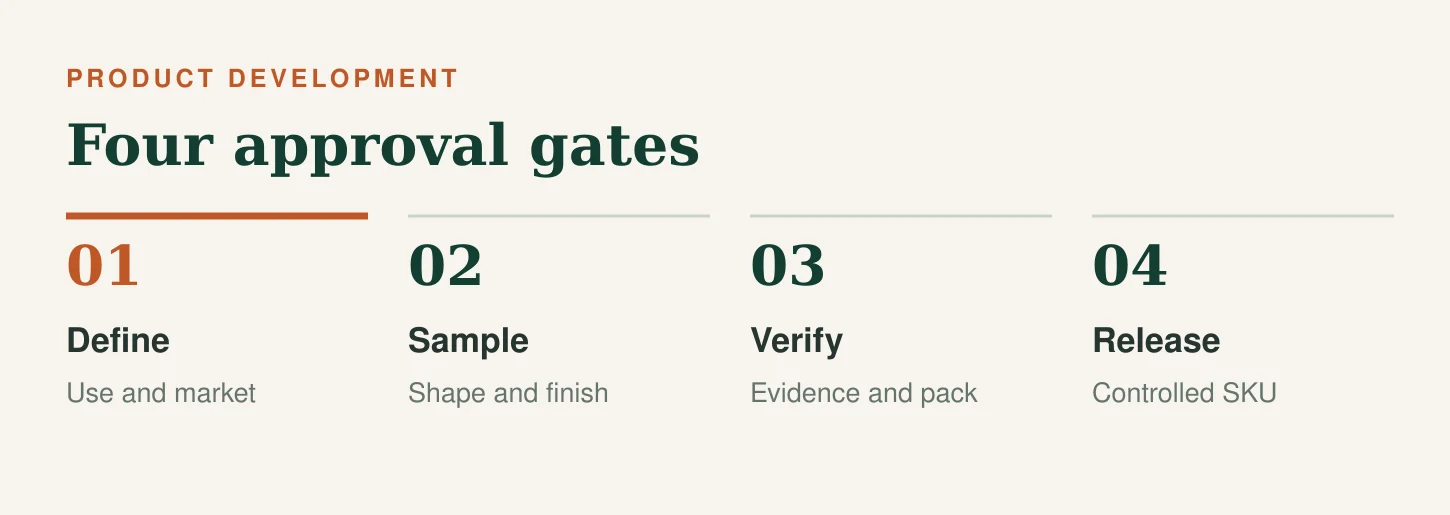
Approval gates for this product brief; the final steps depend on the project.
Compare quotations on the same basis
A meaningful price comparison starts with one shared specification and a written quotation scope. Record whether each offer includes tooling, sample rounds, surface decoration, individual packaging, outer cartons, testing, inspection, and freight terms. A quote for a blank white existing body cannot be compared directly with one for a custom relief mold and retail box. The cheapest line item may simply omit work the launch requires.
|
Cost element |
Question for each supplier |
Buying consequence |
|---|---|---|
|
Shape and tooling |
Existing body or custom mold; who owns and maintains it? |
Affects initial spend and future portability. |
|
Decoration |
Which method, positions, colors, and proofing rounds are included? |
Affects appearance and repeatability. |
|
Packaging |
Inner protection, retail box, master carton, and drop-test target? |
Affects landed damage and shelf readiness. |
|
Testing and inspection |
Which SKU versions, laboratory, sampling plan, and reports? |
Affects evidence and release decisions. |
|
Delivery |
Incoterm, lead-time start point, and split-shipment rules? |
Affects timing, risk transfer, and total cost. |
Request a price break for realistic order volumes and a separate line for one-time tooling. Ask what happens if a design changes after sample signoff. Suppliers may reasonably reprice a larger handle, thicker wall, extra firing step, or new package. A disciplined comparison makes those changes visible before production. Do not publish a generic “China porcelain mug price” in a sourcing article: shape, decoration, quantity, testing, packaging, exchange rates, and freight can all change a project quotation.
Quality controls that a buyer can verify
A porcelain mug can look fine in a catalog and still fail the intended use. Define inspection for visible faults such as cracks, chips, pinholes, glaze defects, base wobble, print registration, and inconsistent color. Add dimensions and capacity to the same inspection sheet. When several shapes or colorways share an order, sample by SKU and batch rather than treating a mixed carton as one uniform population. Agree how defects will be classified and what happens after a failed inspection.
For use in coffee service or home kitchens, ask about the actual product’s suitability for washing, microwave use, thermal changes, and handling. A photo of factory equipment proves neither a test result nor a care claim. The report should identify the tested article, decoration and glaze, date, method, and result. If a lid or silicone part is included, the evidence package must cover that component and its intended contact conditions as well. A declaration for an earlier plain mug does not automatically cover a new decorated version.
Food-contact requirements depend on the sales market. In the United States, the FDA publishes compliance policy guides for lead and cadmium leaching from ceramicware; these are enforcement guidance, not an “FDA certification” that a supplier can simply claim for every mug. In the EU, food-contact materials sit under the general framework and good manufacturing rules, with specific provisions for ceramic articles. Buyers should obtain the applicable declarations and test evidence for the intended markets and current product configuration. A factory audit is useful for supplier assessment, but it does not substitute for product-specific evidence. See the official references below and obtain market-specific advice when needed.
Packaging is part of the product specification
Mugs fail in distribution as well as in the kiln. A tall handle, projecting lid, or narrow base may require a different insert from a short cylindrical mug. Define the selling unit and the shipping unit. A retail gift set may need a presentation box that also survives e-commerce parcel handling; a foodservice replenishment order may prioritize efficient master cartons and easy counting. Ask for a packaging prototype with the actual mug, not a box diagram sized from a drawing.
Inspect the delivered package for movement, contact between ceramics, compression at the handle, and clear orientation of lids or accessories. If the customer has a transit test protocol, agree it before mass packaging is ordered. Record carton marks, SKU codes, barcodes, and pallet limits so a mixed order can be received and traced. A clean design with poor case-pack discipline can create returns and stock discrepancies that overwhelm a small ex-factory saving.
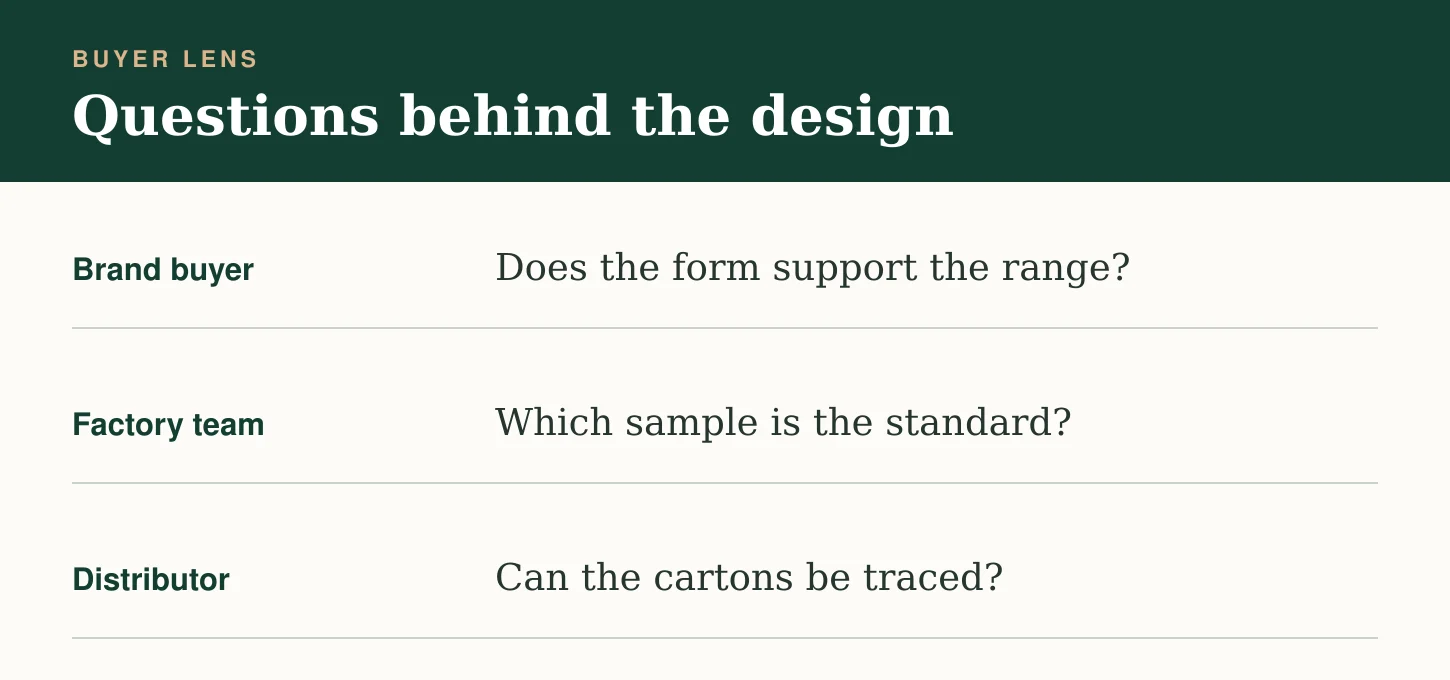
Buyer questions that should inform the approved product specification.
A practical first RFQ
Send a compact brief with the target market, expected launch window, first-order and annual quantities, target capacity and measuring method, shape reference, artwork, required care claims, packaging format, and requested tests. Invite the supplier to identify assumptions and propose a sample sequence. Ask for the quotation, tooling terms, draft quality criteria, and the name of the production entity. A good response clarifies ambiguous requirements before offering a firm promise.
Use a supplier scorecard after the samples arrive
Do not award the project from a PDF quotation alone. Compare each candidate against the same five evidence groups: interpretation of the brief, physical sample, production controls, documents for the destination market, and commercial terms. Note whether the supplier volunteered a realistic constraint. A team that flags a handle attachment risk or a decoration conflict may be more useful than one that says yes to every request without a test plan. Record the reasons for selection so a later employee understands why a seemingly cheaper quote was declined.
The scorecard should reflect the actual program. A licensed character mug may weigh rights control and complex mold execution heavily. A plain café mug may place more weight on repeat shade, cup-and-saucer fit, and reliable replacement stock. A corporate gift project may prioritize packaging and a fixed delivery window. Assign weights before reviewing offers to avoid changing the rules after seeing a favorite sample. The result is a decision aid, not a mathematical proof that one factory is universally best.
After choosing a partner, agree an escalation route for sample rejection, production deviation, shipping damage, and delayed delivery. Name who may approve a concession and who must be informed. A replacement or rework remedy should be written in terms that can be executed across borders. These operational details protect a brand more directly than a broad marketing statement about being a “trusted supplier.”
Daye Porcelain describes an OEM path for brand-designed mugs and an ODM development route for projects that need design support. Its custom ceramic mug page and OEM/ODM service page are starting points for checking whether a particular brief fits its manufacturing process. Share the actual design, market, and volume through the project inquiry page to discuss feasibility and a project-specific quotation; no published article can establish a universal MOQ or delivery promise for a custom shape.
Frequently asked questions
Do “China porcelain mugs” and “porcelain china mugs” mean the same thing?
Not necessarily. A buyer using “China porcelain mugs” may be looking for porcelain mugs manufactured in China. In “porcelain china mugs,” however, “china” may simply describe fine tableware. Neither wording proves the actual body or production origin of a listed product. In an RFQ, specify the porcelain body and the manufacturing country separately, then confirm both on the approved sample and product records.
Is a factory audit enough to approve a porcelain mug for the US or EU?
No. An audit examines an organization or facility against its stated scope. Food-contact evidence concerns the particular article, finish, decoration, and destination market. Keep both streams of evidence and check that the legal entities and dates match the supply chain.
Should we use an existing mold or commission a new one?
An existing shape can reduce development work when the product fits your brand and the rights to use it are clear. A new mold gives more control over silhouette and exclusivity but adds tooling, revisions, and a longer approval path. Compare the total program, not only the first unit price.
What should be retained after the first order?
Keep the approved physical sample, drawings, artwork revision, component list, packing specification, test reports, inspection records, and any deviation approvals. Those records give the next order a measurable starting point rather than relying on memory or catalog photographs.