

Table of Contents

A porcelain coffee mug range works when each vessel has a clear job. The espresso cup, everyday mug, and larger milk-drink cup need not share one capacity or one wall profile, but they should feel like a family in the hand and on the shelf. For a brand or café chain, the commercial question is how to translate that family into manufacturable shapes that can be reordered consistently.
This guide compares the decisions behind fine porcelain coffee mugs, everyday coffee mugs, and espresso-sized cups. It focuses on useful fill volume, rim and handle feel, saucer fit, decoration, cleaning, and the evidence needed before a purchase order. It does not treat “porcelain” as a guarantee of heat retention, chip resistance, or food-contact suitability. Those outcomes depend on the particular design and verified tests.
Key takeaways
- Espresso, everyday coffee, and larger milk-drink formats need separate fill and handling approvals.
- Cup and saucer fit should be tested as one system.
- A fine porcelain appearance does not guarantee heat or washing performance.
- Reorder control starts with retained samples and size-specific artwork and packaging.
Give each drink format a clear capacity definition
Begin with the beverage menu or retail use case. A short espresso service and a generous filter coffee are different experiences. Record the target beverage volume and the headspace needed for carrying, milk, foam, or stirring. A catalog may quote brim capacity, which is the liquid held at the very top; customers usually drink at a lower practical fill level. Put both values and their measurement method in the development brief. This small distinction prevents a surprising number of sample disagreements.
Do not let one oversized body stand in for the whole range merely because it is easier to buy. A very large mug may look impressive in a product photo but feel heavy when full, cool a small drink quickly, and occupy more shelf and dishwasher space. Conversely, a delicate espresso cup can be pleasant for a short drink and unsuitable for an office refill. Sample with actual drinks and the intended service routine. Ask baristas or testers to handle the mug when filled, not just when dry and empty.
The shape changes the experience as much as the nominal volume. A wide opening gives room for milk drinks and aroma, while a narrower top can change how a drink is presented and how easily it cools. Height affects center of gravity and shelf clearance. A narrow base may look elegant but needs a stability check, especially when a customer will carry a cup and saucer together. A buyer should write these as preferences to test rather than universal material claims.

Illustrative coffee service scene: evaluate the cup family in its intended workflow.
The rim, handle, and saucer form one interface
The lip is where porcelain first meets the user. Review its thickness, roundness, glaze coverage, and drinking angle. A fine rim can feel refined, but a very thin exposed edge may make the product less forgiving in high-volume service. The handle needs adequate finger clearance, secure attachment, and a balance that feels natural with the intended fill. Request samples with the actual production handle, because a small mold change can alter both ergonomics and breakage risk.
For coffee cups with saucers, test the pair rather than approving each piece separately. The foot ring should seat reliably in the saucer well without rocking. There must be enough room for a spoon, a small biscuit, or a service card if those are part of the concept. A stacked presentation should be checked in the real café tray or retail pack. “Compatible saucer” is too vague if cup and saucer come from separate drawings or factories; identify them as a matched set and control the fit in inspection.
Many brands want a visual family: a repeated curve, handle language, glaze white, and logo placement across sizes. That is possible without forcing identical proportions. An espresso cup may require a smaller, more secure handle; a tall coffee mug may need more clearance. The range should be judged as a system with individual functional approvals. Photograph each approved SKU alongside the others under consistent lighting, then retain physical samples to control shape and shade in later orders.
Fine porcelain is a design choice, not a performance certificate
“Fine porcelain” can signal a smooth, bright finish and a lighter visual profile. It does not specify a single wall thickness or a guaranteed performance level. Ask a supplier to describe the proposed body, its surface finish, and whether the production sample matches the quoted material. If a thinner wall is central to the brand experience, test its rim and handle behavior in the intended use. If the mug must endure frequent washing and stacking, define those conditions rather than asking generally whether it is “durable.”
Heat performance requires a controlled comparison. Beverage starting temperature, fill volume, room conditions, wall geometry, lid, and whether the cup is preheated all affect the outcome. A thicker wall does not automatically keep coffee hot longer in every scenario, and a dense porcelain body is not an insulated travel vessel. Ask for an application-specific test if temperature is a marketing claim. For ordinary product selection, comfort, use pattern, and cleaning may be more useful than an unsupported minute-by-minute promise.
White glaze also varies. One supplier’s cool white can look blue next to another supplier’s warm ivory. If the coffee range will sit beside existing plates or a color-critical brand palette, approve a fired color standard. Evaluate more than one piece from a trial run and agree acceptable variation in normal lighting. A photograph on a monitor cannot settle a fine shade dispute.
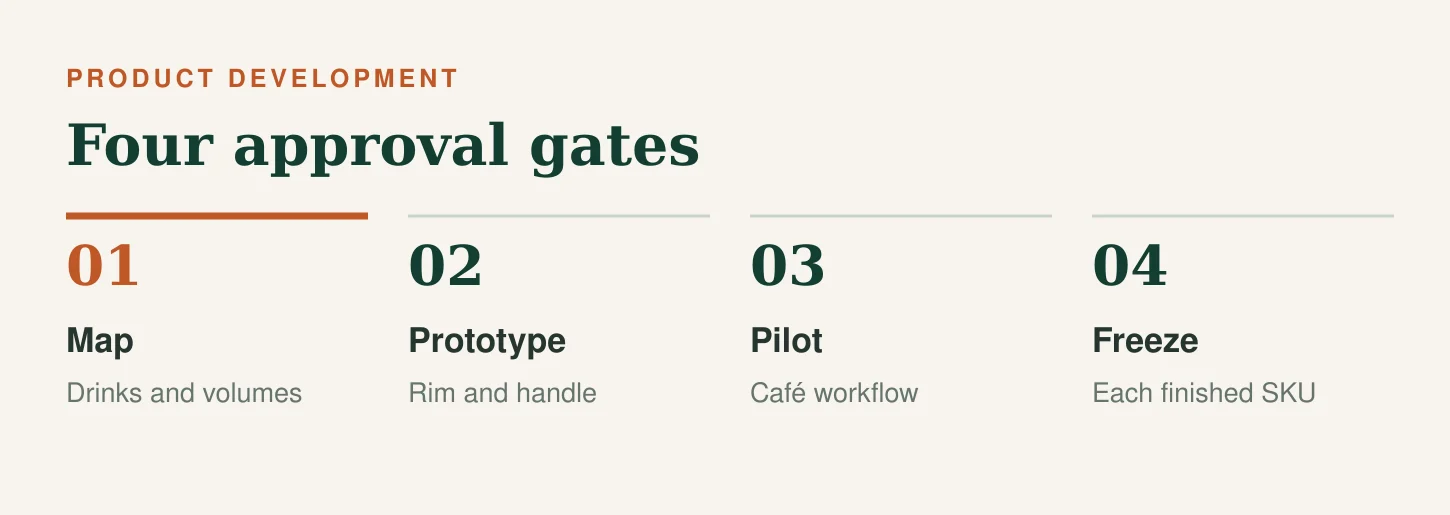
Approval gates for this product brief; the final steps depend on the project.
Decide what can be standardized across the range
A product family can share certain operations without sharing every mold. A common decoration method, glaze family, packaging language, or logo position may simplify approvals. Yet the surface curvature changes how a graphic wraps; artwork cannot be scaled from a wide mug to a tapered espresso cup without proofing. The design team should prepare a separate print area and position guide for each SKU, then compare them together as a collection.
|
Decision |
Espresso cup |
Everyday coffee mug |
Larger coffee mug |
|---|---|---|---|
|
Primary use |
Short serve, often with saucer |
Daily desk or café serve |
Milk drink, long drink, or gifting |
|
Approval focus |
Rim, cup and saucer fit, small logo legibility |
Handle balance, fill line, repeat use |
Full weight, base stability, pack size |
|
Typical risk to test |
Chipping and handling at small scale |
Shade and print consistency |
Transit stress and uncomfortable full weight |
The table describes a design review, not fixed specifications. A café’s service style can differ from a retail gift range. Before committing to tooling, run a short handling test with the buyer’s own equipment: espresso machine tray, cup warmer, dishwasher rack, café shelf, or home packaging. Record the observations and change the drawing if needed. This is cheaper than trying to solve an ergonomic defect after the first full order.
Decoration and cleaning should be approved together
A logo that looks good on a rendering can become cramped beside a handle, distorted near a curve, or faint after firing. Ask for a fired proof on the intended body and set a visible tolerance for location and color. If a metallic accent or overglaze detail is proposed, do not assume the same microwave or dishwasher instructions as an undecorated cup. The complete finished article, including its decoration, needs an appropriate care decision and supporting evidence.
Food-contact review is also product-specific. In the US, FDA compliance policy guides address lead and cadmium leaching from ceramicware. In the EU, the general food-contact framework, good manufacturing rules, and ceramic-specific measures are relevant. A factory’s physical test list or quality-system audit does not by itself certify every cup shape or colorway for every destination. Identify the specific SKU, glaze, decoration, and any food-contact accessory on each report or declaration. Do not use “FDA approved porcelain” as shorthand for a test report.
If the range includes several artwork variants on a shared white body, ask how the supplier decides which variants are tested and what changes require retesting. A revised pigment, new decoration position near the rim, or different glaze can matter. The buyer does not need to prescribe the laboratory’s entire protocol in a marketing brief, but does need an evidence matrix that maps each finished item to the destination market and intended use.
Packaging and reorder discipline
An espresso cup with saucer can break where pieces contact one another; a tall mug stresses a different part of its box. Build a pack for each selling unit, then assess the full master carton. Confirm whether pieces ship assembled, nested, separated, or in individual gift boxes. Record the SKU and barcode location so a warehouse does not confuse two visually similar white sizes. A family of eight items multiplies opportunities for picking errors unless the cartons and photos are clear.
Set an approval reference for the full range. Store the signed sample, artwork files, drawings, fill method, acceptable variation, pack specification, and care labeling for each item. When adding a new shape later, compare it with the retained set instead of starting from a web photograph. A supplier who can reproduce a pleasing first sample but not the second purchase order has not solved the brand’s real problem.
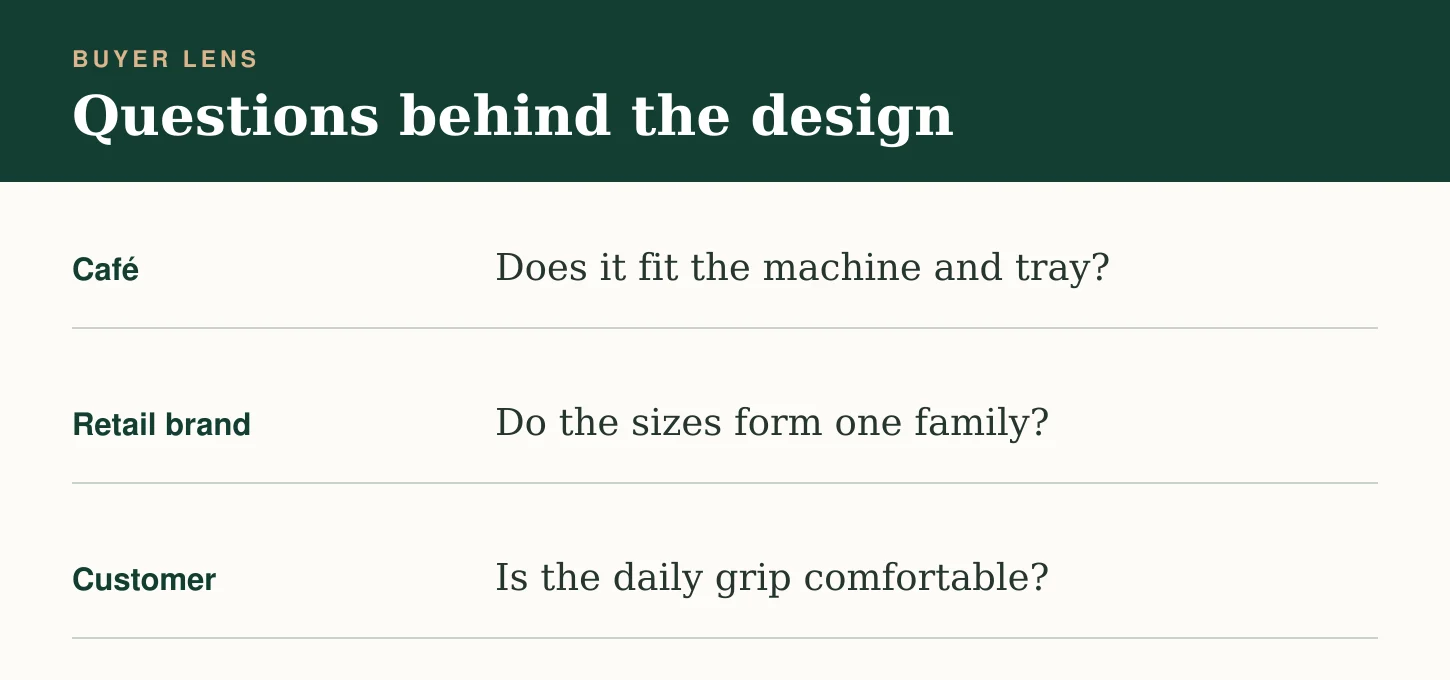
Buyer questions that should inform the approved product specification.
A short development brief for the factory
List each drink format with target practical fill, brim volume target, outside dimensions, rim and handle preferences, saucer requirement, decoration, quantity forecast, packaging, and destination markets. Include the launch schedule and identify which shape or color is already fixed. Ask the factory to flag design conflicts and separate mold, sample, testing, and production milestones in its response. This encourages useful engineering discussion instead of a premature per-piece quote.
Pilot the range where it will actually be used
Before signing off an entire range, place a small number of production-standard samples in a representative environment. A café can record how the cups fit espresso machine clearance, tray layout, cup warmers, saucer storage, and washing racks. Retail testers can unbox the mug, photograph it for an online listing, and use it at home under the proposed care instructions. Ask users to report specific issues: a hot handle, hard-to-clean foot ring, unstable saucer, awkward fill, or logo hidden by a right-handed grip. “Feels premium” is useful feedback, but the specific observation drives a mold or artwork change.
Run the pilot with the full collection visible. A cup can work alone and look mismatched beside its siblings. Check whether the white tone shifts across sizes, whether the handles feel related, and whether the same logo appears to be at the same visual height when the cups are displayed together. If the range includes both an espresso cup and a 16 oz mug, exact geometric scaling may make the smaller mark illegible or the larger mark dominant. Approve a visual system rather than a single unmodified artwork template.
Document the outcome as a decision log. Some requests are essential for launch; others are preferences for a later revision. When the supplier changes a mold or firing approach, ask which earlier approvals must be repeated. A pilot is valuable only if the lessons reach the drawing, inspection sheet, packing specification, and sales copy. Otherwise, the first large order may faithfully reproduce a sample that the café team already found inconvenient.
Plan replacement stock at the same time. A café may break cups and saucers at different rates, while a retailer may sell them only as a matched set. Decide whether either piece can be purchased separately, how a later white shade will be controlled, and how cartons identify the corresponding size. A workable replenishment plan can make a modestly priced range more valuable than a striking one that cannot be repeated. The brand’s first purchase order should create a product system, not a one-season photograph.
Daye Porcelain’s coffee cups and saucers page and custom mug page describe relevant project routes. Its prototyping and mold development page helps frame a custom-shape discussion. A brand team can send the actual menu, volume targets, reference design, and market requirements through the project inquiry form. Feasibility, price, minimum quantity, and timing belong to that project response, not a generic online claim.
Frequently asked questions
Is an espresso cup a porcelain coffee mug?
It can be, but “espresso cup” describes a use and size class rather than a material. Treat it as a separate SKU in a family because its rim, handle, saucer fit, and fill method differ from a full-size mug.
Does thin porcelain always feel hotter to hold?
Surface temperature depends on wall design, fill, beverage temperature, and handling. A thin or double-wall form should be sampled and measured in the intended use. The material name alone does not establish a safe or comfortable outside temperature.
Can one test report cover the entire color range?
That is a question for the applicable market, test plan, and laboratory. A report should identify the tested construction and decoration. Ask the supplier to document why a variant is covered, and retest where a material or process change makes that rationale invalid.
What makes a coffee mug collection easy to reorder?
Version-controlled drawings and artwork, retained physical standards, agreed tolerances, component codes, approved packaging, and test records. Keep the coffee service team involved in sample approval so a technically correct reorder also feels right in daily use.