Table of Contents
“Ceramic or porcelain?” is often the wrong first question in a mug sourcing meeting. Porcelain is a ceramic. Buyers usually mean “porcelain or another ceramic body such as stoneware.” Once that language is clear, the useful comparison is the specific body, shape, glaze, decoration, intended use, and evidence available for each proposed mug.
This guide is for retail, hospitality, and brand procurement teams choosing a material direction for a custom collection. It separates the visual and handling trade-offs from claims that require testing. It also explains how to compare two suppliers’ samples without assuming that a category name guarantees heat retention, dishwasher suitability, chip resistance, or food-contact compliance.
Key takeaways
- Porcelain is a ceramic; compare it with a specified body such as stoneware.
- Shape, wall, rim, glaze, and use often matter more than the material label alone.
- Test heat, handling, care, and damage claims on the complete candidate mugs.
- Compare like-for-like tooling, decoration, packing, and evidence in supplier bids.
Use precise material language
Ceramic is a broad family. Porcelain, stoneware, and earthenware are all ceramic products, though they differ in bodies and processing. Museum material descriptions commonly associate porcelain with a white, high-fired, vitrified body, often including kaolin; stoneware can be high-fired and produced from other clays. In everyday commerce, terms such as “fine china,” “new bone china,” “ceramic,” and “porcelain” may be used loosely. The buyer needs the supplier’s description of the actual proposed body and an approved sample, not only a listing title.
The label should match the product. If a quotation says “porcelain mug” but the tested item or packing calls it stoneware, resolve the discrepancy before creating consumer copy. Ask whether the body changes between plain and colored versions or between sizes. A white glaze can make a nonporcelain body look pale in a photograph. Conversely, a distinctive colored glaze can hide the visual cues a buyer expects from porcelain. Material identification belongs in the technical specification and product file.
The intended use may make one direction more appealing. A brand seeking a light visual profile and crisp white ground may start with porcelain. A line that emphasizes a tactile, substantial, handmade aesthetic may consider stoneware. Neither selection makes the other unsuitable. Evaluate a real mug at the target capacity and retail position rather than applying a universal ranking to whole material families.
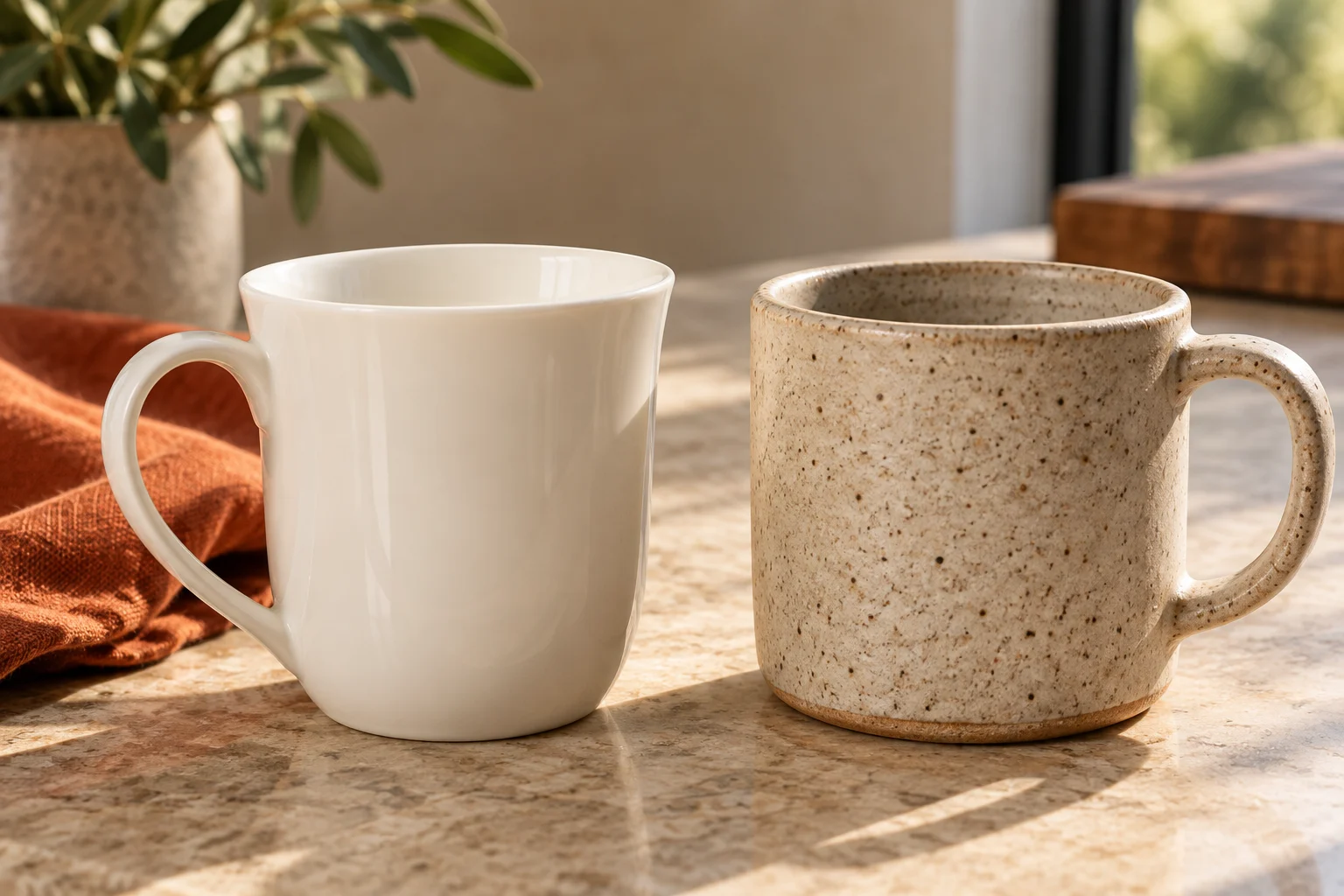
Illustrative material comparison: compare finished vessels at the same useful fill.
Compare the vessel, not isolated material claims
The body is only one part of what the customer experiences. A thin-walled porcelain mug and a thick-walled stoneware mug differ in mass, rim feel, and geometry. Put both at a similar practical fill and use them with the same beverage. Record empty and full weight, handle comfort, lip feel, stability, and how the glaze looks under the intended lighting. If the products will be used in a café, wash, stack, and carry them under café conditions. A desk gift and a service mug can favor different choices.
Heat retention is often described too confidently online. A mug’s starting temperature, whether it is preheated, beverage volume, wall thickness, opening size, ambient conditions, and lid all matter. It is not defensible to say “porcelain always holds heat better” or “stoneware always wins” without comparing specific designs under the same conditions. If temperature is central to the product promise, commission a controlled test and report the method. If not, focus the buying discussion on ergonomics and use.
Durability also needs definition. A hard ceramic surface can resist some wear yet chip at a thin rim or break after a fall; ceramic materials are generally brittle. A thick body may survive routine handling better in one design but add weight and a more prominent handle joint. Define the failure mode that matters: rim chips, handle breakage, dishwasher appearance, thermal shock, or transit damage. Test the proposed mugs for that use instead of treating “stronger” as one property.
|
Buyer question |
Porcelain option |
Stoneware or other ceramic option |
How to decide |
|---|---|---|---|
|
Visual language |
Often chosen for a refined white surface |
Can support heavier, varied textures and glazes |
Compare fired samples with the range. |
|
Hand feel |
Depends on actual wall, form, and handle |
Depends on actual wall, form, and handle |
Test at practical fill. |
|
Heat claim |
No universal advantage from label |
No universal advantage from label |
Use the same controlled test. |
|
Care and food contact |
Finished SKU needs evidence |
Finished SKU needs evidence |
Check market and decoration. |
|
Cost |
Depends on design and volume |
Depends on design and volume |
Compare like-for-like quotations. |
The table is a decision framework, not a specification sheet. A supplier can design a light stoneware mug or a substantial porcelain mug. If the brand needs a particular look, build that into the drawing and approval sample instead of expecting the material word to produce it automatically.
Body, glaze, and decoration form one product
The glaze influences color, touch, cleaning, and the surface a beverage contacts. A plain white porcelain mug and a reactive-glaze stoneware mug may require different visual tolerances. A brand that wants six nearly identical white pieces in a set should approve a shade standard and decide how much variation can appear between cartons. A line deliberately celebrating glaze variation should explain that expectation in retail copy and inspection criteria. “Variation” should not become an excuse for defects the buyer never accepted.
Decoration adds another layer. A logo decal, underglaze motif, overglaze print, and metallic accent can have different appearance and care implications. Ask for the specific decoration method and a fired proof. The process used for a competitor’s mug cannot be inferred from a photo, nor can its care instructions be copied to your version. Review artwork position near the handle and rim and retain production files with a revision code.
A common mistake is approving a blank body, then treating the decorated version as equivalent for every test and label. The finished article is what the customer uses. Ask the supplier and test partner whether a body, glaze, pigment, or position change affects the evidence basis. Keep product identification on reports precise enough to answer that question later.
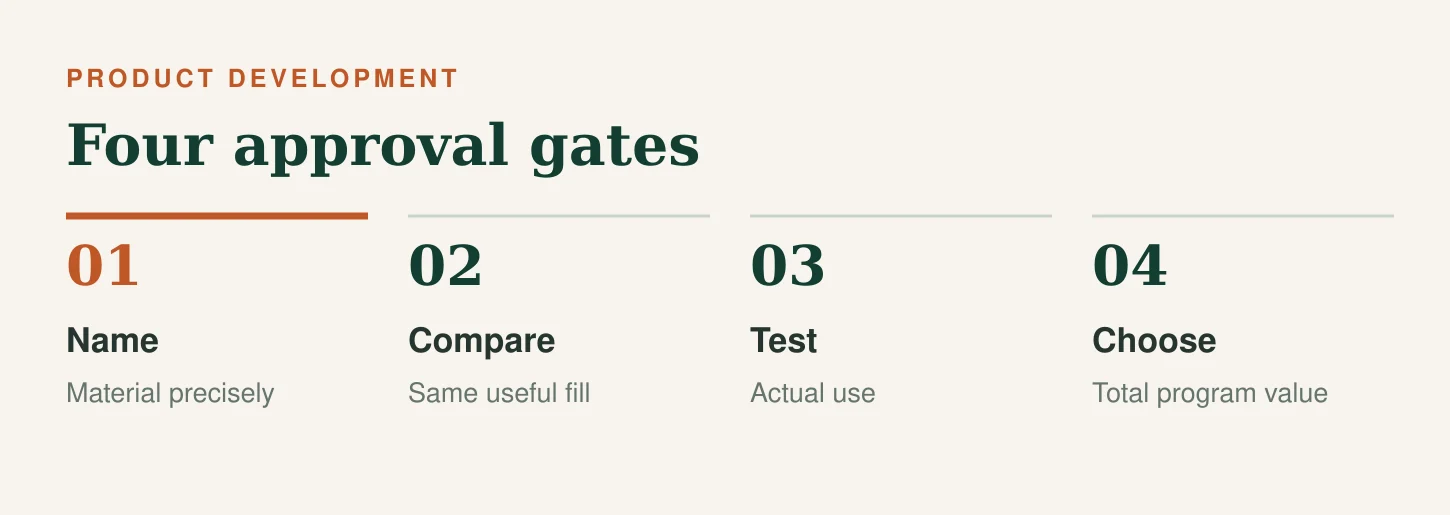
Approval gates for this product brief; the final steps depend on the project.
Safety and care are market and SKU decisions
The US FDA’s compliance policy guides discuss lead and cadmium leaching from ceramicware. EU food-contact materials fall under the general framework and good manufacturing rules, with specific provisions for ceramics. A method such as ISO 6486-1:2019 describes testing for release of lead and cadmium from relevant dinnerware; the existence of a method does not show that a particular mug was tested or passed. Ask for documents that identify the final article, test conditions, date, and target market. Other countries can set different rules.
“Food safe,” “lead free,” “microwave safe,” and “dishwasher safe” are not interchangeable claims. A migration result addresses one type of concern, not whether a metallic print sparks in a microwave, a glaze appearance survives many washes, or a handle withstands repeated use. A factory audit documents a facility or management process within its scope; it is not product certification for every SKU. Request a separate evidence trail for each claim the brand plans to make.
Do not market a material as inherently harmless or dangerous. A well-made finished porcelain mug and a well-made finished stoneware mug can both be appropriate for food use when they meet applicable requirements. The buyer’s job is to specify the product and verify its evidence. If a supplier cannot connect a report to the actual finish and destination, resolve the gap before making a consumer claim.
Cost and supply continuity
Compare like with like. A plain stock stoneware body quoted in bulk and a custom porcelain relief mug in a retail box are different programs. Ask each supplier to quote the same target capacity, decoration, packaging, inspection, testing, and freight basis. Separate one-time tooling from unit price. If a body is an existing shape, clarify the rights to use it and whether it is available for repeat orders. If a new mold is required, define ownership and maintenance.
The full cost also includes breakage, dimensional variation, packaging volume, and the risk of a poor match on reorders. A line with many colorways may need more sampling and more artwork control than a plain body, regardless of material. The margin model should use a realistic delivered cost and returns assumption, not only an ex-factory number. No responsible manufacturer can promise one universal price or MOQ for every combination of size, glaze, and decoration.
Create a retained standard for the chosen material and finish. On the next run, compare random production pieces with the signed sample for shape, shade, rim, handle, decoration, and packing. A brand with both porcelain and stoneware families should keep distinct product names and technical records. That clarity makes customer service, replenishment, and regulatory review easier.
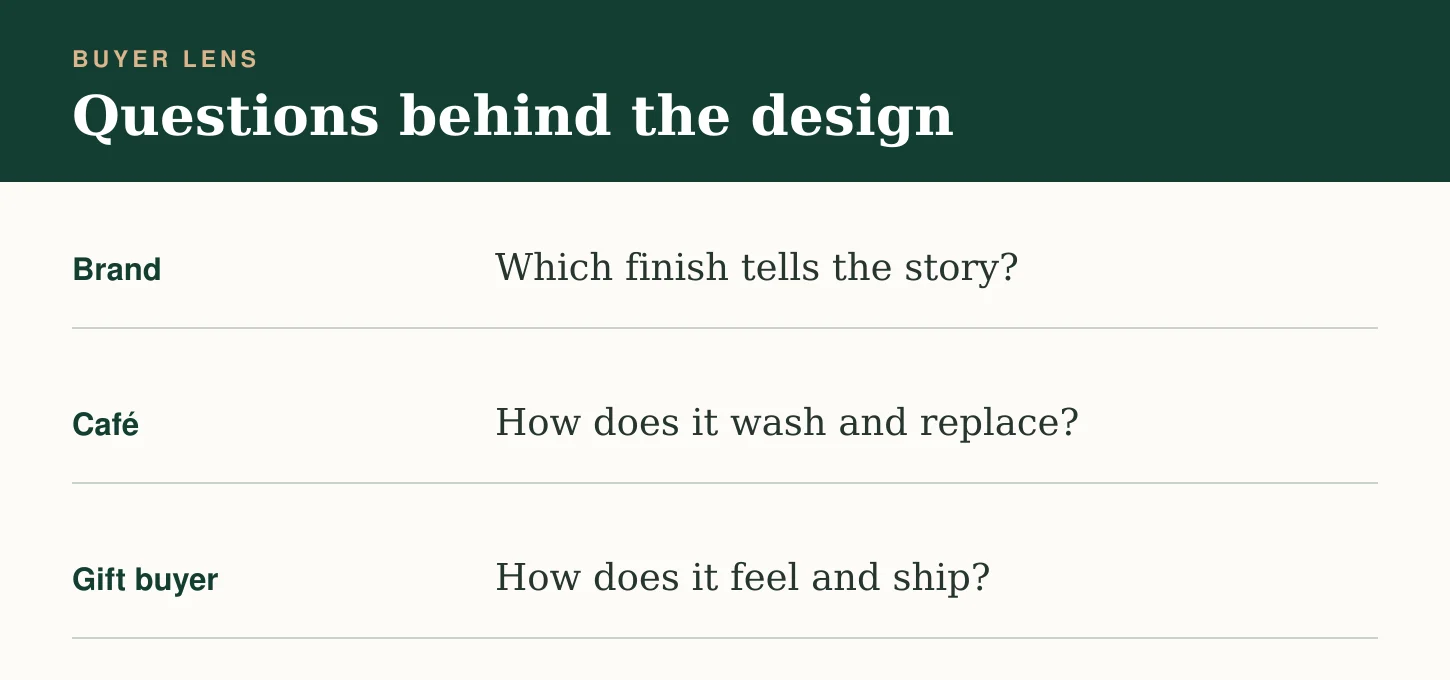
Buyer questions that should inform the approved product specification.
Run a fair sample comparison
Request two or three prototypes against one brief. Set the same practical fill, intended user, sales market, care goal, decoration area, and pack channel. Test each with actual beverages and handling. Score only attributes the brand values: visual match, comfort, stability, cleaning, packing efficiency, and evidence readiness. If one prototype wins on feel but not decoration, revise that design rather than changing materials reflexively.
Ask suppliers to explain the differences they quote
Two suppliers can quote the same dimensions and show very different mugs. Ask each to describe the body, glaze, forming route, decoration, and any component that changes between the sample and production. If one offers porcelain and another stoneware, request physical samples at the same practical fill and a breakdown of tooling, pack, testing, and freight. A comparison that mixes a stock blank with a custom sculpted form cannot isolate the effect of material. If the terms are unclear, have the supplier revise the quotation before the buyer ranks it.
Ask what a failed sample would mean for the schedule and cost. A body may need a mold adjustment to correct capacity or handle comfort; a print may need another fired proof; a pack may need a stronger insert. Those costs are project costs regardless of whether the mug is porcelain or stoneware. Make the decision on the total program and the supplier’s ability to control a repeat run. The lowest first quote is not a reliable proxy for the lowest delivered cost.
Keep the material comparison honest in marketing
The final product page can describe the actual hand feel, finish, capacity, and care. It should not say that one material is “toxin free,” unbreakable, inherently heat retaining, or safe for every appliance. If a controlled test shows a useful advantage for the specific product, state its conditions. Without such evidence, a buyer can still make a compelling case for a design: a crisp white coffee service, a tactile stoneware gift mug, or a coordinated set with a comfortable handle. The concrete features are more persuasive than broad material myths.
When the assortment includes both bodies, help the customer distinguish them through clear photos and accurate names. Do not call all products “porcelain” merely because the brand or supplier uses the term in a category title. Keep care labels separate where needed and make replacement orders against SKU-specific standards. A collection can celebrate different materials while maintaining a coherent brand language in shape, palette, and packaging.
If two prototypes appear equally attractive, make the final decision against the buyer’s most expensive failure. For a café, that may be replacement frequency or cleaning labor. For a gift brand, it may be transit breakage or visual inconsistency between boxed items. For a private label retailer, it may be a lack of dependable repeat stock. The material name helps describe the product, but the business risk determines what to test and negotiate first.
Daye Porcelain presents custom ceramic mug and coffee cup development options. Its quality control page and testing laboratory page can frame questions about physical checks. Send a material preference, target use, market, drawing, finish, and volume forecast through the project inquiry page to discuss which construction is feasible. The supplier’s response and actual samples should decide the project, not a blanket claim made by an article.
Frequently asked questions
Is porcelain a type of ceramic?
Yes. “Ceramic versus porcelain” is common shopping language, but a technical comparison normally contrasts porcelain with another ceramic body such as stoneware or earthenware. Specify the actual two materials under discussion.
Is porcelain always more durable than stoneware?
No universal ranking is reliable for a finished mug. Shape, wall and rim design, firing, glaze, and handling conditions change the result. Define the kind of damage that matters and test the actual candidates.
Which material keeps coffee hot longer?
Neither label answers the question on its own. Compare complete mugs at the same fill, starting temperature, preheat condition, and ambient environment. A lid or opening size may change the result substantially.
Do both materials need food-contact evidence?
Yes, when the finished items are sold for food or drink use. Match evidence to the specific body, glaze, decoration, and destination market. Do not treat a manufacturer’s audit or a report for another SKU as proof for the new mug.
References
- The Metropolitan Museum of Art, Edo Period Japanese Porcelain
- Victoria and Albert Museum, A to Z of Ceramics
- The American Ceramic Society, Structure and Properties of Ceramics
- ISO 6486-1:2019, lead and cadmium release test method
- US FDA, ceramicware lead contamination guide
- European Commission, food-contact materials legislation