Table of Contents
Bone china and conventional porcelain can both make elegant white mugs, but they are not interchangeable purchase specifications. A thin, subtly translucent bone china cup may support a refined tea or gift collection, while a different porcelain body may be better suited to a brand’s chosen shape, decoration, capacity, and everyday service conditions. The finished mug matters more than a material name alone.
This guide is for brand owners, distributors, and product developers comparing material routes for a private label range. It explains what the names mean, what to inspect in physical samples, how the choice affects artwork and packaging, and what evidence to request before a US or European launch. It also separates the material decision from country of manufacture: “china” in tableware language does not prove that a mug was made in China.
Key takeaways
- Bone china is a porcelain family distinguished by bone ash in the body; ask for the actual body specification rather than relying on a marketplace label.
- Compare finished mugs at the same useful fill volume, including rim feel, weight, balance, decoration, and care requirements.
- Translucency and a fine profile can be valuable design traits, but neither proves that every finished SKU is stronger or safer.
- Approve market-specific food-contact evidence and any dishwasher or microwave claim for the decorated product, not a blank sample.
Name the body before discussing its benefits
The word “china” causes confusion because it can describe fine tableware, bone china, or a place of origin in everyday speech. The Victoria and Albert Museum notes that the term has been used broadly for ceramic tea wares and that bone china is a porcelain form containing bone ash. A museum collection description from the Isabella Stewart Gardner Museum identifies bone china as a porcelain made with bone ash, feldspathic material, and kaolin. These sources support a material distinction; they do not make “china” a reliable shorthand for a particular supplier or country.
Ask the supplier to identify the body offered for the quoted SKU. “Fine porcelain,” “fine china,” and “bone china porcelain” may be used loosely in listings. A useful specification names the body, the glaze, the forming route, the decoration method, and any material disclosure the buyer needs. If the commercial team proposes a body substitution later, treat it as a new sample approval rather than a wording change on an invoice. An unmarked white mug can look similar in a photograph while differing in weight, wall profile, translucency, and behavior in use.
Traditional bone china contains calcined animal bone ash. The exact recipe of a modern product should be confirmed with the producer; a historical formulation is not evidence for a current mug. This point matters to buyers with vegan-positioned collections, religious or ethical sourcing requirements, or internal material disclosure rules. If an animal-derived ingredient is unacceptable, state that condition in the first brief. Do not assume that a product called “new bone china” has the same composition as traditional bone china, or that the label alone proves the absence of animal ingredients. Request a written composition declaration for the actual body.
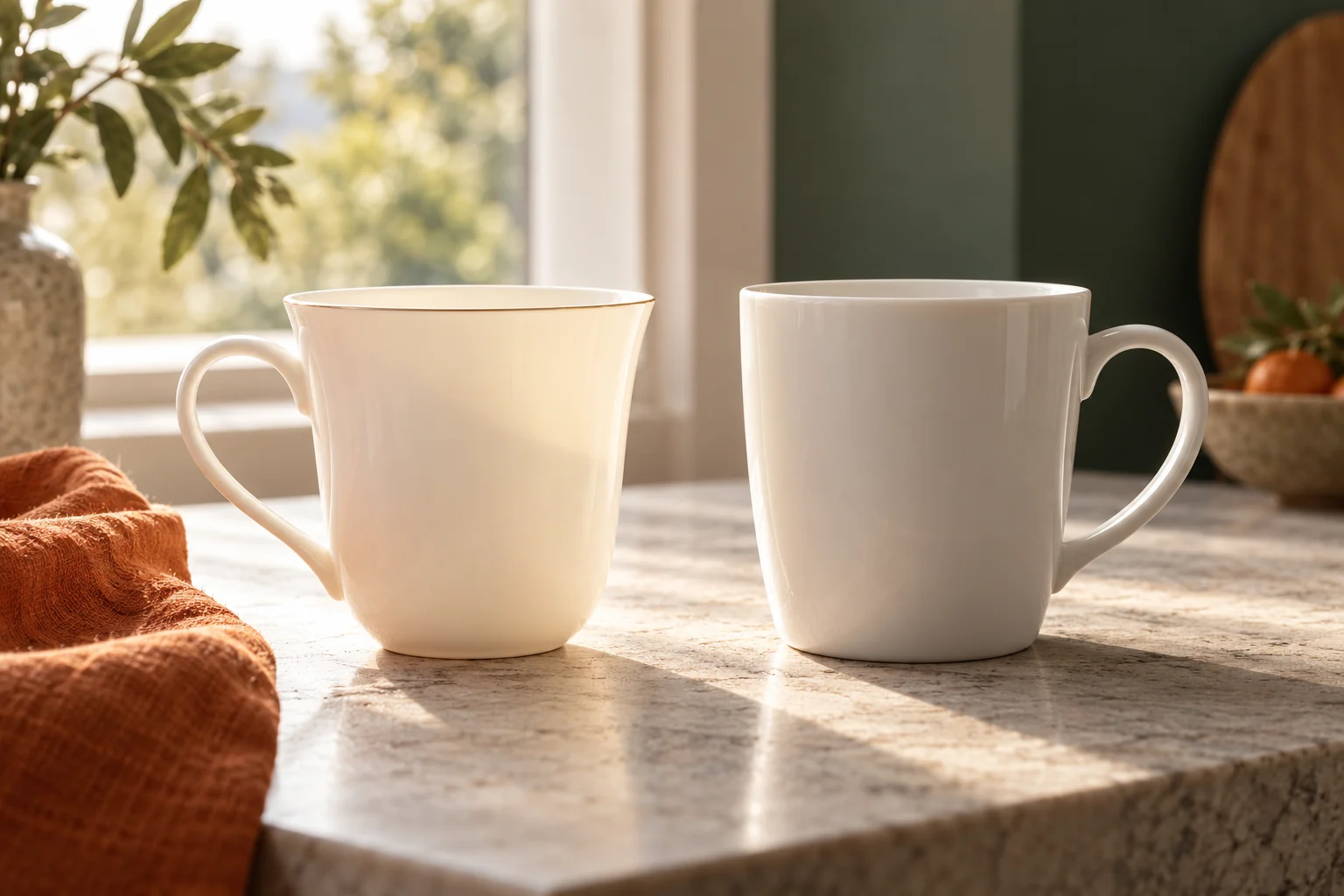
Illustrative material study: judge rim, wall, and appearance on finished samples.
Compare a finished mug at the same useful fill
A meaningful comparison starts with products that solve the same use case. A 220 mL thin-walled bone china tea mug should not be judged against a 450 mL heavy porcelain café mug and presented as proof that one material is always lighter. Ask for two or three candidate forms at the same comfortable drinking volume, with an agreed method of measuring it. Record brim capacity separately. The rim shape, handle opening, center of mass, and glaze surface all affect the experience more directly than a catalog adjective.
Weigh each empty mug and then handle it at the intended fill. A lighter wall may feel refined at a tasting table but need different protection in individual parcels. A thicker mug may feel reassuring in a café yet take up more shelf and carton space. Neither outcome is universal; geometry can overwhelm a simple material comparison. Look at the vessel on a table from several angles and check whether the base sits flat, whether a finger can comfortably clear the handle, and whether a user can drink without an awkwardly flared lip.
Test translucency under consistent lighting if it is part of the design promise. A bright point source held behind a thin sample can show a glow that disappears under ordinary room light or when decoration covers the wall. Compare the same position and approximate thickness, then describe the effect honestly in photography and product copy. A brand that wants a crisp white ground for printed artwork may value even glaze and repeat shade more than maximum translucency.
|
Buying criterion |
Bone china candidate |
Other porcelain candidate |
What to verify on the finished SKU |
|---|---|---|---|
|
Body and disclosure |
Bone ash is part of the traditional body route. |
Body composition varies by recipe and supplier. |
Written body description and any ingredient restrictions. |
|
Visual character |
Often chosen for a fine, luminous, subtly translucent look. |
Can offer a wide range of white tones and wall profiles. |
Physical shade and translucency under agreed light. |
|
Handling |
A thin form may feel light and delicate. |
Weight depends strongly on shape and wall design. |
Same useful fill, total weight, grip, and balance. |
|
Decoration |
Artwork must suit the surface and firing sequence. |
Technique and glaze also affect the finished result. |
Fired proof, placement, registration, and abrasion behavior. |
|
Operations |
Fine profiles may change packing and replacement planning. |
Robust geometry may simplify some programs. |
Actual breakage, transit, care, and reorder evidence. |
The table is a buying framework, not a performance ranking. Ask each vendor for a sample and evidence tied to the exact configuration. “Strong,” “light,” or “premium” on a specification sheet becomes useful only when the buyer defines a measurable question behind it.
Match the material to the collection rather than a label
Bone china can suit a fine tea collection, an elevated gift set, or a tableware line where a delicate silhouette is central to the brand. A contemporary coffee range may prefer a different porcelain body if the design calls for a broad handle, larger fill, thicker wall, or dense color. Both are design choices, not a hierarchy in which one body is automatically the premium answer. The more relevant question is whether the buyer can sustain the same form and finish through production and replenishment.
If a brand is developing a coordinated range, consider how the mug sits beside a saucer, plate, or teapot. A white tone that looks acceptable by itself may appear gray or cream next to existing pieces. If the brand uses photography across many channels, approve a physical color standard and photograph it with the other range components. For a line with several suppliers, the achievable shade tolerance matters as much as a perfect first sample. An exceptionally fine rim that cannot be reproduced reliably at the desired volume may be a poor launch choice.
For cafés and hospitality, collect feedback from the people who carry, wash, stack, and replace mugs. Measure clearance beneath an espresso machine or shelf if that matters. A delicate look may still be suitable for service, but the claim should be established with a realistic pilot and approved cleaning process. Conversely, a heavier form is not automatically safe from chips at the rim or handle. Handling and storage design can change the result more than the body name.
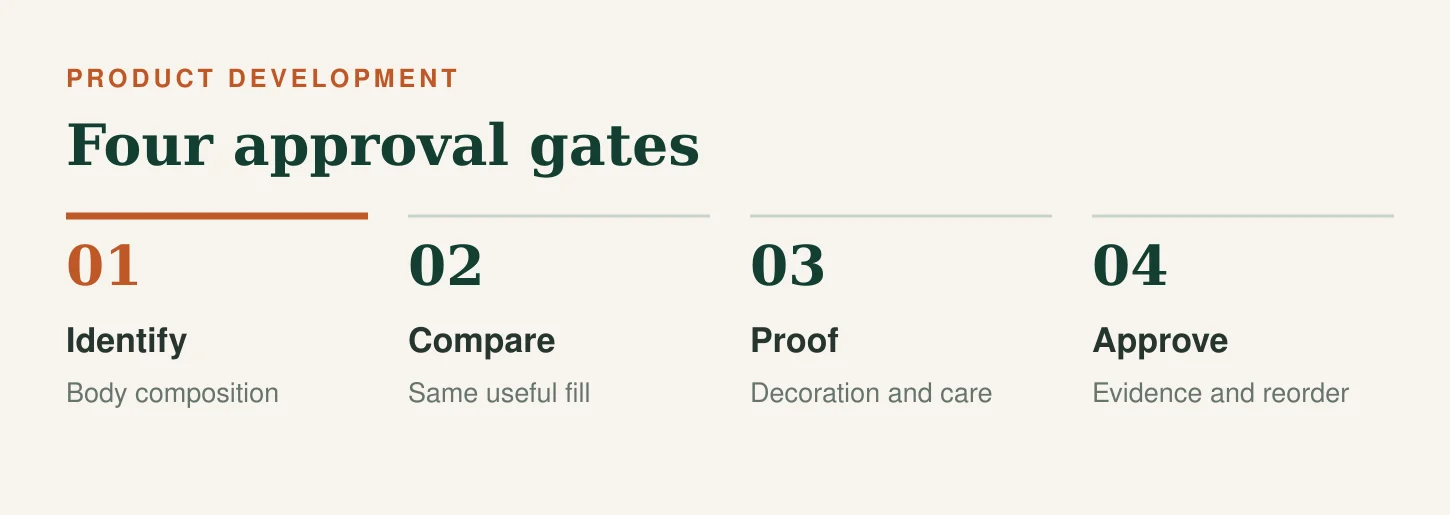
Approval gates for this product brief; the final steps depend on the project.
Artwork and glaze can change the answer
A decorated mug is a system of body, glaze, color, and applied finish. A translucent white body may be visually ideal when left plain, yet a large opaque print can hide that advantage. Metallic accents, colored interiors, rim bands, or artwork near a food-contact area can introduce extra approval questions. Request a fired proof on the actual body and glaze rather than evaluating artwork only on a paper print or a different blank mug. Ask where decoration sits relative to the lip and inside surface.
Specify the intended care claim before approving decoration. An undecorated mug’s washing or microwave result does not transfer automatically to a metallic detail or a new applied finish. If a brand wants a “dishwasher safe” statement, agree how that claim will be supported for each decorated SKU and any accompanying accessories. A gold-look accent, for example, may affect microwave suitability; the buyer should not infer care instructions from body composition alone. Write the final care copy only after the relevant configuration is tested.
The same discipline applies to food contact. The US FDA publishes compliance policy guides addressing lead and cadmium leaching from ceramicware. The European Commission explains the framework for food-contact materials and rules for ceramic articles. These are regulatory sources for market planning, not a universal “FDA-approved porcelain” badge. Ask a qualified laboratory or compliance adviser to match the current product, decoration, intended food contact, and destination market to the appropriate evidence package. Keep the report’s sample identity and production revision with the approval record.
Sample the manufacturing decision in stages
Start with an undecorated form comparison. Approve usable capacity, dimensions, weight, base stability, handle clearance, rim feel, and a physical shade range. Next, test decoration on the chosen body. The proof should show the final logo scale and position, color, surface finish, and expected variation at a seam or curved area. Then approve a packed sample with the exact mug and any lid, saucer, or insert. One attractive shelf photo cannot show the stress around a handle during parcel transit.
Retain a production-standard sample with a version code and a simple measurement sheet. If a supplier changes glaze, mold, raw-material source, or decoration route, ask what changes in appearance and performance and whether a new test is needed. A reorder should be compared with the retained standard, not with a compressed image embedded in an old email. For a multi-SKU range, sample each form and decorative configuration that presents a distinct risk; one report should not silently stand for every colorway.
The order of decisions saves time. If an expensive decoration proof is made before the rim and handle are approved, a minor shape change can invalidate the artwork. If the package is designed before final dimensions, inserts can pinch the handle or let the base move. Make the approval gates explicit in the product calendar and name who signs off at each stage. This is especially useful when a brand, trading company, and factory share a project but keep different copies of the brief.
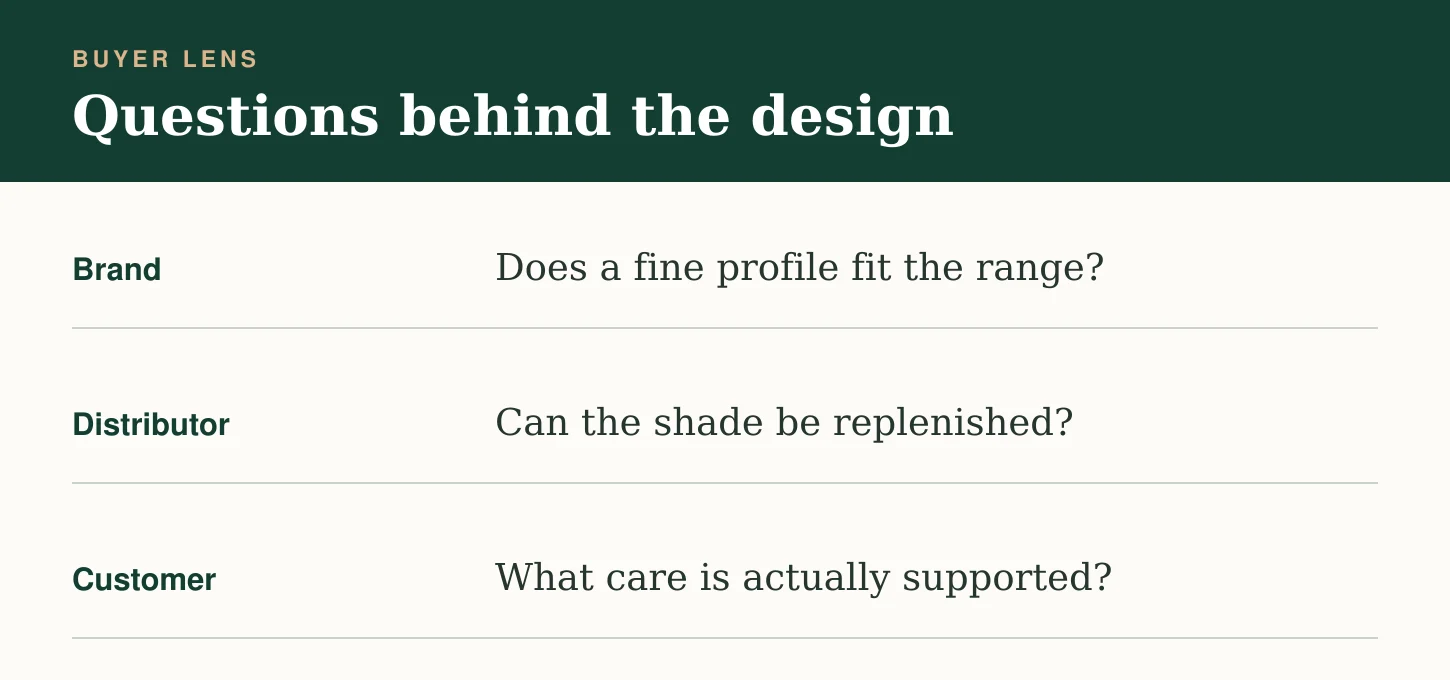
Buyer questions that should inform the approved product specification.
Compare quotations on a complete program basis
Request equivalent quotes for the same useful fill, dimensions, decoration coverage, individual packing, case pack, inspection, tests, and freight term. Separate one-time mold or artwork setup from recurring unit cost. Ask what sample rounds and revisions are included. A bone china quote may appear higher or lower for reasons unrelated to the body itself: shape complexity, batch size, firing route, artwork, packaging, yield, and supplier capacity can all influence the offer. Avoid publishing a universal price premium without a specific comparable brief.
Plan the reorder before the launch order. How will the supplier control shade and wall feel? Will an existing mold remain available, and who owns a custom mold? What happens if a decorated item is discontinued but a retailer still needs replacements? Which defects trigger rework or a credit? A lower initial unit price can be unattractive if the replacement plan is uncertain or the brand must approve an entirely new shape for the second season.
For European and US brands, consider the language of the final product page. If bone ash is material to purchasing decisions, make the disclosure accurate. Do not equate “fine china” with an origin claim. Do not promise that a mug is unbreakable, automatically microwave safe, or universally dishwasher safe because its body is bone china. Describe the observed finish, approved capacity, intended use, care instructions, and country-of-origin information from the actual product record. Clear copy reduces both customer confusion and avoidable returns.
Daye Porcelain describes custom mug development and OEM/ODM services. Its custom ceramic mug page and OEM and ODM overview explain the general route for a brand brief. A buyer seeking bone china specifically should ask Daye through the project inquiry page to confirm whether the requested body and shape can be produced or sourced for that project, then request physical samples and product-specific evidence before committing to the material in a launch plan.
Frequently asked questions
Is bone china a type of porcelain?
Yes. Museum sources describe bone china as a porcelain type or hybrid that incorporates bone ash. In a purchase order, use the agreed supplier body specification rather than assuming that all products called “porcelain” have the same recipe.
Does “china mug” mean it was manufactured in China?
No. “China” can be a tableware term. Country of origin is a separate factual and labeling question. Check the production records and destination-market labeling plan rather than drawing an origin conclusion from the material name.
Is bone china always lighter and stronger than porcelain?
No universal ranking follows from the words alone. Compare finished forms at the same useful capacity and evaluate weight, rim and handle performance, washing, and transit against the actual application. Body recipes and vessel geometry both matter.
Can a bone china mug be called vegan?
Traditional bone china uses animal-derived bone ash. A buyer with a vegan requirement should specify the excluded ingredients and obtain a written declaration for the offered body. Marketing language such as “new bone china” is not sufficient proof of its composition.
Can a decorated bone china mug go in a microwave or dishwasher?
That depends on the finished mug, especially its decoration and any metallic detail, as well as the supplier’s supported care instructions. Do not transfer a claim from a blank sample to a new decorated SKU without appropriate evidence.
References
- Victoria and Albert Museum, An A to Z of Ceramics
- Isabella Stewart Gardner Museum, Bone China Cup and Saucer
- US FDA, Lead Contamination in Pottery and Ceramics
- US FDA, Cadmium Contamination in Pottery and Ceramics
- European Commission, Food Contact Materials Legislation
- Daye Porcelain, Custom Ceramic Mugs