

Table of Contents
Porcelain espresso cups and saucers look like a simple two-piece product until the first sample slides across the plate, the handle blocks a spoon, or the two pieces arrive in different shades of white. For a café, the set is a serving tool. For a retail brand, it is a complete product with one price, one photograph, one pack, and a clear replacement policy. Both buyers need the cup and saucer developed together.
This guide is for brands, distributors, hospitality buyers, and trading companies specifying an OEM or ODM cup-and-saucer line. It focuses on fit, service use, coordinated design, packing, inspection, and reorders. It does not assume that any pictured item from a supplier catalog can be copied or supplied on an unstated minimum order quantity. The Daye Porcelain coffee cups and saucers collection is a relevant product category to discuss against a complete project brief.
Key takeaways
- Approve the cup foot and saucer well as an interface on real fired pieces.
- Define the sale unit, count, replacement route, and carton before comparing quotes.
- Match the fired white reference and decoration across both components.
- Test the packed set and the serving routine, including spoon placement, washing, and stacking.
Start with the way the set is served
An espresso cup and saucer can support several service styles. A café may place a small spoon, sugar portion, or biscuit beside the cup. A retail buyer may want the saucer mainly for a coordinated gift presentation. Some operators transport drinks on trays; others serve them at a counter and stack empty saucers near the machine. Write down the intended routine because it affects saucer diameter, well position, rim, handle clearance, and decoration area.
Decide whether the saucer is round, oval, or otherwise shaped, and what must fit beside the cup. A generous saucer may create a better space for a spoon but use more shelf and carton space. A compact saucer can look refined, yet a spoon may project beyond its edge. Test with the actual spoon and a filled cup. The serving unit is more informative than a flat drawing of two isolated parts.
The cup volume still needs its own method. State the intended espresso serving and practical headroom separately from brim capacity. A supplier may quote a “90 mL cup” based on the maximum fill; the café may use far less in service. Ask for both the capacity method and the external dimensions, then confirm them on the physical pair. If the range includes a second size, label it as a distinct cup-and-saucer SKU so a warehouse cannot substitute one for the other.
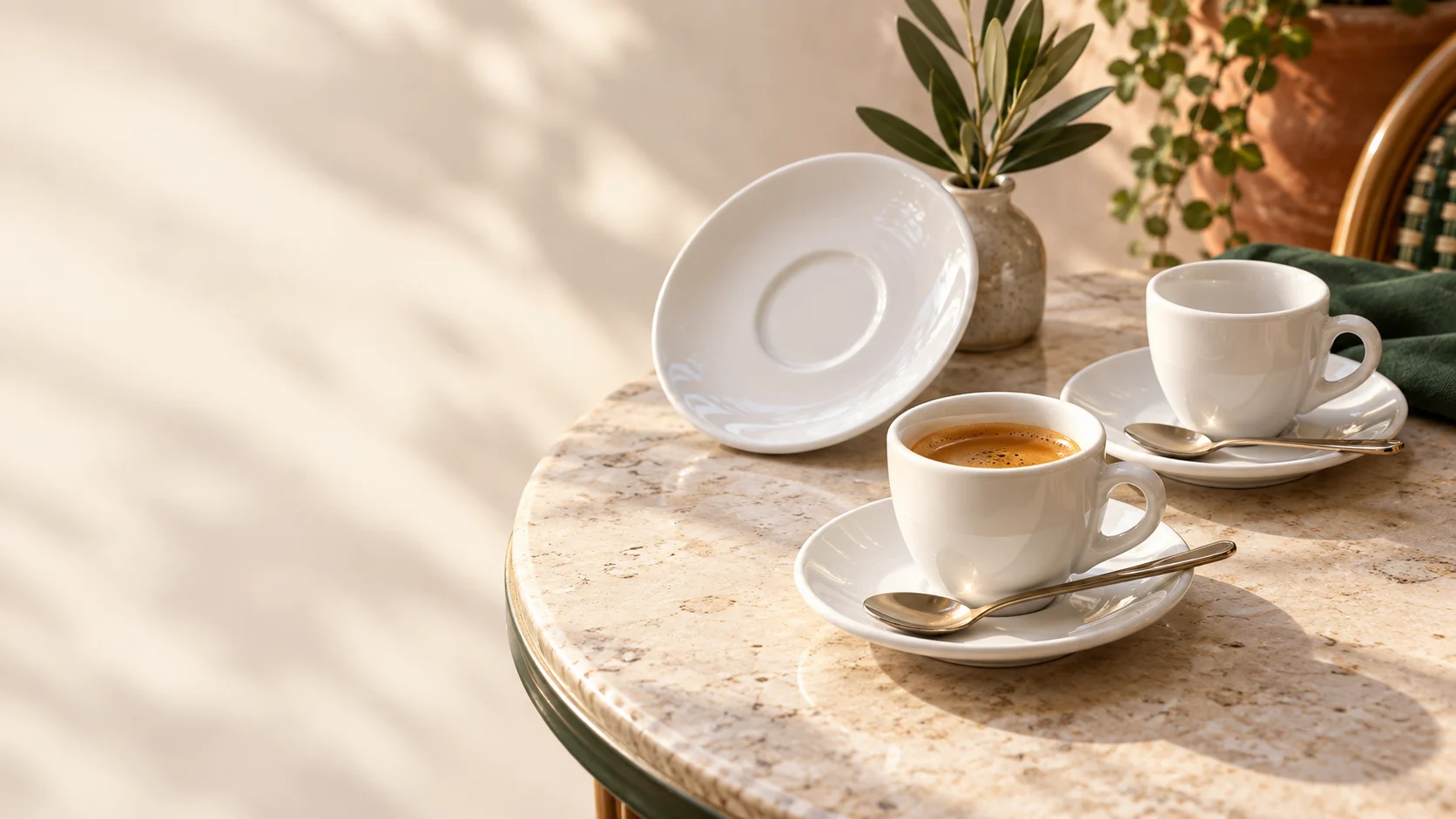
Illustrative cup-and-saucer setting: test the fired pair as one serving unit.
Engineer the foot and saucer well together
The foot ring of a fired cup must sit securely in the saucer’s central well. A perfectly centered CAD view cannot show every outcome of forming, firing, and glazing. Check several cups against several saucers, including examples near the allowed limits. The pair should resist casual sliding when carried in the intended manner, yet lift without catching or scratching. A saucer well that is too deep can make the cup feel trapped; one that is too shallow may not locate it at all.
Put the filled cup on the saucer and carry it the way staff will. If a spoon is included, test whether the handle leaves room for it and whether the spoon rocks on a raised pattern. Check the combined center of gravity when the cup is moved toward the edge to make room for a biscuit. This is a use test, not a claim that any particular dimension universally prevents spills. The correct tolerance depends on the actual foot, glaze, well, and service practice.
There is also a visual fit. The cup can look too large for the plate, or a narrow cup can appear lost on an oversized saucer. Photograph each pairing from above, from the customer’s eye level, and in its intended retail pack. Approve both function and proportion. If the saucer will serve several cup sizes, test every pairing rather than assuming a common center well solves the range.
Decide how many SKUs the range really needs
|
Commercial unit |
Best reason to choose it |
Operational question |
|---|---|---|
|
Cup only |
Existing service already has suitable saucers or no saucer is needed |
Can the buyer identify a compatible replacement later? |
|
One cup and one saucer |
Clear café serving or individual gift unit |
Can either component be replaced separately? |
|
Pair of cup-and-saucer sets |
Retail presentation for two people |
Is the pack size practical for parcel delivery? |
|
Four- or six-place set |
Coordinated hospitality or home collection |
How are components protected and counted? |
|
Mixed finish collection |
A visual story across several colorways |
Are color, item code, barcode, and care instructions controlled per variant? |
The table is a way to clarify the quote. The phrase “porcelain espresso cup set” can mean two cups, four cups, four pairs with saucers, or something else entirely. Spell out every component and quantity in the product title and purchase order. If a set includes spoons, state their material and whether they are provided by the ceramic manufacturer or another supplier. A spoon that is merely shown in a photograph should not become an accidental promised component.
Retail and hospitality can share the same cup mold but use different packs. The café may prefer bulk cartons with divided pieces and the ability to reorder loose saucers. The retailer may need a printed gift box and a consistent product photograph. This is a packaging variant, but it can create different SKUs and different handling tests. Ask the supplier to cost both configurations if both channels matter.
Match the body, glaze, and decoration
White porcelain has visible character. A warm white cup on a cool white saucer can look mismatched even if each item is acceptable on its own. Approve a retained fired reference for both components under suitable light. For a patterned range, determine whether the saucer repeats the full motif, carries a small accent, or remains plain. Do not scale a cup graphic automatically to a shallow saucer: curves, wells, and contact areas change the artwork’s appearance.
Logo placement deserves its own proof. A mark at the bottom of the saucer well may be covered by the cup; a mark near the rim may be hidden by a spoon. The underside can carry an identification mark, but the retail team should not assume the customer will see it during use. Approve physical decorated pieces and the proposed photography at once. If a metallic line or overglaze detail is added to only one component, the care instructions for the sold set must reflect the complete assembly.
The buyer should also specify how the two pieces are kept together through production, packing, and fulfillment. Use a clear item code for the cup, another for the saucer, and a parent code for the sellable set. An inspector needs to know which shade and pattern pair belong together. A later reorder may involve only saucers; without component-level control, a nominally matching white may be visibly different beside stock from the previous shipment.
Sample the full assembly, not separate show pieces
The first review is fit: several fired cups against several fired saucers, checked for wobble, contact marks, and stability. The second is service: drink volume, machine clearance, spoon placement, carrying, and cleaning. The third is finished appearance: color, motif, logo, and realistic product photography. The fourth is transit: retail unit pack, bulk carton, drop or distribution evaluation appropriate to the channel, and a count at unpacking. Do not approve a set from one posed pair while the production tolerance remains unwritten.
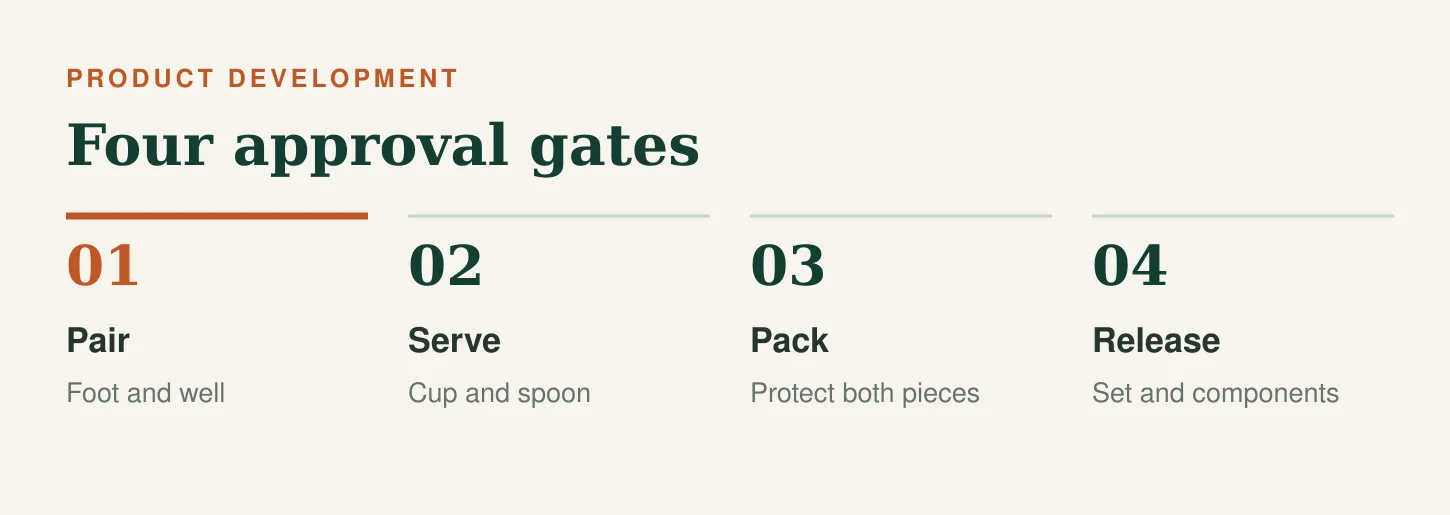
Approval gates for this product brief; the final steps depend on the project.
Build a small matrix for the sample review. Record cup outside diameter at the foot, saucer well fit, practical fill, handle clearance, saucer diameter, packed dimensions, and the precise defect examples that would cause rejection. Use measured results to agree tolerances with the maker. A sample may be visually pleasing but fail the product description if its comfortable fill differs from the number that marketing intends to publish.
Check storage and washing. Cups and saucers may be stacked separately, nested in a tray, or placed in a dishwasher rack. Glazed contact points can mark over repeated movement even if a single sample looks perfect. Trial the relevant handling routine and describe it accurately. A dishwasher claim is tied to the finished decoration and proposed care instructions, not to the word “porcelain” alone.
Packaging and freight are part of the design
Two ceramic pieces can contact each other inside a box. Specify a divider or other protective arrangement that keeps the cup foot, rim, handle, and saucer edge from taking repeated impact. Inspect a real packed sample after representative handling. A tight retail box can look premium and still transmit damage if its insert lets the components collide. Bulk cartons also need an unambiguous component count and orientation.
For a set sold online, photograph exactly what arrives. Show the number of cups and saucers, the scale of the cup in a hand or beside a spoon where appropriate, and the pack contents. Avoid a styled scene of four place settings if the sale unit is one pair. The listing’s capacity, dimensions, care, and material should trace back to the final approved SKU. This reduces return disputes and makes a reorder easier to communicate.
Compare quotes on the same basis. Request the unit price for each packing route, any new mold or printing setup, sampling, testing, carton configuration, and spare components. Consider the cost of a broken saucer relative to the cost of an entire replacement set. A slightly higher unit price with reliable spare parts may serve a hospitality account better than a low initial price that forces replacement of both pieces.
Verify food-contact evidence by market and finish
The cup is a food-contact article; its glaze and decoration deserve review for the destination market. A saucer may also contact a spoon or food item, so the buyer should describe its intended use rather than assume it is decorative only. FDA guidance for US ceramicware addresses extractable lead and cadmium. The European Commission identifies the EU food-contact framework, good manufacturing practice, and ceramic-specific legislation. Ask for evidence that corresponds to the relevant finished product and market, including decorated variants where appropriate.
Do not call the set “FDA approved” because a supplier has a general certificate. Likewise, a test on a plain cup is not automatically the right document for a differently decorated saucer. Map the submitted reports and declarations to item codes; clarify any justified family grouping with the supplier and relevant testing body. Confirm local labeling and care requirements before the retail pack is printed.
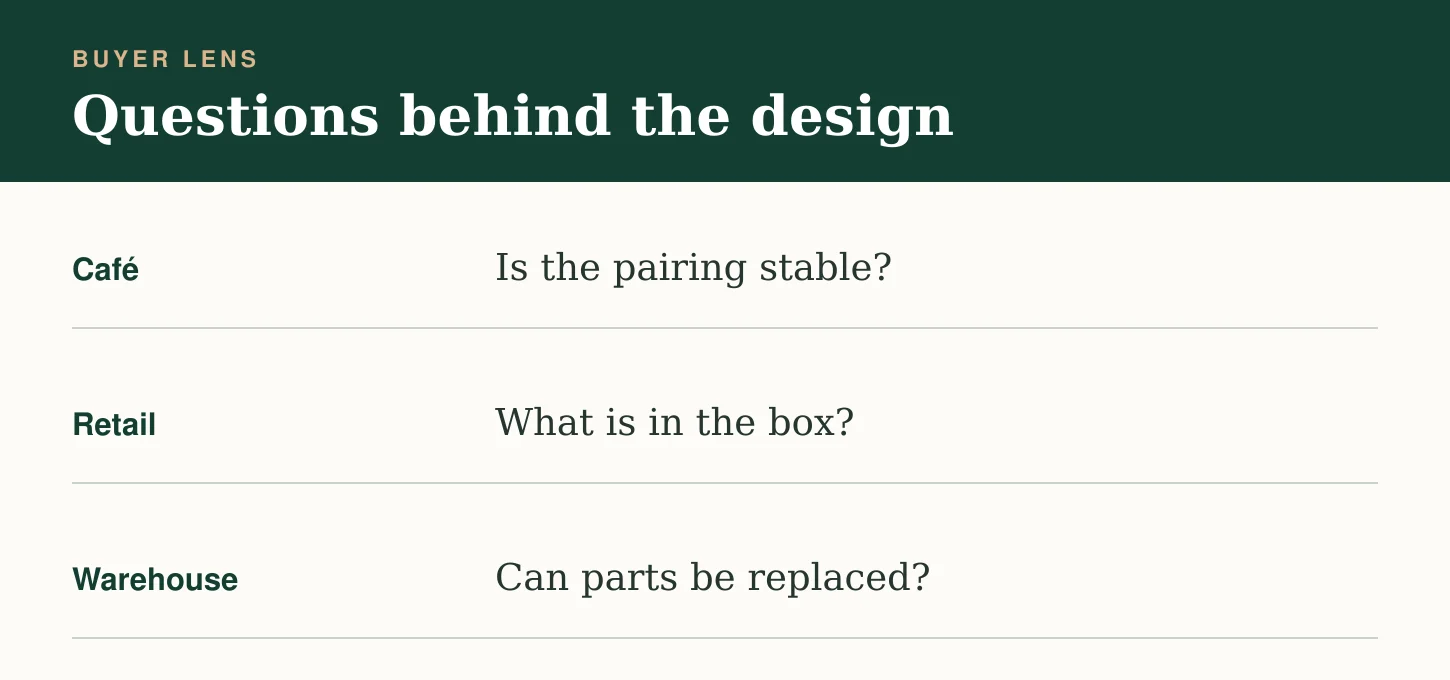
Buyer questions that should inform the approved product specification.
A practical RFQ for cup-and-saucer sets
Send the target serving volume, cup shape and dimensions, saucer use, spoon requirement, white or color reference, decoration artwork, quantity per sale unit, intended markets, packing route, planned volume, and launch date. Ask the maker to return a proposed pairing, sample schedule, tolerance plan, component prices, and replacement terms. This is more useful than asking for the cheapest “cup and saucer” photograph.
Daye Porcelain’s coffee cups and saucers page and custom ceramic mugs page can frame a coordinated drinkware discussion. If the project needs a proprietary pairing, its prototyping and mold development page is a starting point. Send the complete brief through the project form and ask for project-specific feasibility, cost, timing, and evidence.
Frequently asked questions
Do porcelain espresso cups and saucers have to be sold together?
No. A café may buy components separately, while a retailer may want a fixed gift unit. Define the selling unit and replacement policy before pricing, packing, and photography. If they are sold as a pair, approve their fit as one assembly.
What makes an espresso saucer the right size?
It should support the filled cup and the intended serving items without looking or feeling awkward. Test the actual cup, spoon, tray, and storage method. Diameter alone does not establish stability or usability.
Can one saucer fit different espresso cups?
Possibly, if their foot rings and balance work with the same well. Test each intended cup against several production-standard saucers and document the acceptable pairing. A shared drawing is not enough.
Is a four-piece porcelain espresso cup set two cups and two saucers?
It often is, but product descriptions vary. State “two cups plus two saucers” or the exact component count on the sales page, carton, and purchase order. The count should match the barcode-linked SKU.
Can the cup and saucer use different decorations?
Yes, when the design is intentional and the resulting care and food-contact evidence are suitable. Approve fired samples together; do not assume a motif transferred from a vertical cup wall will look the same on a shallow saucer.