Table of Contents
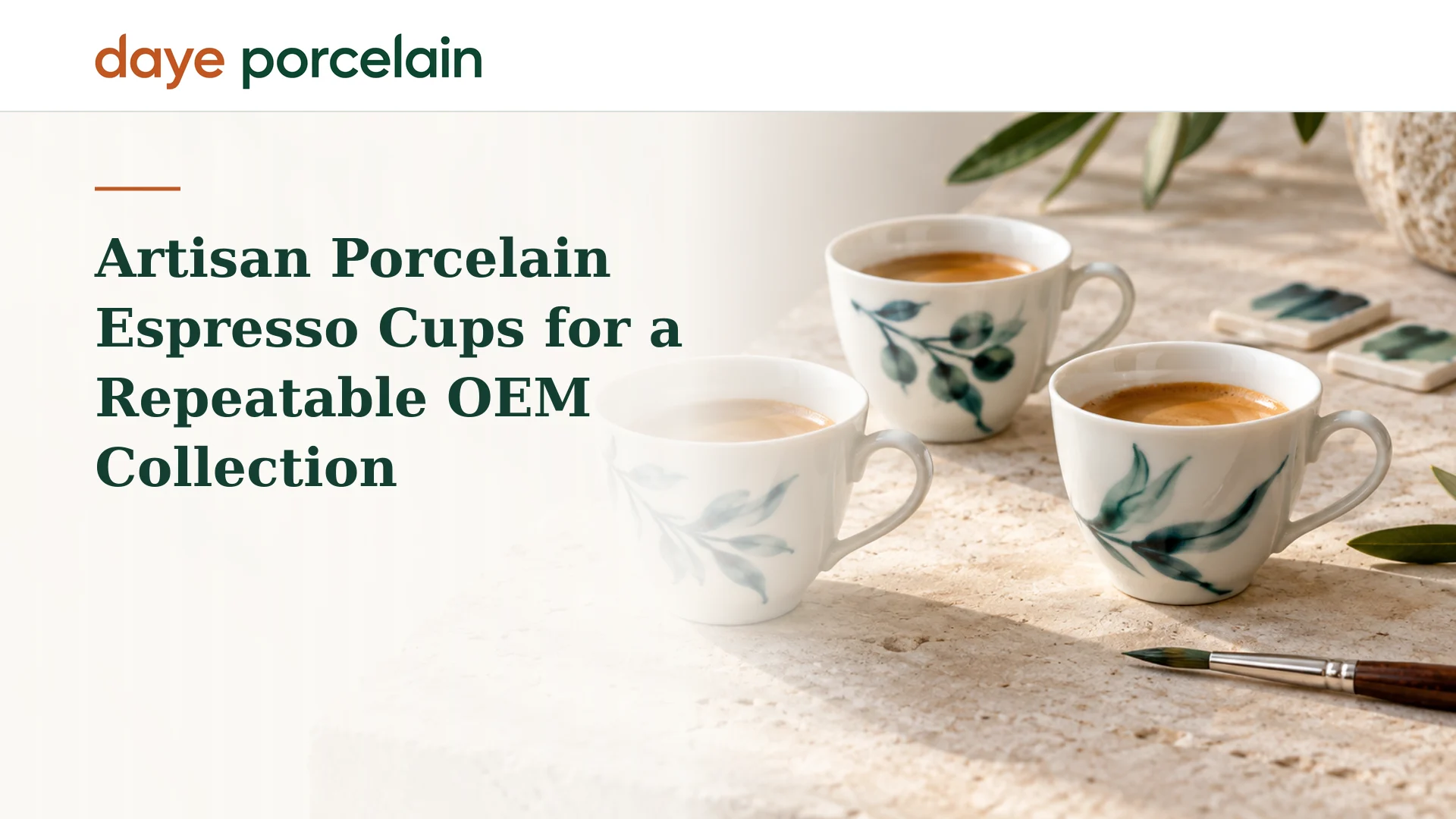
Artisan porcelain espresso cups appeal to brands that want a human, tactile appearance in a small daily object. The commercial challenge is to make that appearance honest and repeatable. A softly varied brush motif, a shaped handle, or a distinctive fired glaze can give a cup character. None of those details proves that every unit was hand-thrown, hand-painted, or made in a particular workshop. A brand must decide which variation it wants and which characteristics have to remain controlled.
This guide is for retail brands, specialty coffee businesses, gift programs, and distributors developing an original artisan-style espresso line with an OEM or ODM partner. It focuses on the design and decoration process, approval limits, truthful descriptions, and reorder control. It is distinct from a general coffee cup range guide: the decision here is how to create a recognizable aesthetic without losing the specification a buyer needs.
Key takeaways
- Define “artisan” as a specific visual and production brief, not an unsupported manufacturing claim.
- Choose which features may vary and which must match a retained fired sample.
- Approve decoration on a real espresso cup, including its rim, handle, foot, and any matching saucer.
- Write product copy only after the production route and finished care performance are confirmed.
Begin with an original visual language
“Artisan” can point to several different appearances: a restrained brush motif, a subtle hand-formed impression, a glaze with controlled movement, a fine colored edge, or a cup whose shape feels less machine-perfect than standard café whiteware. These routes differ in labor, repeatability, cost, and the claims that the finished product can support. Ask the brand team to select two or three concrete visual qualities from physical references and specify what should remain absent. A loose request for “handmade looking” gives neither designer nor factory a measurable goal.
Start with the espresso service itself. A decorative cup still needs a comfortable useful fill, a stable foot, an inviting rim, and a handle suited to the intended user. A strong motif cannot rescue a cup that does not fit beneath the target machine. First approve an undecorated body for capacity, handling, and cleaning. Then apply the visual route to that body. If the artwork changes how the handle or rim is finished, repeat the handling review on the final decorated version.
Create original artwork or commission it under a clear license. Antique ceramics, café photography, and named designer pieces can inspire a palette or a broad mood; they should not be treated as permission to reproduce a recognizable pattern or proprietary shape. Keep the source files, color references, permitted uses, and ownership terms with the product record. This matters when a successful first collection expands to a larger cup or a second market.
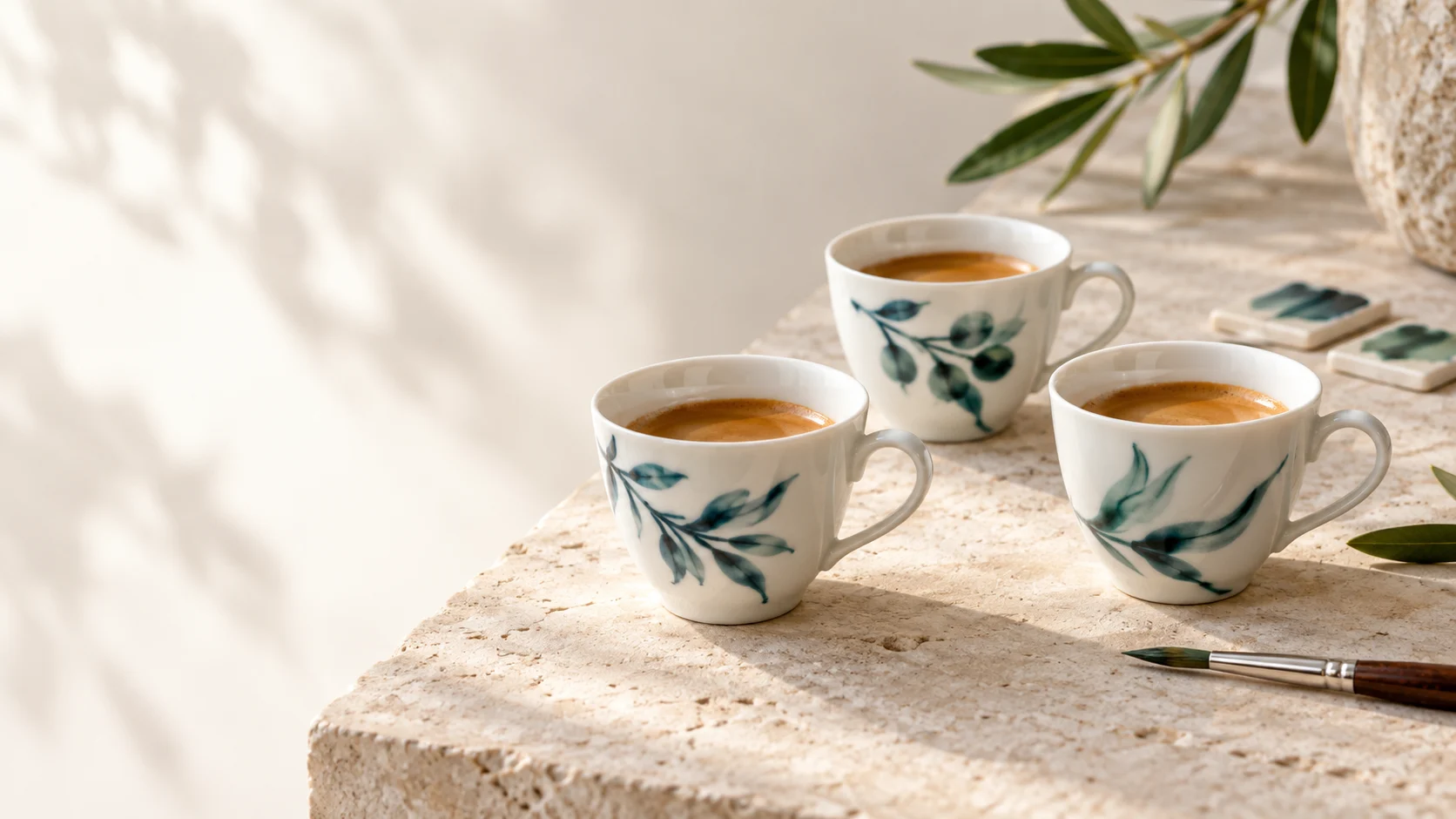
Illustrative artisan-style motif: define and approve the allowed fired variation.
Separate the appearance from the production method
A hand-painted appearance can be produced in different ways. Individual brushwork has one type of variation and labor cost. A ceramic decal can repeat artwork closely, though its surface appearance and firing route differ. Underglaze and overglaze methods have different technical considerations; the buyer should ask the supplier to name the actual method used for the quoted SKU. The word “hand-painted” belongs on a listing only when the process truly includes that step for the product sold.
The same principle applies to glaze. A reactive or intentionally varied glaze may produce attractive movement, but the allowed light and dark range should be approved on several fired pieces. A photographic hero sample can be unrepresentative of a whole shipment. Build a physical range board with acceptable examples at the edges of the desired spectrum and examples that fail. Describe where movement is welcome and where it is not, particularly near the drinking rim, inside surface, and logo.
Porcelain itself can support a refined, light appearance, but “porcelain” does not mean every body is thin, translucent, or identical in shade. Specify the body and glaze in the supplier brief, and evaluate the finished cup. If a speckled or coarse look is desired, ask whether the proposed body is actually porcelain or another ceramic such as stoneware. The online description should name the material accurately rather than borrowing the search term for a different product.
Compare decoration routes before commissioning samples
|
Route to the desired look |
What the buyer may gain |
What to control |
|---|---|---|
|
Individual brush application |
Visible human variation in each piece |
Artist or operator method, placement, motif limits, labor, and claims |
|
Repeated ceramic transfer |
Consistent artwork over a larger program |
Fired color, registration, edge visibility, and surface durability |
|
Varied glaze effect |
Organic tonal movement without a fixed motif |
Approved shade range, food-contact surface, and batch consistency |
|
Sculptural body detail |
Character in the form rather than the print |
Mold rights, handle comfort, cleaning, and packing |
|
Subtle line or edge accent |
A restrained premium cue |
Placement tolerance and care for the final finish |
No route is inherently more “authentic” or more durable in every implementation. The product claim should say what was actually done, and the test plan should follow the finished materials and decoration. A retailer may choose a repeated motif because it can be replenished reliably; another may knowingly accept individual variation and explain it honestly to customers. Both are valid design choices when the specification and labeling agree.
Write acceptable variation into the brief
Variation is valuable only when the buyer can distinguish intended character from defects. Agree on color family, motif scale, placement envelope, glaze coverage, and visible brush or edge behavior. A small change in the location of a leaf motif may be welcome; a logo lost behind the handle may not. A controlled range can permit each cup to differ while maintaining a coherent shelf presentation.
Ask for a group of samples rather than one perfect cup. Put them side by side under retail and café lighting, then compare how the set looks as a whole. Measure practical fill and external dimensions as well as color and artwork. Photograph the approved range in a neutral setup and retain the physical pieces. Written words such as “subtle” or “organic” are too elastic for an inspection team without these references.
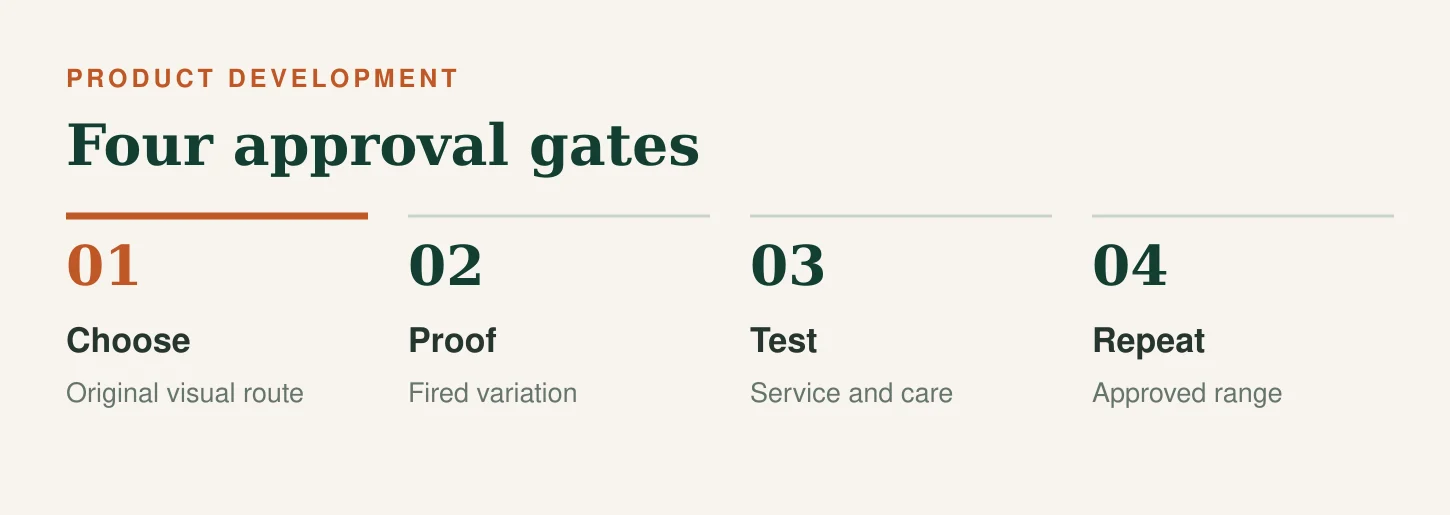
Approval gates for this product brief; the final steps depend on the project.
There are production implications. If the line involves several colors or motifs, specify the quantity of each version and whether all can be reordered at the same terms. If a hand-applied step is part of the claim, determine who performs it, which characteristics they control, and how the method is documented for a later run. Do not claim a specific artisan workforce, geography, or family tradition without evidence. A brand story must remain true when production scales.
Keep the cup useful in an espresso bar
The small size of an espresso cup gives a motif little space to breathe. A pattern that looks graceful on a large mug can crowd the cup and make the logo feel oversized. Test artwork at actual print size and view the fired cup from the guest side and the barista side. Consider what the customer sees while drinking, where fingers rest, and whether a saucer hides part of the decoration. A quiet design may be more legible than a dense print.
The handle and rim are functional touchpoints. Decorative texture should not make the grip abrasive or the drinking edge uncomfortable. Inspect the inside of the cup for cleanability and visual clarity. If the brand wants a raw or matte exterior, clarify which surfaces are glazed and how the care instructions were validated. A photograph does not establish that a finish will tolerate a particular dishwasher, microwave, or commercial cleaning routine.
If a matching saucer is planned, decide whether it echoes the artwork or acts as a neutral frame. The cup foot must fit the saucer well after firing, and the two components should share a compatible white or glaze family. A mixed hand-finished assortment may still need component pairing rules so the set looks deliberate when packed. Specify replacements, since cafés may break saucers at a different rate from cups.
Approve the artwork, the assembly, and the pack
The sample sequence should begin with the body profile and capacity. Next, ask for decoration proofs on the actual cup, not a flat tile alone. Review several fired pieces showing the intended variation. Then test serving, washing, abrasion from stacking where relevant, and the chosen packaging. Use these observations to set the final approval board, item codes, and listing copy. A beautiful glazed sample can still fail the project if the pack lets the cups knock together in transit.
For gift retail, decide whether a single cup, a pair, or a cup-and-saucer set is sold. The gift box may need to show variation honestly rather than promise that every cup has an identical brushstroke. For wholesale café use, bulk packing and component replenishment may matter more than a presentation box. Ask the supplier to price the two channels separately if both are intended. An artisan visual route can change setup and inspection effort even when the underlying cup mold is shared.
Keep product photography aligned with the allowed variation range. If every image shows the darkest, most dramatic glaze, buyers may be disappointed by a lighter but technically acceptable piece. Use multiple examples or a concise variation note when differences are intentional. Do not use “one of a kind” unless each piece really meets the meaning the buyer will infer.
Food-contact and care claims follow the finished item
For US-market ceramic foodware, FDA guidance addresses extractable lead and cadmium. For EU markets, the European Commission identifies general food-contact rules, good manufacturing practice, and ceramic-specific measures. An artisan appearance does not relax these obligations. Review the specific body, glaze, decoration, and any food-contact saucer with the destination market in mind. Ask for documents that identify what was tested, and confirm whether a change in pigment or glaze calls for a new evaluation.
Do not print “lead free,” “food safe,” or “dishwasher safe” simply because a blank body passed an earlier test or a supplier used those phrases on another item. Define the claim precisely and retain evidence for the finished SKU. Likewise, a metallic accent may call for different microwave instructions from a plain underglaze design. Product-page copy should describe the verified use, not a category-wide promise.
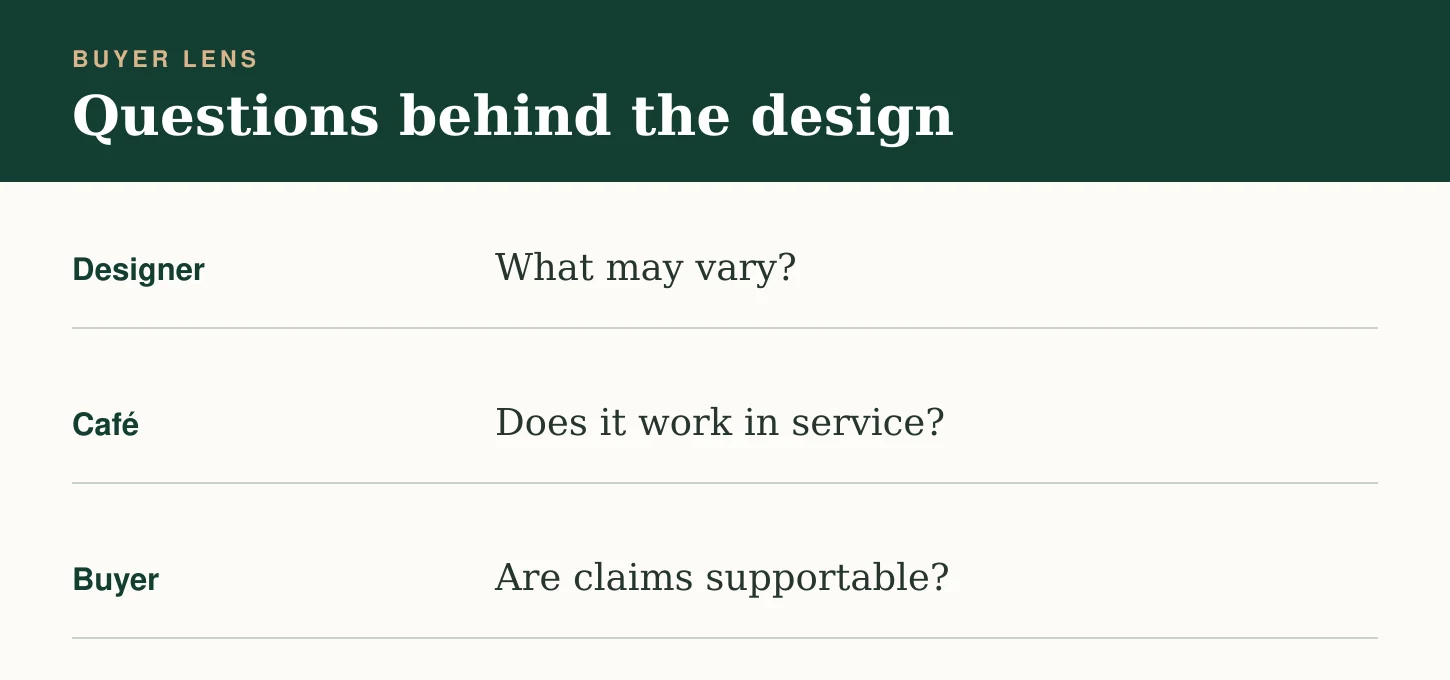
Buyer questions that should inform the approved product specification.
Brief an OEM partner without losing the character
Send the target espresso serving, cup geometry, body material, fired white reference, visual references with permissions, artwork ownership, decoration route or desired appearance, variation examples, target market, proposed care, packaging format, and sales forecast. Ask the maker to explain which decisions require new tooling, which can be sampled on an existing body, and how the design would be repeated. Request a price for the exact finished and packed unit, not just an undecorated blank.
Daye Porcelain’s design development, custom ceramic mugs, and quality control pages provide project routes to discuss. A brand can submit its original design and expected quantities through the project inquiry form. Production method, minimum order, finish feasibility, evidence, and timing need confirmation for that brief. The resulting product story should be as carefully made as the cup itself.
Frequently asked questions
Are artisan porcelain espresso cups always handmade?
No. “Artisan” is often a style description, while “handmade” or “hand-painted” is a production claim. Ask how the actual SKU is formed and decorated before using a method claim. Describe the visible design directly when the process is mixed or uncertain.
Can a hand-painted motif be repeated on a reorder?
It can be repeated within an agreed visual range, but exact brushstroke identity may not be realistic. Retain approved examples, source artwork, placement rules, and unacceptable examples. State what variation a customer should expect.
Is a reactive glaze suitable for an espresso cup?
It may be, depending on the formulated glaze, finished surface, intended use, and test evidence. Review multiple fired pieces for appearance and practical cleaning, then verify the actual food-contact and care claims for the destination market.
Can an artisan-style cup also be part of a matching set?
Yes. Decide whether the saucer repeats the motif or stays neutral, and test cup-to-saucer fit, color compatibility, packing, and replacement stock. A coordinated set need not make every hand-applied mark identical.
What should a brand send to request a custom sample?
Send an original visual brief, intended serving and dimensions, body and finish direction, artwork files and rights, allowed variation, pack count, destination markets, target quantity, and launch timing. Ask the supplier to identify what remains unproven before any care or origin claim is published.