Table of Contents
Searching for a bamboo coffee mug factory can lead to very different products. This guide is about a ceramic drinking cup whose raised body resembles a bamboo stalk. It is not a bamboo-fiber molded cup and it has no required wooden sleeve. A buyer commissioning this form needs a manufacturer that can review sculptural geometry, develop physical samples, control the fired finish, and explain how the same design will be inspected on repeat orders.
The supplier conversation should begin with the proposed cup, not a generic factory ranking. A dramatic node band may affect mold release, finishing, glaze flow, handling, and packing. Those points can be tested on a sample and written into the order. This article gives brand owners, sourcing teams, and trading companies a practical factory-question framework for an original ceramic bamboo design.
Key takeaways
- Send a dimensioned product brief and ask the factory to identify difficult geometry before quoting.
- Inspect several finished samples for node definition, rim, foot, glaze, and practical hot handling.
- Compare suppliers on the same finished and packed SKU, with tooling and revision terms visible.
- Link test reports and inspection standards to the exact product version and destination market.
Define the product before comparing factories
A useful inquiry includes the target useful fill, height, diameters, approximate weight, body material, glaze, handle choice, relief depth, brand mark, packaging, quantities, and target market. A photograph can show the desired botanical mood, but it cannot specify capacity or authorize a copy of a commercial design. Ask for an original interpretation and provide drawings showing the front, side, rim, and base. If only a sketch exists, identify which dimensions the development team should help resolve.
Write the intended use plainly. Is it a smaller stationary coffee cup, a full morning mug, or a giftable desktop vessel? The answer affects heat handling, stability, and pack design. A handleless bamboo-node cup may feel tactile in a product photograph, yet the buyer must try it with a hot beverage. A factory that discusses these practical questions early is helping to define the product, rather than simply pricing a picture.
Avoid ambiguous material language in the RFQ. Specify a ceramic or porcelain body with the bamboo appearance created in form and finish. “Bamboo coffee mug” on its own may be interpreted as a plant-fiber composite or a cup with a separate bamboo lid. Spell out the actual construction so all quotations describe the same article.
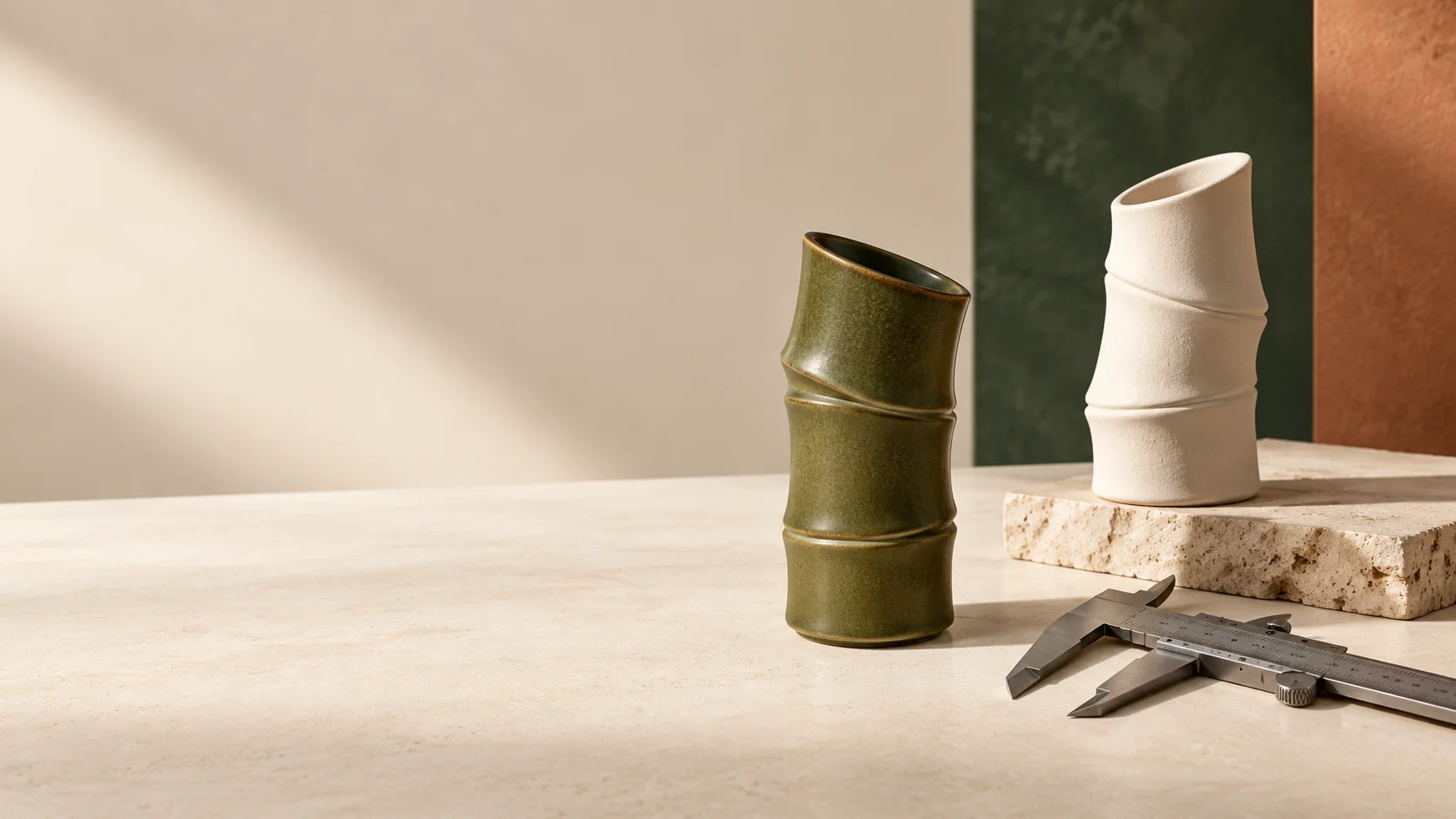
Original ceramic concept study; actual factory process and feasibility require review.
Ask how the sculpted body will be made
Different forms call for different tooling and forming decisions. A raised node that wraps around the body creates a different mold challenge from a shallow incised line. Ask the factory to mark the expected mold parting lines, release direction, and finishing locations on the drawing. Request an explanation of which details might need a softer transition to avoid fragile edges or difficult demolding. The goal is to preserve the bamboo language while making the form repeatable.
A shape proof may reveal issues that an attractive rendering hides. Examine the node rings from all sides. Are they even enough for the intended design? Is the seam visible at the front? Does trimming create a flat spot? Do the bands leave a comfortable grip and an easy-to-clean exterior? Ask to see the unglazed or early prototype as well as the final glazed version so the team can separate shape corrections from color decisions.
Wall thickness deserves attention near relief transitions. A sculptural cup can look substantial while being awkwardly heavy or uneven in the hand. Discuss the proposed body and firing route with the maker, then measure the finished sample. Do not assume a nominal design file predicts final dimensions; ceramic shrinkage and glaze can change fit and visual balance. Retain an approved fired sample as the practical production standard.
Compare evidence at each factory stage
|
Stage |
Ask the factory to show |
Buyer decision |
|---|---|---|
|
Design review |
Marked drawing with node, rim, foot, and parting-line comments |
Accept the proposed construction or revise the form |
|
Sampling and tooling |
Shape proof, fired sample, revision and ownership terms |
Freeze geometry and development scope |
|
Glaze approval |
Several finished cups showing the intended shade range |
Approve color and allowed variation |
|
Production inspection |
Reference sample, checks for chips, wobble, finish, and pack |
Agree acceptance and rejection examples |
|
Shipment preparation |
Tested retail or bulk pack with carton details |
Release the finished SKU for its channel |
This matrix is a discussion aid. The exact process and stage names depend on the form and the supplier. What matters is that the buyer sees a traceable path from its drawing to the shipped cup. A factory may have experience with sculptural merchandise but still need to validate this specific relief, glaze, capacity, and order mix. Ask for project-specific evidence rather than assuming portfolio photographs prove current feasibility.
A supplier should also state what is included in each sample round and who approves changes. If a node band is reduced after the first mold trial, the buyer should receive an updated drawing and sample before the change appears in production. A consolidated feedback sheet keeps separate comments about appearance, capacity, and packaging from being lost in email.
Review the fired glaze on the actual relief
A bamboo form can be finished in olive green, deep forest green, warm white, or another brand-specific shade. The color may appear lighter at the raised ring and darker where glaze gathers. Ask for multiple fired cups from the intended route, not a flat tile alone. Inspect the inside as well as the exterior. A smooth drinking rim, even interior surface, and stable foot are as important as the photographable front.
Define an acceptable range for tone and coverage. If intentional movement is part of the appearance, identify the light and dark limits with physical samples. Inspect the relief grooves for unintentional pooling, bare patches, pinholes, or sharpness. A minor natural-looking variation may suit a gift item, while a major change in node visibility can make the collection inconsistent on a retailer’s shelf.
Logo or artwork placement is another factory question. A transfer crossing a raised node can distort. An embossed mark can require a tool change. Ask to see the actual decoration on the glazed form and confirm the method used. Product copy should not say “hand-painted” or “celadon” just because a sample resembles that look; the method and material must match the claim.
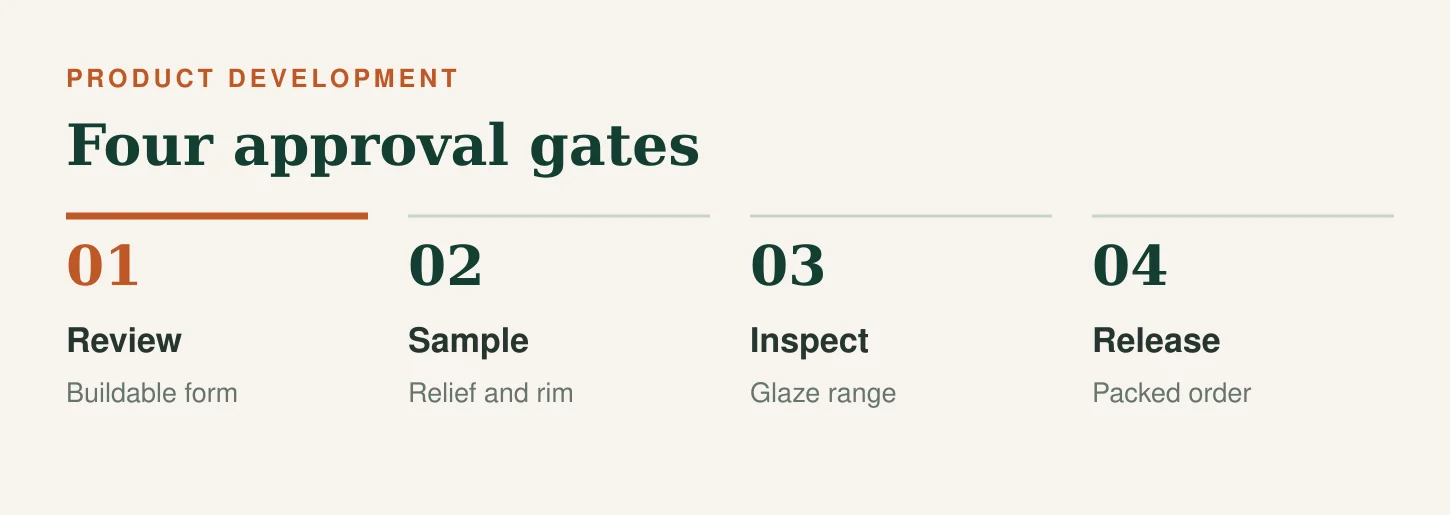
Approval gates for this product brief; the final steps depend on the project.
Understand the quote beyond unit price
Request a breakdown for design review, tooling, sampling, cup production, glaze variants, decoration, individual box, master carton, testing, and delivery basis. Give the same quantity and variant mix to each supplier. A very low quotation may cover a plain cup without the proposed relief or without the gift pack. Another may include tooling in the first order. Normalize the scope before drawing conclusions from the price.
Ask who owns the drawings and molds, whether the form can be offered to other buyers, and what happens to the tooling between reorders. Payment for a mold does not automatically establish exclusive rights unless the terms say so. If a brand provides artwork, record permitted use and confidentiality. If the factory adapts the shape for manufacturability, agree how that revision becomes part of the brand’s approved file.
Schedule depends on the development work and order details, so request milestone dates instead of a generic promise. Identify when drawings are approved, samples are fired, test evidence is available, production is released, and cartons are ready. Leave time for a second sample round if the first relief or lid fit needs work. A seasonal gift program has a different risk from an ongoing café supply line.
Inspect the product that will actually ship
The final inspection standard should name the critical features. On a bamboo-node cup these may include useful capacity, height, base stability, smooth rim, node clarity, handle attachment if present, glaze coverage, logo position, chips, and pack protection. Use a retained fired sample and photographs of accepted and rejected conditions. “Good quality” is too vague for a later batch.
Review more than one piece. Compare node sharpness, shade, weight, and foot wobble across a small group. A single hero sample cannot represent normal production variation. If the cups will be sold as pairs, assess whether two randomly selected units look coherent together. If different colors share one box, check both against the approved assortment and labels.
A carton test should consider the raised bands as the widest and sometimes most vulnerable points. Separate adjacent cups so their nodes do not strike each other. Inspect the retail insert as well as the outer carton. A supplier’s factory gate inspection does not automatically prove the pack is suitable for the buyer’s warehouse and delivery route; agree on the intended configuration and evaluation.
Ask for market and care evidence by SKU
The bamboo motif is decorative; the finished cup is food-contact ceramic. For US sales, FDA sources address extractable lead and cadmium in ceramicware. EU measures for ceramic articles address migration and documentation. Tell the factory the destination markets and ask which final body, glaze, and decoration the report identifies. A different pigment or decoration may require a new review. Avoid blanket “food safe” or “lead free” claims without suitable evidence.
Similarly, a firing temperature or porcelain body does not by itself prove dishwasher or microwave performance. State the intended household or hospitality care and ask for product-specific testing and use instructions. If a lid, metallic trim, or printed decoration is added, check the full assembly. A detailed specification makes the compliance conversation more productive than a generic certificate request.
The same principle applies to safety and quality claims on the website. Say what the factory can document. Do not describe the concept image as an existing Daye product or imply that a sample has passed tests before it is made. A buyer-facing article may show an original editorial concept, but a sales listing needs real product photographs and evidence for the actual SKU.
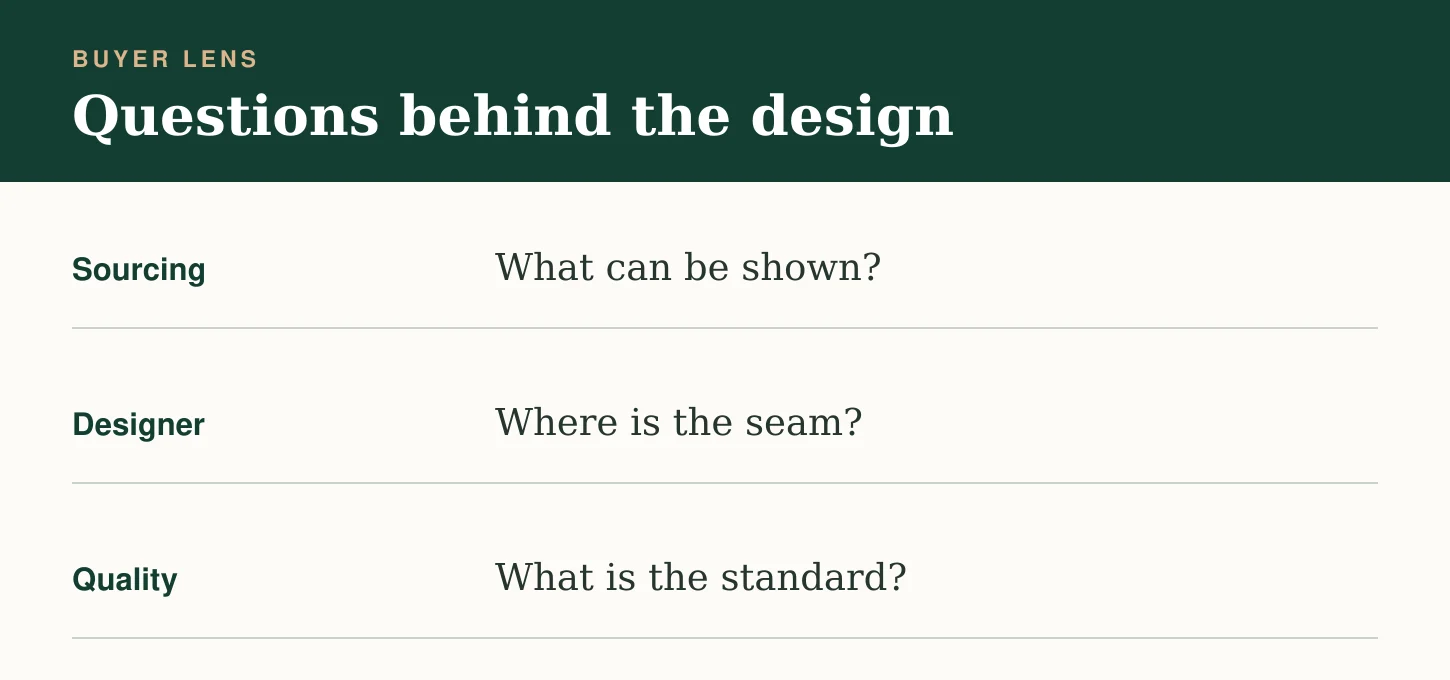
Buyer questions that should inform the approved product specification.
Bring Daye a complete brief
Daye Porcelain’s sampling and mold development page describes reviewing drawings, relief, physical samples, and approval decisions. Its custom ceramic mugs and 3D and character mugs pages show the relevance of decorative and sculptural ceramic work, while quality control addresses inspection against an approved standard. These are capability discussion routes, not a guarantee that a particular concept has already been produced.
Send the original design, target size, body and glaze preference, use case, forecast, target markets, packaging, required evidence, and proposed launch timing through Daye’s project form. Ask for a response that identifies design questions, sample stages, tooling terms, the complete quotation basis, and what would be needed to release production. That response is more useful than asking only, “What is your MOQ for bamboo mugs?”
Frequently asked questions
What should I ask a bamboo coffee mug factory first?
Describe the ceramic construction and send a drawing with dimensions, relief, capacity, finish, quantity, pack, and market. Ask the factory to identify the difficult geometry and propose a sampling path before discussing volume price.
Is a photograph enough for a factory quote?
It can start a conversation, but it does not establish exact geometry, rights, material, or pack. A reliable quotation needs the product and commercial scope. Do not ask a factory to copy a recognizable third-party design without authorization.
How do I compare two factory quotations fairly?
Give both the same drawing revision, finish, order mix, packaging, evidence requirements, and delivery basis. Separate mold and sampling charges from unit price and ask what each quote excludes.
How can a buyer check repeatability?
Inspect multiple fired samples, retain a physical reference, define accepted variation, and agree inspection points for the node relief, glaze, rim, foot, and pack. Review a pre-production or pilot set where the program warrants it.
Does Daye already sell the cup shown in this article?
The imagery is an original editorial concept. It is not presented as a Daye catalog SKU. Feasibility and any eventual product specification must be confirmed through a project-specific review and approved samples.