Table of Contents
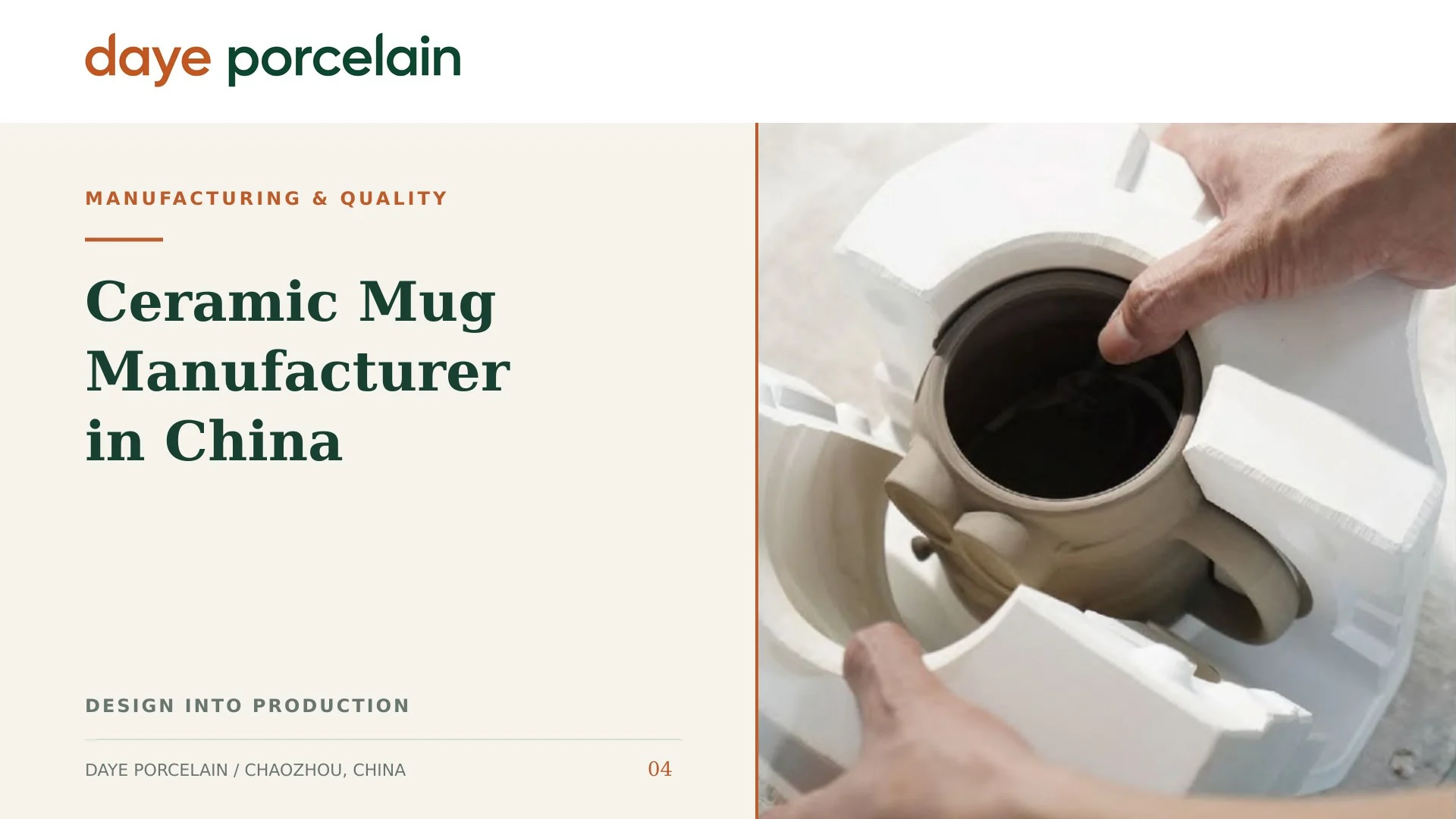
ARTICLE 04 | MANUFACTURING & QUALITY | CORE KEYWORD: ceramic mug manufacturer in China
Finding a ceramic mug manufacturer in China is easy at the level of a search result. Choosing one for an original OEM or ODM mug requires a more technical conversation: how the shape will be formed, where the handle joins, what will shrink during firing, which surface can be glazed consistently, and how a good sample becomes a stable production item. “Ceramic” is an umbrella term rather than a complete material specification. A buyer should decide whether the brief requires porcelain or another ceramic body, then approve the finished article and the route used to make it.
Daye Porcelain’s Chaozhou company introduction describes casting and rolling, installation and trimming, biscuit and glaze firing, decoration, testing and packing. Its development materials discuss samples and molds. These capabilities are relevant to a ceramic mug brief, but the production plan must be tailored to the actual silhouette and volume. This article concentrates on forming decisions and the handover from design to manufacturing, complementing a separate factory audit rather than repeating one.
Key takeaways
- Specify the body material, geometry, useful capacity, handle, surface, and tolerances before asking for a production quotation.
- Choose forming and tooling for the cup’s shape and forecast; a method that suits a simple cylinder may not suit an irregular relief or unusual opening.
- Approve fired samples from the intended process, including several pieces to show normal variation, not merely a rendering or mold drawing.
- Keep drawing, tool, glaze, artwork, inspection, and pack revisions connected so a reorder remains the same product.
Translate a visual idea into manufacturable geometry
Start with the user’s experience. A wide breakfast mug, an espresso cup, and a sculptural promotional mug place different demands on rim, capacity, handle, and weight. Draw the front, side, section, base, and handle clearance. Note the beverage’s intended useful fill, not only the brimful capacity; a café needs headroom and a retail customer needs an accurate label. Record target dimensions after firing. A proposed handle should be tested with an actual hand and hot liquid, because an elegant narrow loop on a screen can be uncomfortable in service.
Mark surfaces by function. The inner wall and lip contact a drink; the outer wall may carry a mark; the foot meets a table; the handle joint takes mechanical load. This map helps engineering identify where glaze coverage is critical, which seams or trim marks will be visible, and what test should be requested. It also prevents a decorative idea from encroaching on a drinking rim without deliberate review. A mood board can establish style, but the dimensioned drawing and physical sample establish what will be manufactured.
Ask whether the desired shape is a small modification of an existing form or truly new tooling. A standard body with custom decoration can shorten development, while an exclusive new form gives a brand more visual ownership at the cost of tool work and validation. Neither route is inherently better. Record the expected annual volume and how long the product should remain available. A one-season promotion and a core café range justify different investments in tool durability and retained references.
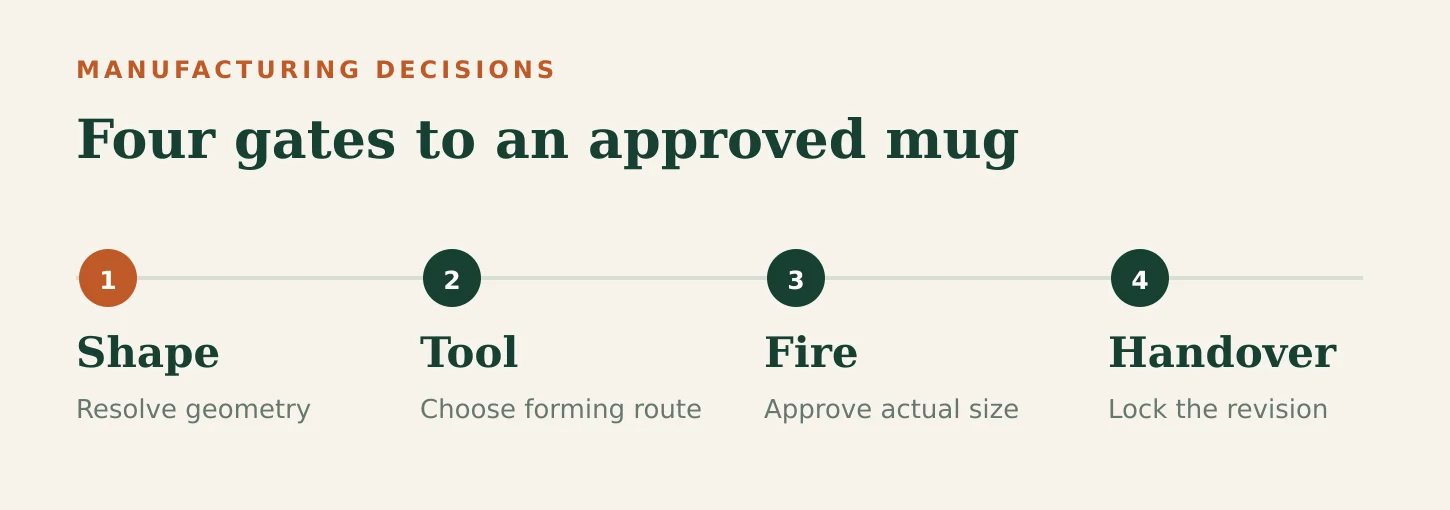
Editorial decision framework; project-specific steps should be agreed in the brief.
Select a forming method for the form, not the marketing label
Daye’s brochure lists both casting and rolling in porcelain production. A manufacturer can explain which method is appropriate for the proposed mug and where separate components are needed. For a regular rotational body, a repeatable mechanical forming route may be efficient. For a more complex or undercut shape, a casting route or revised geometry may be considered. Tooling, demolding, drying, and trimming requirements should be reviewed before a buyer promises a finished silhouette to a retailer. The exact method and its economics depend on the form, material, and planned volume.
The handle is a special design problem. It may be separately formed and joined to the body while both are in the correct condition for assembly. Its angle, top and bottom contact areas, finger space, and transition into the wall affect comfort and strength. Ask for cross sections and sample review at the joint. A photograph of the front of a mug can hide an awkward grip or thin lower connection. The handle also changes carton design because it is often the most vulnerable projection during transit.
Trimming determines many quiet signs of quality. The base should sit without rocking, the foot should be finished consistently, and the rim should feel smooth rather than sharp or thick in an unintended way. Seams should be acceptable under the chosen grade, and heavy repairs should not be disguised by glaze. Set a dimension and weight range that accounts for normal ceramic variation without giving up the visual intent. If the designer changes the wall thickness to improve strength, confirm how useful capacity and appearance change as well.
Understand shrinkage and the fired sample
A ceramic mug changes dimensions as it dries and fires. Tool dimensions are therefore an engineering input, not the finished product guarantee. Approve the fired height, diameter, capacity, handle clearance, and saucer or lid fit, measured by an agreed method. If two components must fit, sample them together across normal production variation. A beautiful prototype that only fits its matching lid once is not a repeatable retail SKU.
The body and glaze work as a system. A glaze that looks appealing on a test tile may behave differently around a handle, on a vertical wall, or inside a deep form. Compare several fired mugs in daylight-balanced conditions and under the lighting where they will sell. Agree on a permissible color and surface range. A heavily textured or matte exterior may be a deliberate style choice, yet the drinking surface and care properties need separate review. Distinguish an aesthetic finish from a functional claim.
A pilot run is the bridge from sample to quantity. It should follow the proposed production tools, forming method, firing, decoration, and pack route. Review a representative set rather than a handpicked best piece. Ask the factory to report the observed dimensional spread, rejects and main causes, and any proposed changes. If the glaze or body recipe is altered after approval, re-evaluate the sample and any dependent tests. A pilot without a documented decision can create more ambiguity than it resolves.
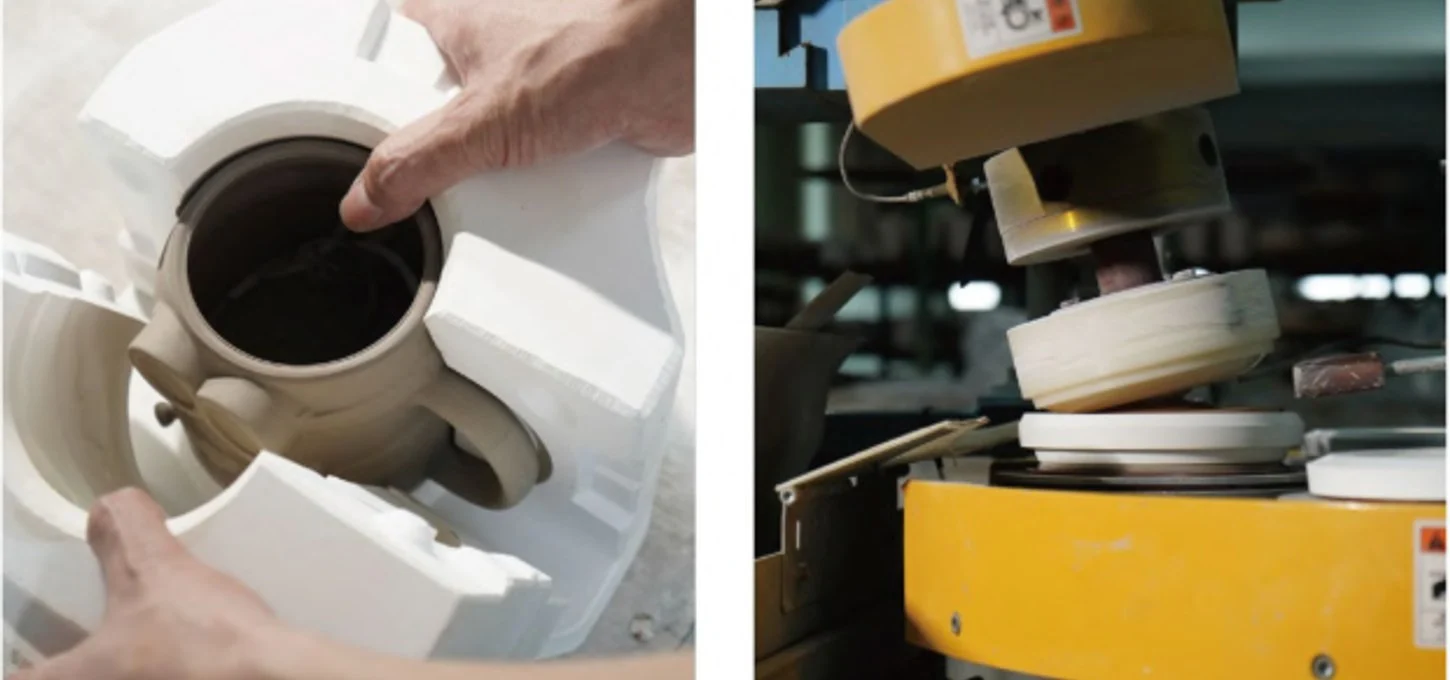
Daye Porcelain company introduction (2024), p. 19: forming processes.
Control the artwork and finishing sequence
If a brand mark is part of the product, include it before signing off the final form. A logo’s perceived size changes on a curved wall; a large handle may interrupt the best viewing angle; a decal can show different fired color than a digital proof. Give the manufacturer vector artwork, position dimensions referenced to the handle, approved colors, and rules for acceptable registration. For an intricate decoration, ask which application and firing route the factory proposes and where intermediate inspection occurs.
Daye’s brochure shows positioning, printing or engraving, hand drawing, and decal application among its available decoration processes. Treat these as options to review, not interchangeable finishes with identical durability or cost. The right method depends on artwork, surface, quantity, intended care, and whether it affects a food-contact area. Approve a finished physical sample and perform use testing consistent with the marketing claims. “High temperature fired” alone does not tell a buyer whether a dishwasher claim is justified for the decorated SKU.
Decoration also affects tooling and scheduling. A mark may require registration fixtures, color separation, a separate firing, or an added inspection step. These are not hidden inefficiencies; they are part of making the design repeatable. Ask that the quote show the decorated and packed unit separately from any undecorated blank price. A fair comparison across manufacturers should include the same visible brand treatment.
|
Development decision |
What to approve |
Frequent handover error |
|---|---|---|
|
Body and tool |
Fired dimensions, capacity, rim, foot and handle |
Approving only a CAD drawing |
|
Glaze and finish |
Fired range on whole mug, care expectations |
Treating a small color tile as final |
|
Decoration |
Finished position, color, method and durability |
Using screen artwork as production proof |
|
Pack and reorder |
Insert, carton, retained master and revision |
Reordering by photo or old quotation |
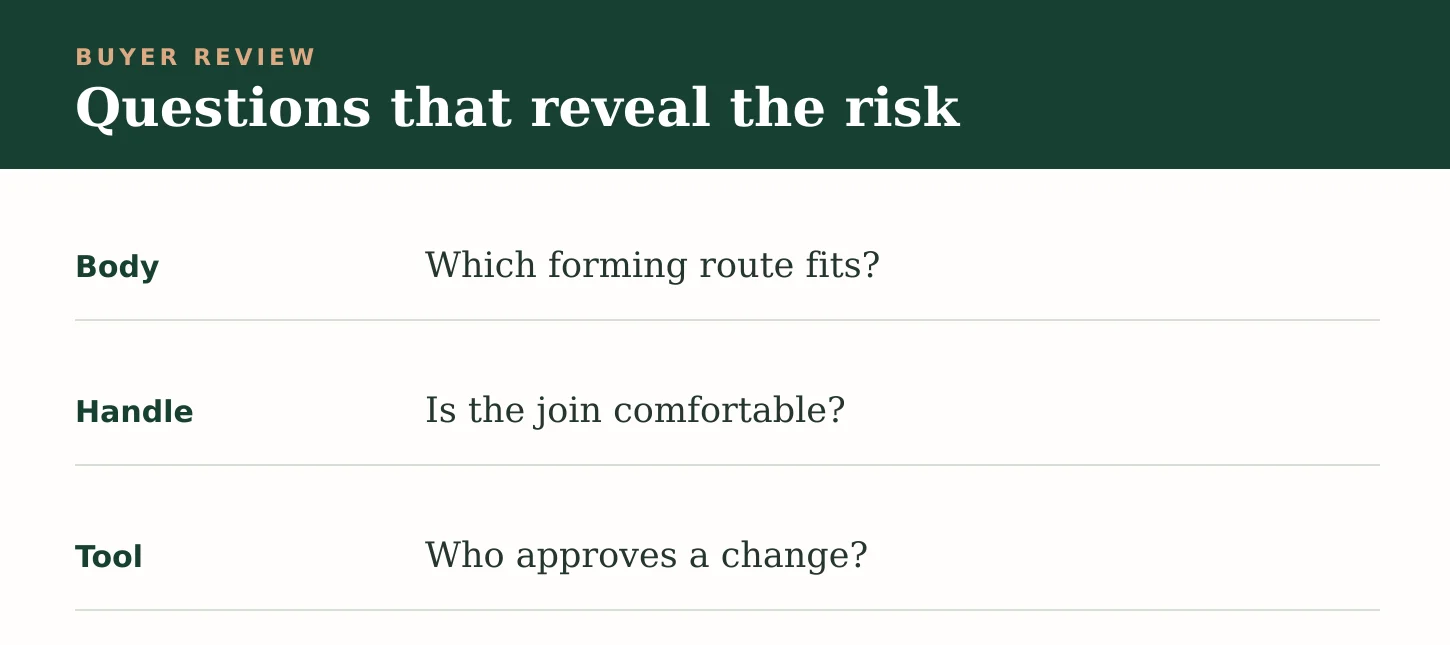
Questions to discuss when approving this particular product or partnership.
Build a release packet the factory and buyer can both use
The final packet should include a controlled drawing, body and glaze description, signed fired masters, decoration files and placement, tolerance and defect guide, test requirements, pack specification, carton markings, and purchase-order revision. Record mold ownership and storage terms when a new form is commissioned. Each document should carry the same SKU and version. The quality inspector should be able to identify the approved cup without asking the designer which of several samples “looks right.”
Choose testing from the intended use. Daye’s 2024 material lists body and handle strength, thermal shock, water absorption, dishwasher, microwave, surface abrasion, and packed transit among possible physical tests. Those tests are project-dependent. A retail mug with a sensitive exterior finish may need abrasion and care assessment, while a café cup with frequent washing might place more weight on handling and repeatability. Food-contact testing for Europe or the United States should cover the finished materials and relevant market requirements. Keep the laboratory report tied to the approved revision.
Agree on production change control. If a new mold, pigment, glaze supplier, decoration route, or packing insert is proposed after a successful launch, ask how it will be validated and approved. The commercial team may see a minor substitution; the quality team may see a change affecting performance. A defined change notice, physical comparison, and targeted re-test keep both views aligned. This is especially valuable for a distributor that sells the same collection for several seasons.
Why Chaozhou manufacturing still needs a precise brief
A ceramic mug manufacturer in Chaozhou may offer deep experience and access to production infrastructure, but geography alone does not solve a design problem. Daye’s prototyping and mold development, design development, and custom mug resources can be used to start a specific conversation about an OEM or ODM range. Share drawings, destination, forecast, and intended care claims; request the proposed route, prototype milestones, pilot criteria, and pack plan.
For an importer, the best outcome is a cup that can be described accurately, sampled physically, tested for its market, and reproduced. A ceramic mug manufacturer in China earns confidence by explaining tradeoffs early and controlling the handover from form to fired product. A strong brief lets the supplier do useful engineering rather than guess which compromises the brand would accept.
FAQ
Is porcelain a ceramic material?
Yes. “Ceramic mug” is a broad search term, while porcelain refers to a more specific ceramic body category. Specify the desired material and performance rather than assuming every supplier uses the same interpretation of “ceramic.”
Is casting always better than rolling for a custom mug?
No. The shape, forecast, wall design, tooling, finish, and desired repeatability determine the route. Ask the manufacturer to show how the proposed method handles the exact geometry and inspect fired pilot samples.
How should I approve a handle?
Check finger space, balance with hot liquid, comfort, join areas, and normal production variation. Define visual alignment and any relevant strength test. A side-view photo alone is insufficient.
When can I get a reliable unit price?
After the form, body, glaze, decoration, quantity, test scope, and pack are defined. A preliminary range can guide concept work, but it should not be compared with a fully specified production quotation.
What should be kept for a reorder?
Retain the approved physical mug, drawing and artwork revision, tool identification, fired color range, inspection criteria, test records, and pack master. Require approval for any material process change before repeating the order.
References
- Daye Porcelain, Introduction of Daye Porcelain (2024), pp. 17–23, 26–27, 34.
- Daye Porcelain: Prototyping and Mold Development.
- Daye Porcelain: Design and Development.
- EUR-Lex: Ceramic objects in contact with foodstuffs.