

Table of Contents

ARTICLE 05 | MANUFACTURING & QUALITY | CORE KEYWORD: porcelain mug manufacturer in China
A porcelain mug manufacturer in China should be evaluated on the finished fired cup, not only on a white-body catalogue image. A brand may choose porcelain for a clean, refined appearance and a consistent coffee-service collection, yet the final experience depends on body and glaze compatibility, wall profile, rim, handle, decoration, and the way normal firing variation is managed. This guide addresses those porcelain-specific decisions and the records needed to repeat an approved mug across orders. It is intended for coffee brands, retail buyers, importers, and distributors planning OEM or ODM production.
Daye Porcelain’s 2024 company introduction documents porcelain production, glazing and firing, decoration, inspection, and in-house physical testing. Club House, an Italian coffee-porcelain company, also identifies Guangdong Daye Porcelain as its historical production partner in its own company history. Those sources establish relevant experience, but they do not remove the need to approve your exact material, finish, and tests. A white espresso cup, a colored café range, and a tall retail mug can require different acceptance limits even when all are called porcelain.
Key takeaways
- Approve porcelain as a complete fired system: body, glaze, decoration, form, and intended use.
- Evaluate several production-route samples for rim, foot, handle, glaze coverage, color, and capacity rather than judging a single hero image.
- Tie food-contact and care evidence to the finished SKU and destination market; a test for another mug is not automatically transferable.
- Retain physical masters and control process changes to make future batches match the approved collection.
Define what the porcelain cup must do
Begin with the service or retail scenario. For a roaster, the drink size, saucer fit, stacked storage, repeated washing, and logo visibility may matter most. For a homeware brand, shelf appearance, tactile surface, gift packaging, and matching colors may be central. Write the useful fill and brimful capacity separately. Specify fired dimensions, weight range, rim profile, base contact, handle clearance, and any intended stackability. These are not decorative details; they determine whether a cup works in the user’s hand and on the customer’s table.
Avoid vague material language in the contract. State the agreed porcelain body and glaze description, the finishes and decoration, and the approved physical reference. “Fine porcelain” or “premium porcelain” can communicate a direction, but neither is a measurable production specification. If the program needs a particular white tone or translucency, define an agreed visual or measured range on fired pieces. A brand selling a family of sizes should also compare the range together so one cup does not look unexpectedly gray or glossy next to another.
The manufacturer should disclose how the design will be formed and fired. Daye’s brochure lists casting and rolling, biscuit firing, glazing and glaze firing. The actual route varies by shape. Ask how fired shrinkage is accounted for, where the cup is inspected before decoration, and how the glaze is applied consistently inside and outside. An attractive body before glazing does not show the final rim, surface, color, or fit.
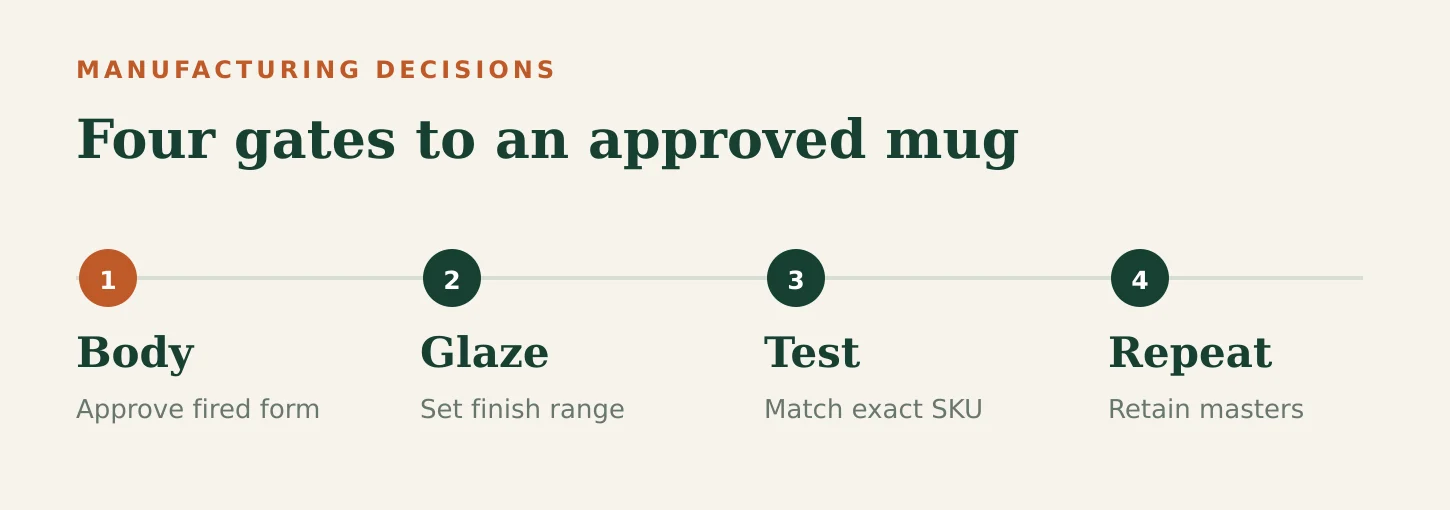
Editorial decision framework; project-specific steps should be agreed in the brief.
Judge the fired white body before adding a logo
White porcelain makes small deviations visible. Check the symmetry of the opening, finish at the foot, contact line on a flat surface, handle alignment, and evenness of glaze coverage. The drinking rim deserves separate attention: it should be comfortable, cleanly finished, and consistent around the circumference. Examine the interior in good light for visible surface defects and review whether the chosen grade permits any variation there. Defects near the lip or food-contact area cannot be excused by an attractive exterior photograph.
Ask to see several fired pieces from the intended tool and kiln route, including the normal range rather than only the best example. One piece cannot define variation. Set objective ranges for height, diameter, useful capacity and weight, then use retained physical samples for visual criteria that are hard to describe in words. For a white range, viewing under one consistent light source helps prevent a subjective dispute about warmth or bluish cast. For colored glazes, approve the range across different parts of the mug because a color may appear deeper where glaze gathers.
The foot is easily overlooked but affects both use and display. A mug that rocks can frustrate a café even if the side view looks perfect; a rough unfinished base can mark a table. Check the approved contact surface and foot finish, including when a cup sits on its saucer. If a lid is involved, test several cup-lid pairs rather than assuming the single photographed pair represents production. Porcelain’s fired dimensional variation should be engineered into the fit.
Control glaze and color across a collection
A colored porcelain collection often needs more than a single glaze chip. Ask for a whole-cup reference showing the exterior, interior, handle, and rim. State whether a natural shade shift or subtle variation is part of the design. If the brand wants a highly uniform color, the factory should say what it can reliably hold at the intended quantity. Reject examples should show where variation becomes unacceptable. A matte finish may change tactile and care expectations; a glossy finish may reveal pinholes or uneven application more clearly. Neither should be sold with unsupported care claims.
Build a color approval method for repeat orders. Keep an approved low, middle, and high sample where appropriate, record lighting and review distance, and identify who may release a borderline batch. A color code alone does not capture the interaction of body, glaze thickness, and firing. If a supplier proposes a new glaze source or firing profile, request a physical comparison and targeted tests before substituting it in a reorder. Small process changes can produce visible differences on a white or tightly curated range.
Daye’s brochure describes inspection of the white body before decoration. That creates a sensible control point: remove unacceptable fired cups before spending on marks or second firings. Confirm which defects are screened and how the result is recorded. The buyer should then inspect the finished decorated item separately, because a sound body can still fail logo alignment or color requirements.
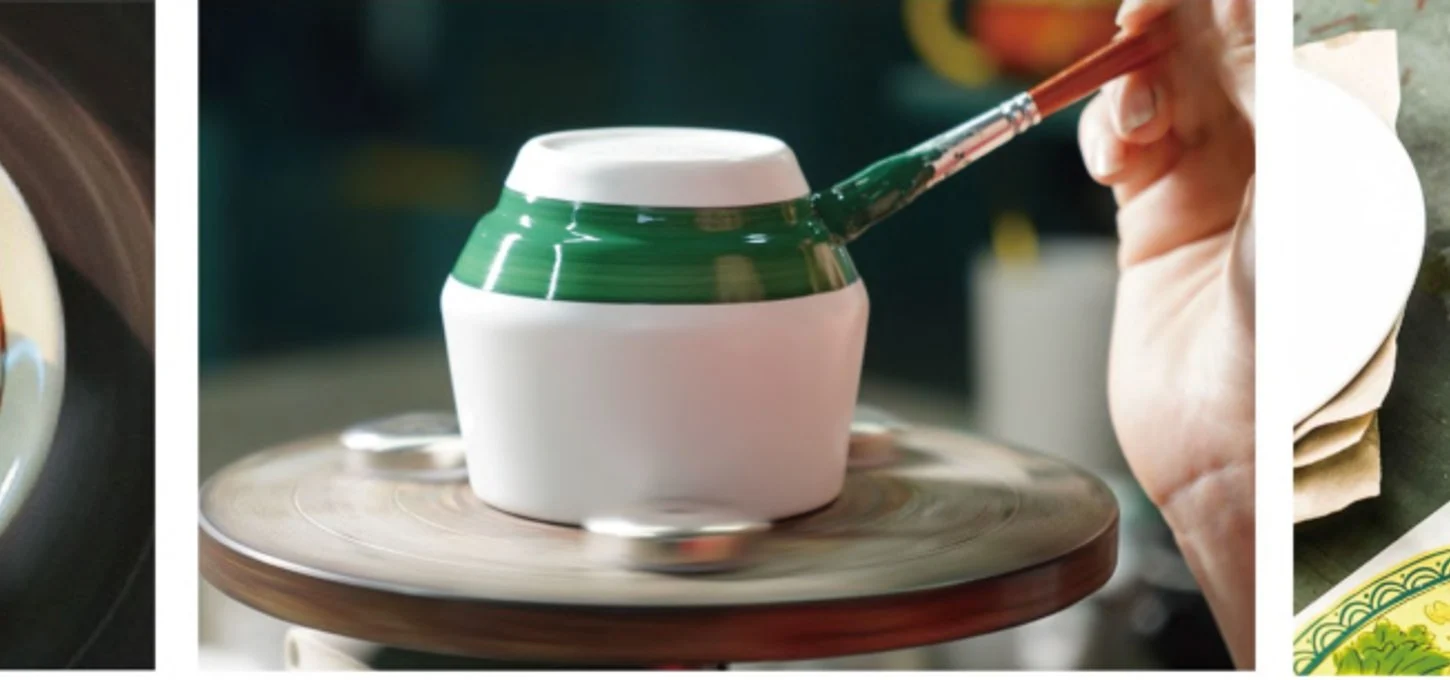
Daye Porcelain company introduction (2024), p. 22: hand decoration.
Choose decoration with use and evidence in mind
The branded porcelain cup may carry a decal, print, line, or other finish. Decide whether the mark is meant for a static retail display or daily café service. Place artwork on a real fired form; curvature and handle position change how it looks. Agree on logo size, orientation, acceptable registration, and whether decoration reaches the rim or any food-contact surface. Daye’s 2024 introduction shows positioning, printing or engraving, hand decoration, decal application, and decal inspection, but the actual method for a program must be specified.
Ask what additional firing or inspection the chosen decoration requires. A well-fired cup is not automatically a durable printed cup. If the customer expects frequent dishwashing, obtain an appropriate product-specific evaluation of the finished mark. If a specialty effect is proposed, discuss abrasion, staining, and care language before packaging is printed. A brand should describe what the test supports rather than assuming all decorated porcelain behaves the same way.
The product range may also include a saucer. Approve cup-saucer fit, contact points, movement during carrying, and how the logo appears in service. A saucer design can look coherent as a pair yet allow the cup to slide or rattle in the carton. Both components should be evaluated together in the intended pack and normal handling routine.
|
Finished-cup attribute |
Approval evidence |
Reorder risk if omitted |
|---|---|---|
|
Fired form and capacity |
Sample set, drawing and measurement method |
Cup size drifts after a tool change |
|
White or colored finish |
Whole-cup range samples and defect guide |
Shade or gloss shifts between seasons |
|
Logo and decoration |
Fired decorated master, artwork revision |
Position or color changes silently |
|
Use and transport |
SKU-matched tests and packed pilot |
Care claim or shipment damage dispute |
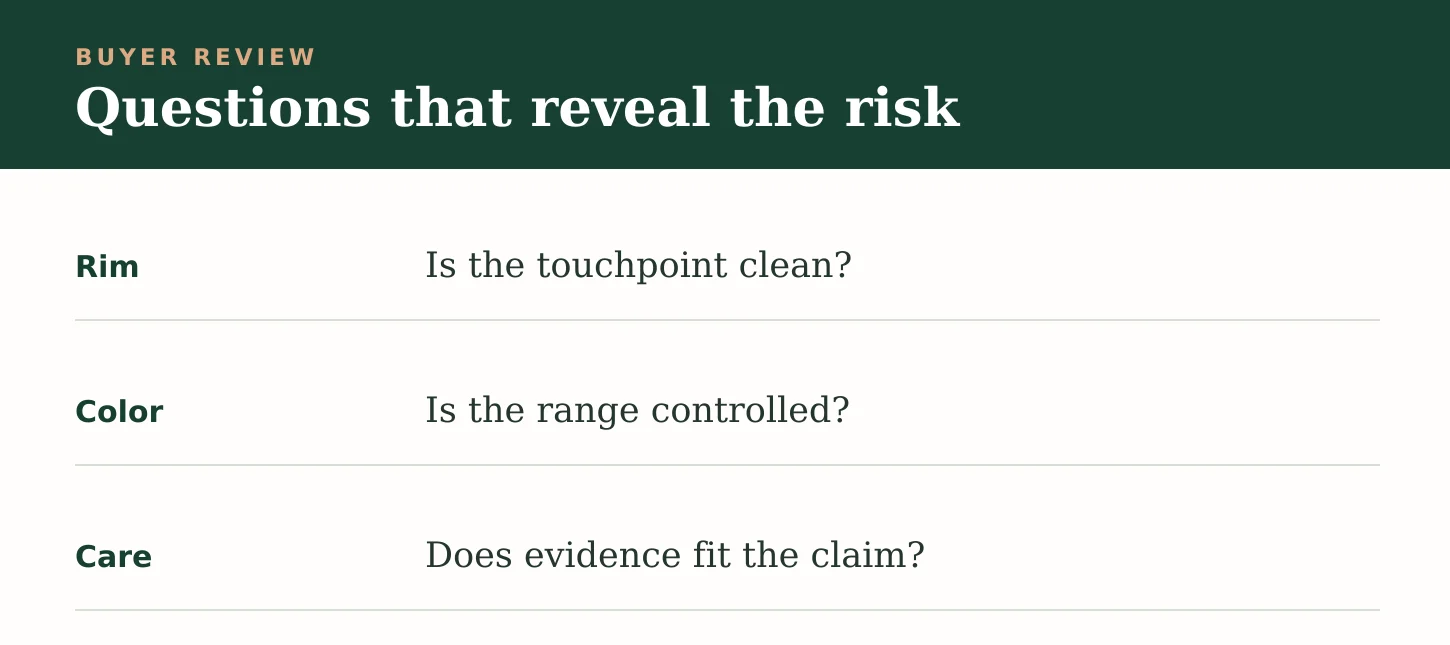
Questions to discuss when approving this particular product or partnership.
Make a test plan for the exact market
Porcelain intended for food use must be evaluated under the applicable destination-market requirements. EU ceramic rules address release of lead and cadmium from ceramic articles intended to contact food; US FDA guidance addresses extractable metals in ceramicware. The buyer should agree with a qualified laboratory on the current requirements, samples, surfaces, and report language for the actual finished cup. “Food safe” is a claim to support with documentation, not a conclusion from the word porcelain or a photograph of a certificate.
Physical tests should follow the intended use. Daye describes laboratory capabilities including dishwasher and microwave checks, thermal shock, water absorption, body and handle strength, abrasion, and packed-product transit. Select the relevant tests and acceptance criteria before asking for a report. A café service cup may prioritize repeated care and handle performance. A retail mug in an elaborate gift pack may need both finish review and transport testing. Test results need the sample identity, revision, date, method, and outcome; another product’s passing report should not be presented as this SKU’s evidence.
Testing does not replace production inspection. A few laboratory samples may pass while a shipment has crooked marks or chips caused by packing. Agree on incoming, in-process, final, and pre-shipment checks as appropriate. Define critical, major, and minor defects, the sampling plan, and the decision path for failures. The aim is to connect a safe and attractive approved design to the actual goods received by the distributor.
Plan for long-term repeatability
For a coffee company, reordering the same cup may matter more than launching many seasonal styles. Record the body, glaze, decoration, tool identifier, fired master, acceptable range, carton design, and test file under one SKU revision. Retain more than one approved piece if different teams or sites need a reference. Photograph the references for communication but rely on physical samples when judging surface, color, and rim feel. Specify how long tools and master samples will be stored and who owns them.
Discuss what will trigger reapproval: a new mold, body formulation, glaze ingredient, decal supplier, firing route, or packing insert. Not every change needs a complete restart, but each should be assessed against the characteristics it can affect. A revised carton may require transit validation; a revised decoration may affect care or food-contact testing. This change control protects the buyer’s retail promise and the factory’s ability to show it followed an agreed process.
A porcelain mug manufacturer in Chaozhou can support a long-running collection when it treats the cup as a controlled product rather than an interchangeable generic blank. Daye’s quality control, coffee cups and saucers, and start a project resources provide an entry point. Bring the intended design, use, destination and forecast, then ask for a proposed sample-to-production plan with explicit test and reorder gates.
FAQ
Is every white porcelain mug the same material and quality?
No. Body, glaze, form, firing route, finish standard, and use testing can vary. Compare the exact fired products against the same specification and evidence requirements.
Why approve multiple samples rather than one?
Ceramic processes have normal variation. A set shows whether dimensions, color, handle position, and decoration can remain within a range the brand accepts. A single ideal sample hides that information.
Can a previous food-contact report cover a new printed logo?
Do not assume so. The decoration, its placement, and any material changes may affect the applicable assessment. Ask a qualified laboratory to define the required scope for the finished new SKU and destination.
What makes a colored porcelain reorder consistent?
Retained whole-cup range samples, controlled material and process inputs, a shared inspection guide, and approval of significant changes. A digital color number by itself cannot capture the fired surface.
Is Club House proof of all Daye cup performance claims?
No. Club House’s published history corroborates a production partnership and an audit milestone. It does not certify every Daye mug or provide a test result for a new buyer’s specific design.
References
- Daye Porcelain, Introduction of Daye Porcelain (2024), pp. 17–23, 26–27, 47.
- Club House: Company and history.
- EUR-Lex: Ceramic objects in contact with foodstuffs.
- US FDA: Pottery (Ceramics) Lead Contamination.