Table of Contents
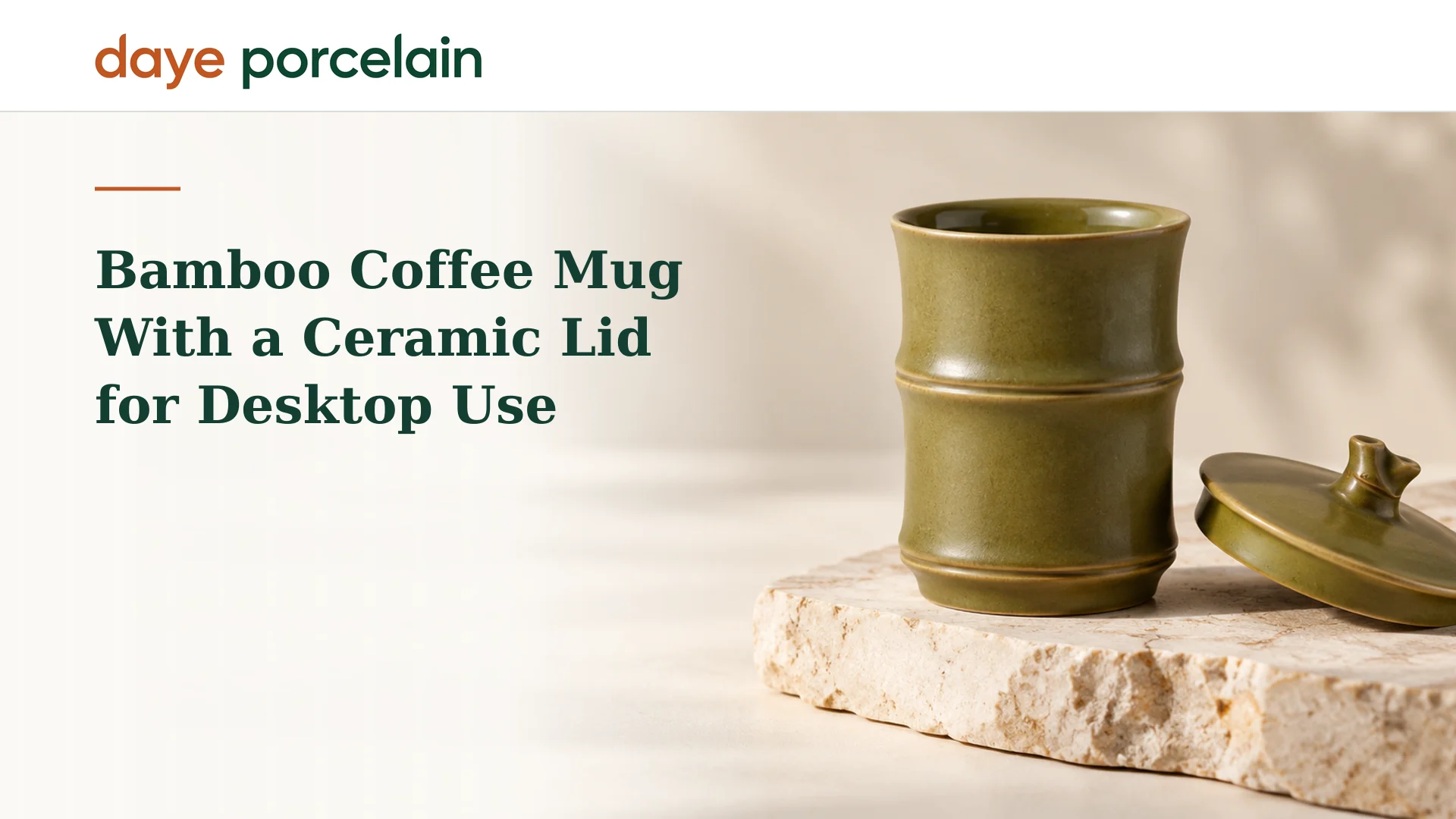
A bamboo coffee mug with lid can be designed as a coordinated ceramic object: a stalk-inspired cup and a removable ceramic cover that looks at home on a desk or table. The bamboo element is the sculpted form of the cup. Both the drinking vessel and the proposed cover are ceramic. A lid may help shield a drink from dust or slow cooling during a pause, but a loose ceramic cover does not make the cup spillproof, insulated, or suitable for carrying in a bag.
For a brand, the lid changes the development brief. It adds another formed and fired part, a fit relationship, an extra edge that may chip, and a second piece to protect in the box. This article focuses on that component decision. For the underlying original form, see Daye’s design development approach; here the practical question is whether a lid improves the intended home, office, or gift experience enough to justify the added complexity.
Key takeaways
- Define what the lid should do and where the mug will be used before choosing its profile.
- Prototype the fired cup and ceramic lid as a pair, including fit after normal production variation.
- Keep the drinking rim comfortable when the cover is removed, and provide a clean place to rest it.
- Describe a covered desktop mug honestly; closure, heat retention, and care claims need product-specific evidence.
Decide what the cover is meant to do
A buyer may ask for a lid because the cup appears more giftable, because the drink is left on a desk, or because a collection needs a distinctive finishing detail. Those are different goals. Write a one-sentence use case before sketching: “A customer drinks coffee at a stationary desk and places a ceramic cover on the cup between sips.” That sentence gives a designer a better starting point than “make a bamboo travel mug.” The intended use determines fit, handle choice, capacity, and copy.
A decorative cover can complete a bamboo-stalk silhouette. A shallow dome could suggest a new shoot; a flatter disk might look architectural. The design should remain an original interpretation, rather than copying the exact join, knob, and proportion of a named product. The cup must also stand alone visually. Most users will leave the cover on the table while drinking, so a cup that only looks finished with its lid in place will disappoint in normal use.
Consider whether the lid needs to cover the entire drinking opening or simply act as a removable rest cover. If the brand wants a sipping aperture, the object enters a different product system: position of the opening, lip clearance, cleaning, and potential splash behavior all need review. A fitted component still may not prevent leakage when tilted. Avoid using “travel” in the item name unless the complete construction and intended handling support that claim.
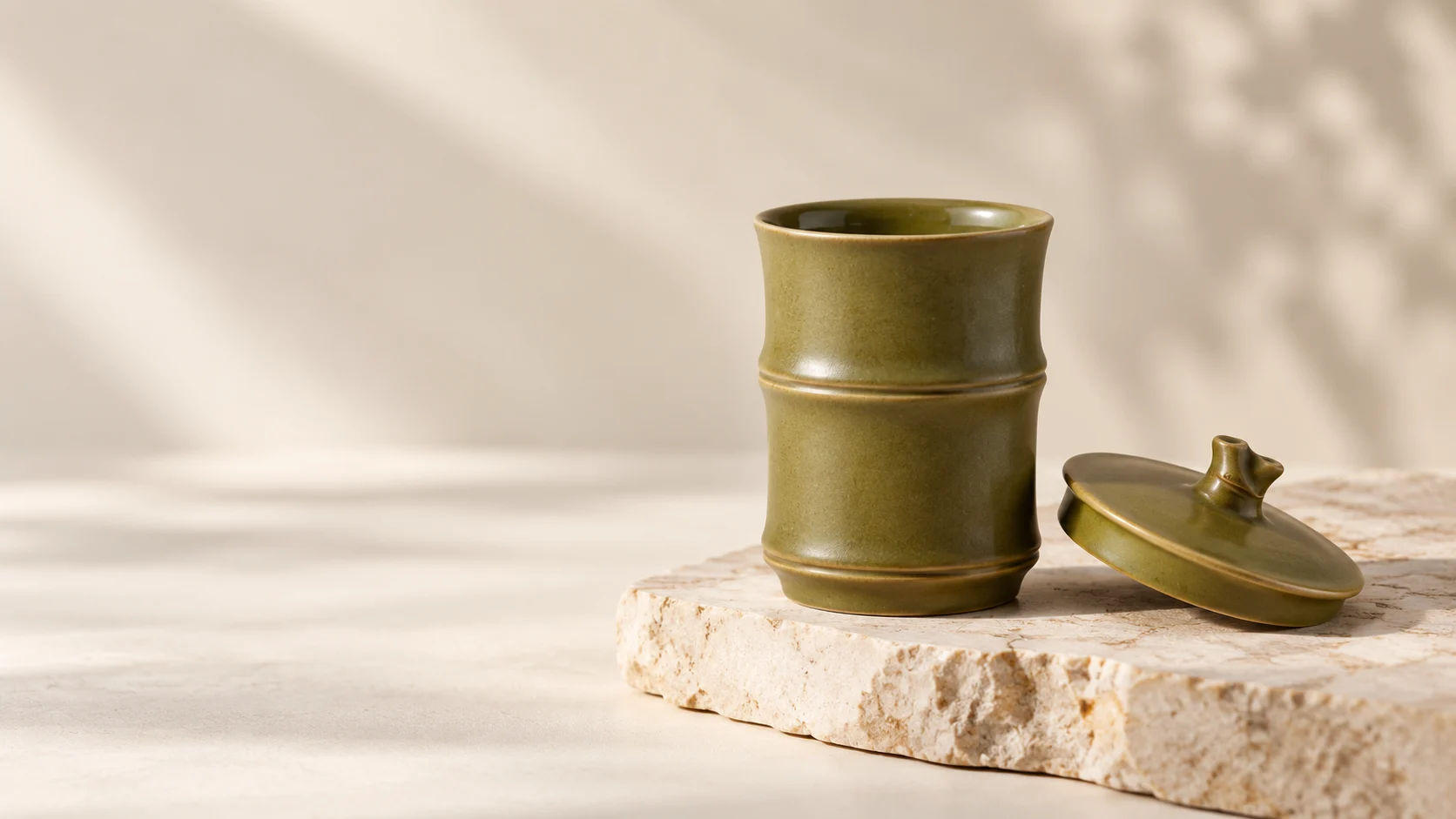
Editorial ceramic cup and lid concept; actual fit and use require physical samples.
Compare ceramic lid architectures
|
Cover approach |
What the customer experiences |
Development checks |
|---|---|---|
|
Shallow over-rim cover |
A clean silhouette and easy removal for stationary use |
Rim clearance, rocking, grip point, and protection of the lip |
|
Recessed ceramic locating ring |
A more defined seating position on the cup |
Fired dimensional variation, rubbing points, cleanability, and removal effort |
|
Reversible cover or coaster concept |
A place to rest the lid while drinking |
Stable orientation in both uses, surface contact, glazing, and pack configuration |
None of these forms guarantees a seal. A recessed ring may feel secure when the cup stands upright but still loosen if the mug is carried or tipped. An over-rim cover may be attractive and simple to lift, yet a wide overhang can be vulnerable in transit. The reversible idea is useful only if the underside is designed and finished for its second function. Ask the product team to show the exact intended motions in a sample demonstration rather than relying on a rendering.
The grip point should be easy to find without making the lid look like a novelty accessory. A small raised ceramic node can suit the bamboo language; an extremely thin stem can be fragile. Review a user lifting the cover with dry and slightly damp fingers. If the cup is hot, does the hand need to touch the hot wall to remove the cover? If the lid has a very small grip, does it slip during repeated service? These are prototype questions, not properties implied by ceramic as a material.
Protect the drinking experience
Start with the open cup. A smooth, continuous rim and useful fill should be approved before a cover is added. The lid must not force a thick rolled edge that makes drinking awkward. Test the mug with the size of coffee or tea it is meant to hold, leaving space below the brim for normal movement. An ornate sculptural exterior can make a compelling image, but the inside of the cup should remain easy to see and clean.
If the design is handleless, assess hot handling with the cover on and off. The raised bamboo nodes may give fingers a place to rest, but they do not provide a tested thermal barrier. A smaller serving may be a better fit for a handleless desk cup than a large, very hot drink. If a handle is required, its form should relate to the cup’s node rhythm and leave room for the cover to be removed. Test the finished glazed sample with actual hot liquid.
The lid should have somewhere to go. It may be set upside down on a clean table, placed on a matching saucer, or designed to act as its own rest. Each option affects the underside glaze, the shape of the grip point, and the sales pack. A photograph showing the cover elegantly balanced may conceal the everyday question of what the user does with a damp lid between sips. Include this small sequence in the approval trial.
Develop fit on fired samples
Ceramic changes size during firing. A nominal CAD fit is a starting point, not a release standard. Ask for multiple fired cups and lids from the intended process and try the parts across the set, not only in pairs selected by a photographer. The cover should seat without scraping a sharp edge, rocking excessively, or becoming difficult to lift. Define what acceptable movement feels like, especially if a locating ring is used.
Measure the critical diameters, but do not reduce fit approval to a single number. A lid can meet a dimension and still sit visibly off-center if the cup rim has changed shape. A sculpted bamboo body may include a seam or finishing point near the top; inspect whether it interferes with the cover. A glaze that pools on the ring can change fit after the shape sample was approved. Review the cup and cover in their actual final finishes.
Make a simple pass-and-fail board. It could show the approved seating gap, acceptable wobble, and unacceptable chips or sharp contact points. Retain the final pair as an inspection reference and note its drawing and glaze revisions. A different cup size needs its own lid fit review; a lid from the small size should not silently become a replacement for the larger one. Keep component item codes separate even if the retail box is sold as one SKU.
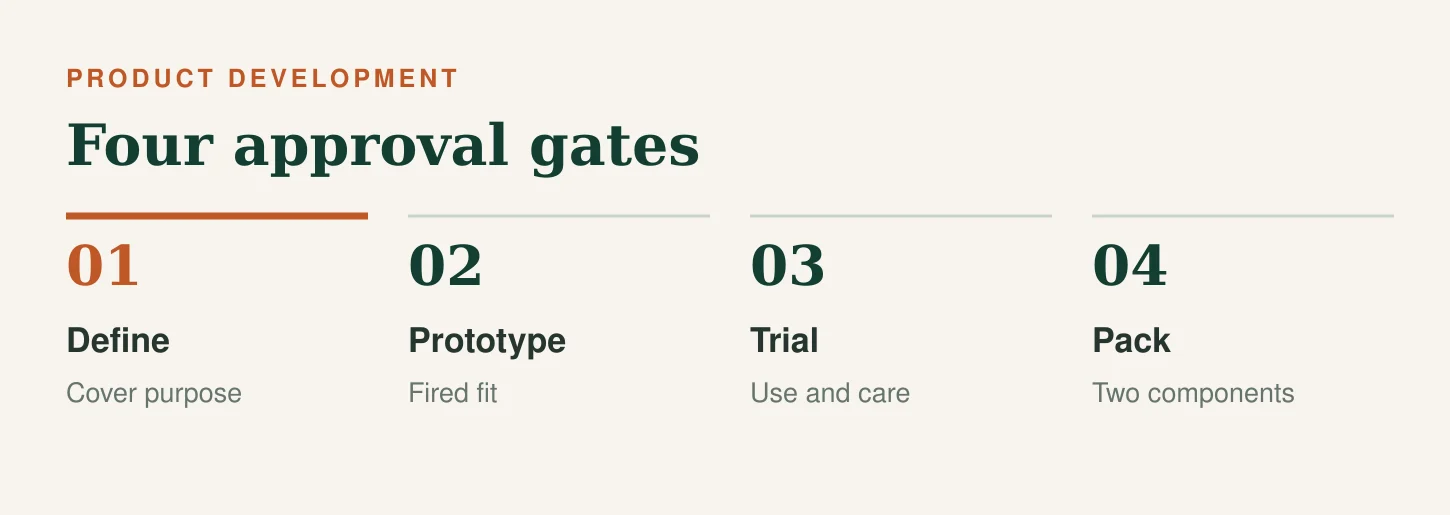
Approval gates for this product brief; the final steps depend on the project.
Design the glaze and decoration as one set
A bamboo-inspired cup often uses a green or ivory glaze that reveals the raised nodes. Apply the lid finish to a real fired sample and review the pair in daylight and under intended retail lighting. A flat color file will not predict whether the lid appears lighter because it lies horizontally, nor whether glaze collects in a recessed locating ring. If the cup and lid use different colors, make the contrast intentional and photograph the exact approved combination.
The underside of the cover may be visible while it rests on the table. Decide whether it is glazed, how any unglazed contact areas are finished, and what surface it is expected to touch. Decoration near the cup rim or the cover’s seating edge deserves special review for wear and food-contact considerations. A logo can be placed discreetly on the foot or box if a large exterior print would interrupt the sculptural stalk. Avoid a method claim such as “hand-painted” unless it reflects the actual approved production route.
Care copy must follow the final combination. If the mug and lid have different decorative finishes, the printed care statement needs to be true for both parts. Do not infer dishwasher or microwave suitability from the fact that a plain ceramic sample handled those uses. The specific body, glaze, decoration, and component form should be considered together.
Pack two fragile components
A lidded bamboo coffee mug has at least two contact surfaces to protect: the cup and the cover. The lid knob, lip, and any locating ring can strike the cup during transport if both are put in a loose box. Design the insert around the fired dimensions, including the widest bamboo nodes, and decide whether the cover travels seated on the cup or in a separate cavity. Then test the packed configuration for the proposed distribution route.
A retail gift box may show the lid on the mug through a window, but an open display can expose a delicate cover edge. A closed box with a clear photo may travel more safely. For wholesale, specify inner pack, master carton counts, gross weight, orientation, and a way to identify spare lids. If customers can order a replacement component, the glaze batch and fit need a practical matching policy. A distributor should know whether a broken lid requires replacing the entire gift set.
The number of parts should be clear on the product page. Show the open cup, the cover from above, the lid resting beside the mug, and the underside or locating detail. State useful capacity for the cup, dimensions for the complete assembly, and any limitations on portability. A polished lifestyle image cannot replace these factual images for a buyer deciding how to list the SKU.
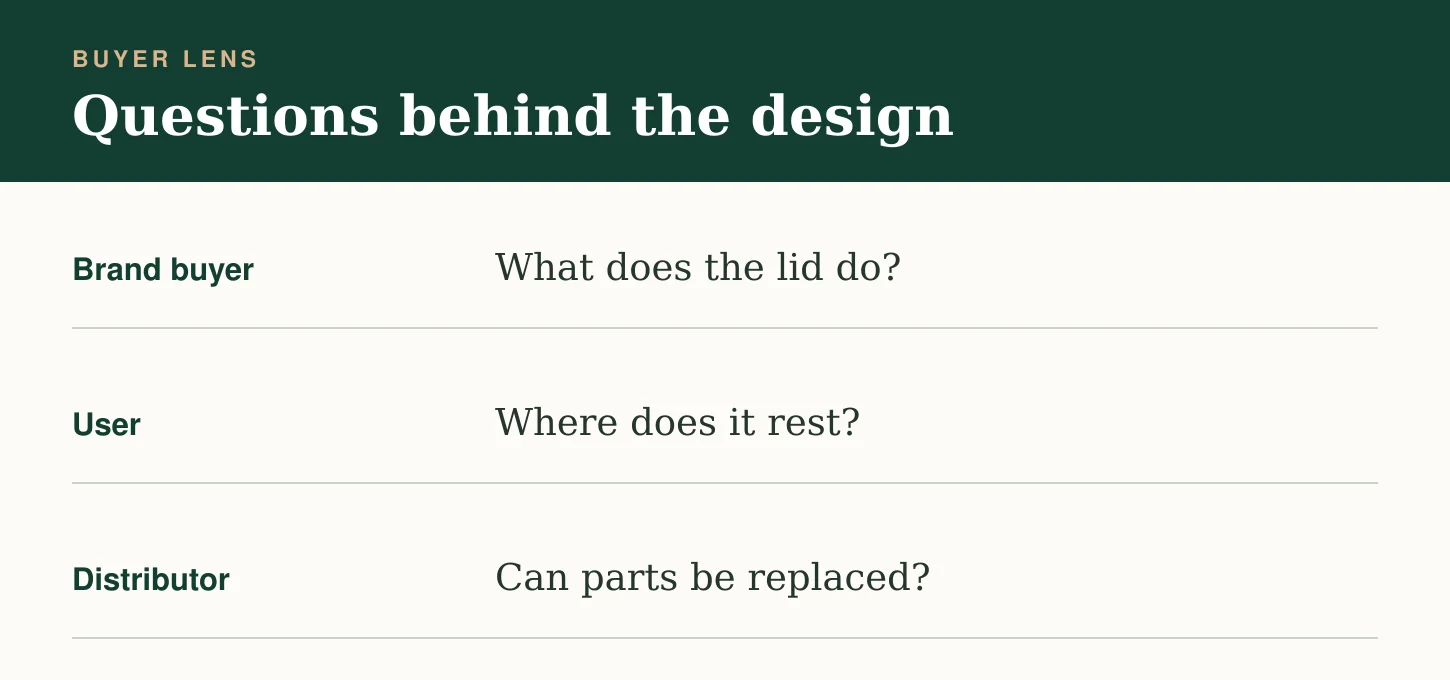
Buyer questions that should inform the approved product specification.
Verify the finished item for each market
A ceramic drinking cup is food-contact ware. US FDA information addresses extractable lead and cadmium in ceramicware; EU rules for ceramic articles address migration and documentation. The specific finish and intended markets should guide the supplier’s evidence. If the lid can touch liquid, the mouth area, or a surface used for food, include those contacts in the technical review. A botanical appearance says nothing about compliance.
Any performance statement about keeping a drink warm needs an appropriate test method and a defined condition. In ordinary descriptive copy, “removable ceramic cover” is clear and useful. “Leakproof” and “insulated” are stronger claims requiring a suitable construction and substantiation. The same is true of “dishwasher safe” or “microwave safe.” Separate the emotional value of the design from factual performance claims before printing cartons.
Send a focused OEM brief
Include the cup drawing, target useful fill, rim and base dimensions, bamboo relief details, lid purpose, preferred architecture, glaze reference, logo position, target market, pack format, initial quantity, expected reorder, and launch date. Ask which dimensions are critical to the fit and whether the lid and body require separate tooling. Request a quotation for a finished boxed pair, with component and sample charges identified.
Daye Porcelain describes custom ceramic mugs and sampling and mold development for product-specific briefs. Its special-structure cups page emphasizes evaluating a proposed construction through samples and testing. Those pages offer a path for discussing an original lidded concept; they do not establish that the pictured design is a stock product or that a given lid will seal. Submit the drawing and intended use through the project form for a project-specific review.
Frequently asked questions
Is a bamboo coffee mug with lid made of bamboo?
In this article, no. The cup and proposed cover are ceramic. “Bamboo” refers to the sculpted node-like shape. The product listing should name the actual body and glaze and show every part included in the box.
Will a ceramic lid make the mug spillproof?
No such conclusion follows from the presence of a lid. A loose or locating ceramic cover may suit stationary desktop use, but movement, tipping, and impact are different conditions. Do not use a spillproof or travel claim without a designed and verified closure system.
Should the lid have a hole for drinking?
Only if that serves a defined use case. A sipping opening changes lip access, cleaning, and splash behavior. For a removable desktop cover, a closed top may be simpler. Prototype and test the finished design before choosing either route.
Can lids and cups be reordered separately?
They can be planned as separate components, but the maker needs a fit, glaze matching, stock, and replacement policy. Decide this during product setup and assign component codes; do not promise universal interchangeability from a single sample pair.
What should a buyer approve before production?
Approve a group of fired cup-and-lid samples for seating, removal, rim comfort, hot handling, appearance, care evidence, and final pack fit. Keep an agreed physical reference and revision record for later inspection and repeat orders.