Table of Contents
ARTICLE 03 | MANUFACTURING & QUALITY | CORE KEYWORD: best coffee mug factory in Chaozhou
The search for the best coffee mug factory in Chaozhou is understandable, but there is no credible universal ranking for every cup, buyer, quantity, and market. A factory that is an excellent fit for a high-volume white espresso cup might not be the right choice for a sculptural gift mug with a difficult glaze. “Best” becomes a useful sourcing question only when the buyer defines the design, performance, service level, and evidence needed for that particular order. This guide offers a structured comparison for brands, coffee companies, importers, and distributors evaluating Chaozhou manufacturers.
Daye Porcelain is based in Chaozhou, Guangdong, and its 2024 introduction documents forming and firing equipment, decoration processes, an in-house laboratory, OEM/ODM development, and a partnership with Italian coffee-porcelain company Club House. These are relevant facts to investigate, not proof that Daye is number one against unnamed competitors. The right comparison uses the same brief, similar physical samples, current records, and a consistent landed-cost basis for every shortlisted supplier.
Key takeaways
- Define “best” against your cup and channel: shape, finish, order scale, performance, development support, documentation, and replenishment.
- Compare suppliers on an identical finished and packed SKU, including tooling, tests, inspections, and logistics assumptions.
- Use a trial sample and pilot run to validate claimed capability; photographs and certificate logos alone cannot reveal repeatability.
- Score risks openly, but make critical food-contact or product safety requirements pass/fail rather than averaging them into a flattering total.
Write a sourcing brief before making a shortlist
A useful brief gives each factory the same target. Include the intended drink and useful serving volume, brimful volume if relevant, shape drawing, dimensions, weight preference, handle clearance, body and glaze direction, logo method, destination country, care expectations, sales pack, estimated first order, and annual forecast. Provide reference images as inspiration only, with any intellectual-property boundaries clear. If a design is exclusive, ask about tool ownership, storage, and access; if it is an existing shape, identify what can actually be customized.
Specify which points are fixed and which are open to engineering advice. A café may insist on saucer fit and rapid stacking while allowing a slight change in wall thickness. A retailer may prioritize a specific silhouette and accept a different inner pack if it lowers breakage. Tell suppliers what to optimize. Otherwise one quote may use a standard blank and another may include a new mold, and the price difference will be misread as a quality judgment.
The brief should also name the buyer’s approval process. Who will approve the physical sample, decoration proof, pilot run, product test, and carton? If a trading company is involved, identify the factory-facing technical contact. A factory’s responsiveness is easier to evaluate when it receives a complete question and a clear decision owner.
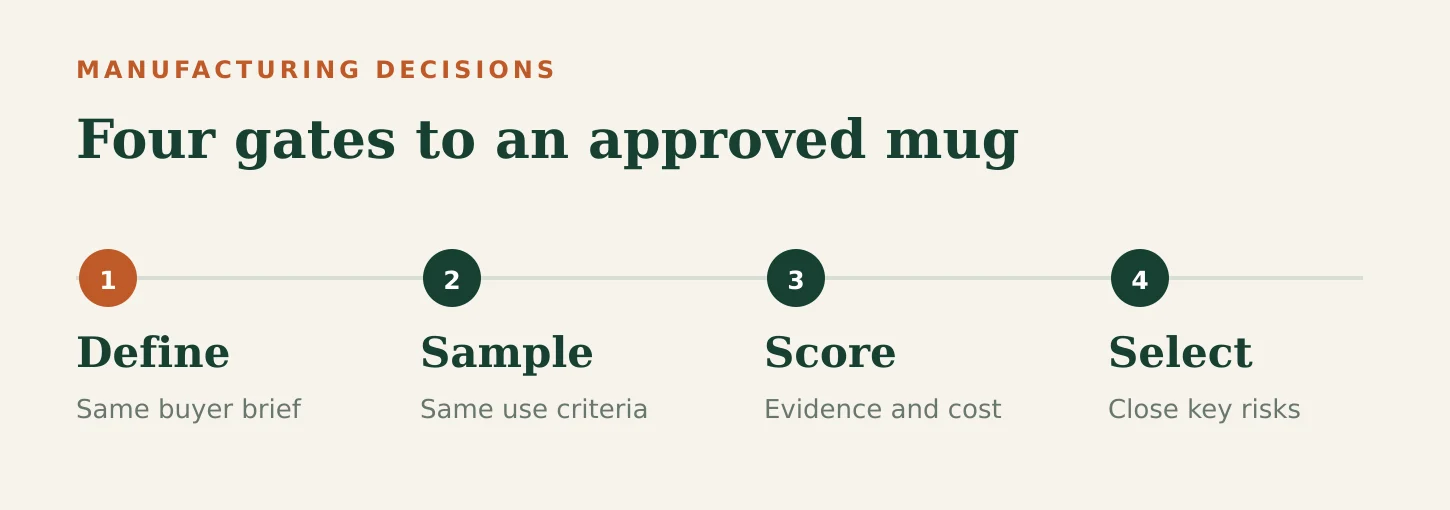
Editorial decision framework; project-specific steps should be agreed in the brief.
Compare capability against the proposed form
Chaozhou is a ceramics manufacturing center, but location does not make production routes interchangeable. Ask each candidate how it will form the body, make and join a handle, control fired shrinkage, glaze the chosen surfaces, and decorate the cup. A high-volume straight-sided coffee cup may suit a repeatable rolling route; an irregular relief form could require a different tool and more hand finishing. The supplier should explain its recommendation and show an analogous process or sample. Avoid assuming every showcased technique can be combined on every SKU.
Daye’s brochure lists casting, rolling, handle installation, trimming, biscuit firing, glazing and glaze firing. It also shows decoration methods including positioning, printing, engraving, hand drawing and decals. A buyer should ask which combination is proposed for the actual mug and where the limiting feature lies. For example, a deep relief can complicate glaze pooling; a small logo can be hard to register on a strongly curved body; a tall narrow vessel may raise packing and stability questions. Useful manufacturers identify these constraints before they become bulk defects.
Review the sample as a group rather than picking the most photogenic unit. Ask for several pieces made with the intended tools and process, including the normal variation a pilot run reveals. Check dimensions, capacity, rim feel, base stability, handle comfort, surface, logo position, and packed presentation. Record which properties are approved, which need revision, and which cannot be achieved at the proposed price or lead time. A transparent “not feasible as drawn” can be more valuable than a supplier promising everything.
Evaluate quality systems with product evidence
A factory may show a certificate or a customer list, but the decisive evidence for your mug is traceable. Ask to see a controlled drawing and artwork revision, fired master sample, in-process inspection rules, defined cosmetic limits, relevant test report, and packed-product release criteria. If a supplier cites an audit, verify its date, site, scope, and status. Daye’s 2024 brochure reproduces several audit and certification examples; current evidence should be requested for the new buying decision.
Daye describes in-house physical tests for microwave and dishwasher use, thermal shock, water absorption, body and handle strength, abrasion, and packed transit. These capabilities can help a buyer build a test plan. They do not establish that a future cup automatically passes. Agree on the exact finished article and market, particularly if food-contact decoration changes. A laboratory report for another cup or an earlier glaze is a prompt to ask for new evidence, not a transferable approval.
Observe how the factory handles defects. It should distinguish a functional risk, a major retail problem, and an agreed minor cosmetic variation. Inspect a sample set under consistent lighting and ask for retained accept/reject examples. A controlled color range is often more useful than a single “perfect” swatch, because firing and glaze application can have normal variation. The brand’s desired appearance should still be explicit enough to protect shelf consistency across reorders.
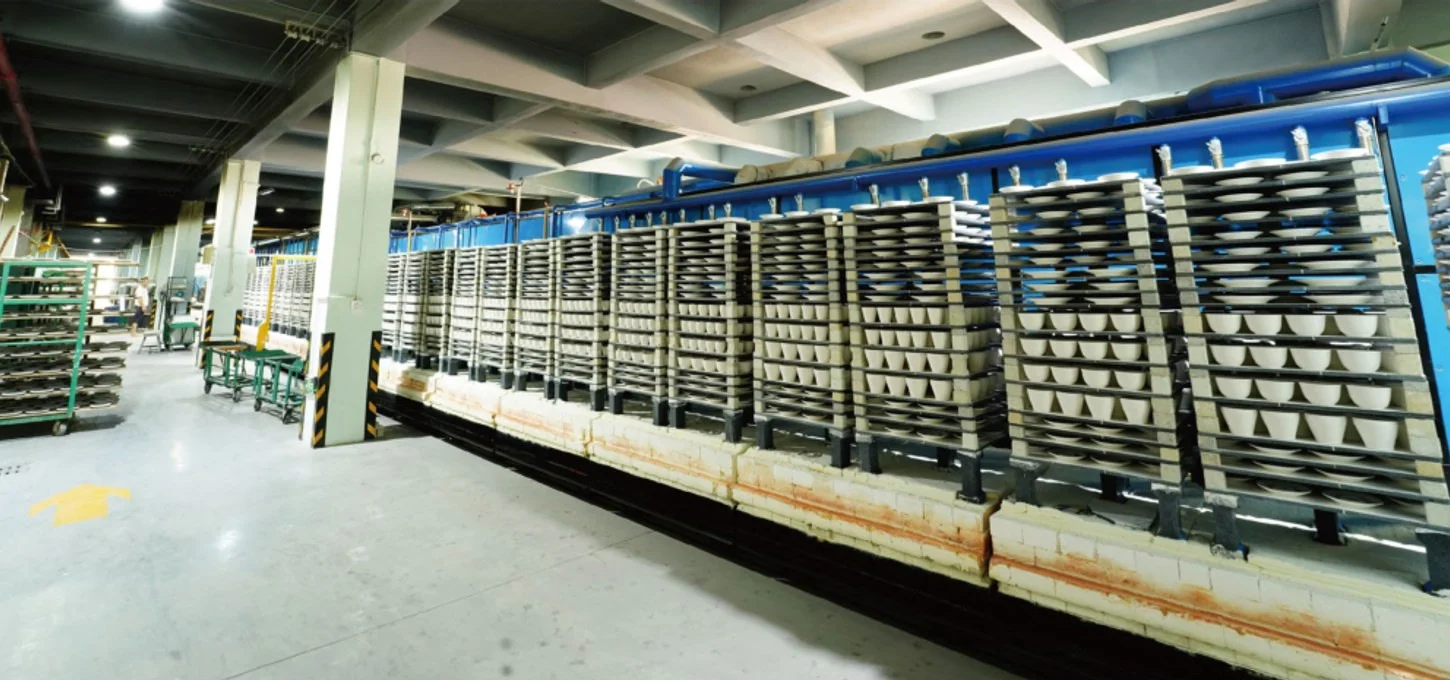
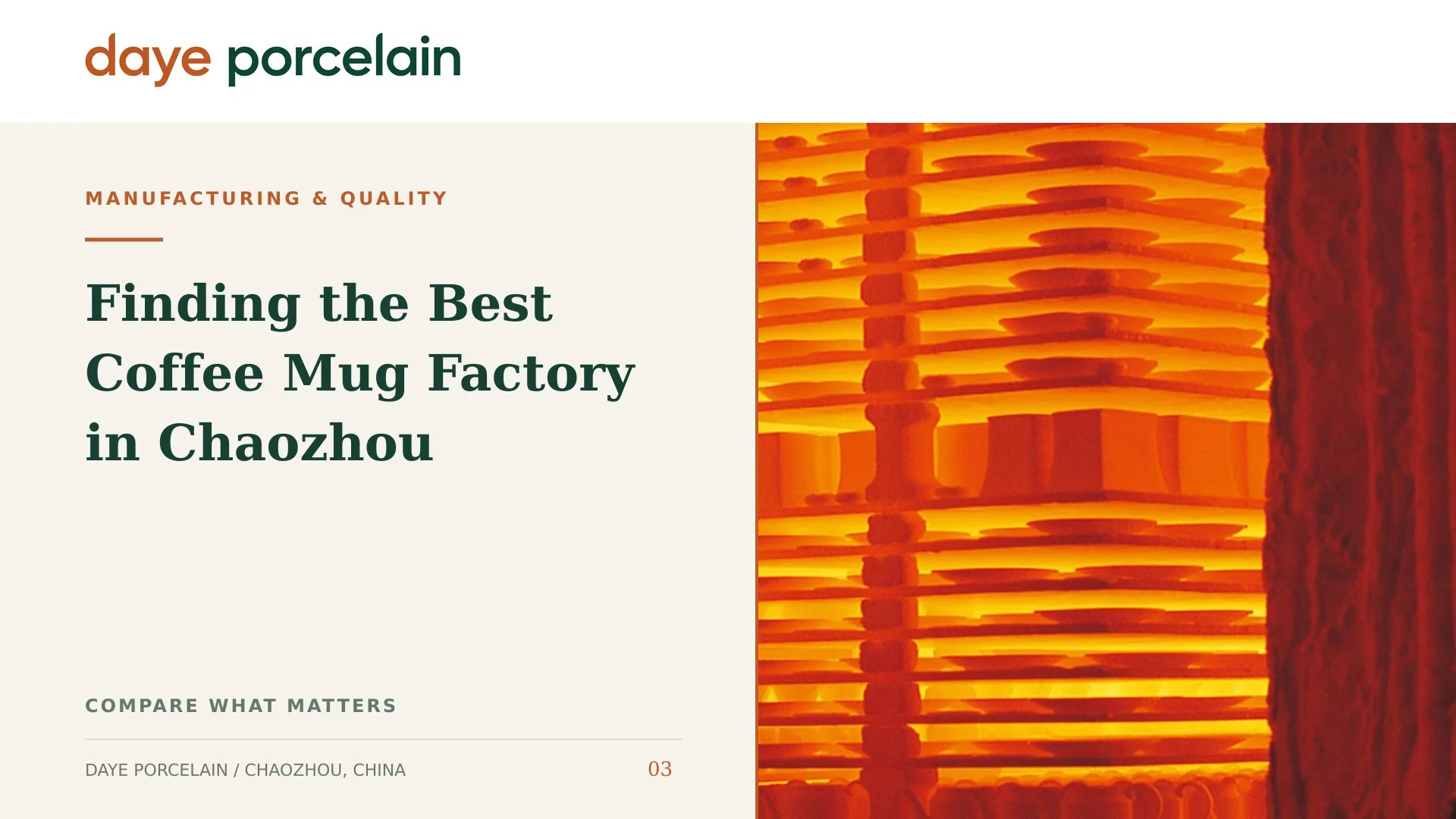
Daye Porcelain company introduction (2024), p. 21: firing equipment.
Use a weighted scorecard, with non-negotiable gates
A scorecard keeps a team from choosing solely by the cheapest quote or the most polished showroom. The weights below are illustrative. Adjust them to the product; a hospitality cup may put more weight on repeatability, while a new retail concept may emphasize development. First reject any proposal that cannot meet the essential food-contact, destination, or ethical procurement conditions the buyer has specified. Then compare the remaining suppliers on evidence and commercial fit.
|
Decision area |
Example weight |
What a strong answer contains |
|---|---|---|
|
Product and process fit |
25% |
Specific forming route, feasible geometry, representative pilot pieces |
|
Repeatability and quality |
25% |
Fired masters, tolerances, inspection records, corrective action |
|
Testing and documentation |
20% |
Current, SKU-matched reports and market plan |
|
Development and communication |
15% |
Named engineer, revision log, clear approval gates |
|
Total landed program |
15% |
Comparable tooling, unit, pack, inspection and shipping basis |
Do not treat these numbers as an objective industry standard. Each bidder should receive an evidence score and a short explanation. If the quality lead gives a low score because a handle-strength concern remains unresolved, a buyer cannot fix the issue by awarding extra points for a cheap carton. Record open risks, owner, deadline, and what evidence would close each one. A factory can move up the list by resolving a real question, not by repeating broad marketing claims.
Assess capacity realistically. Ask about the proposed production window, pilot quantity, tooling lead time, expected output, decoration bottlenecks, and peak-season effects. A brochure figure for a company’s overall scale does not promise your chosen line is free on your dates. Replenishment matters too: request how tools, glaze references, artwork, and pack specifications will be retained for a second order. The best first production run is less valuable if the product cannot be made consistently again.
If the project spans several drink sizes, inspect the range as one family. A consistent rim language, related white tone, coherent handle geometry and stable saucer fit can be more important to a coffee brand than optimizing each cup in isolation. Ask each supplier to identify which bodies can share decoration methods or packing components and which require separate tools. This reveals the operational cost of a collection that looks simple in a concept presentation.
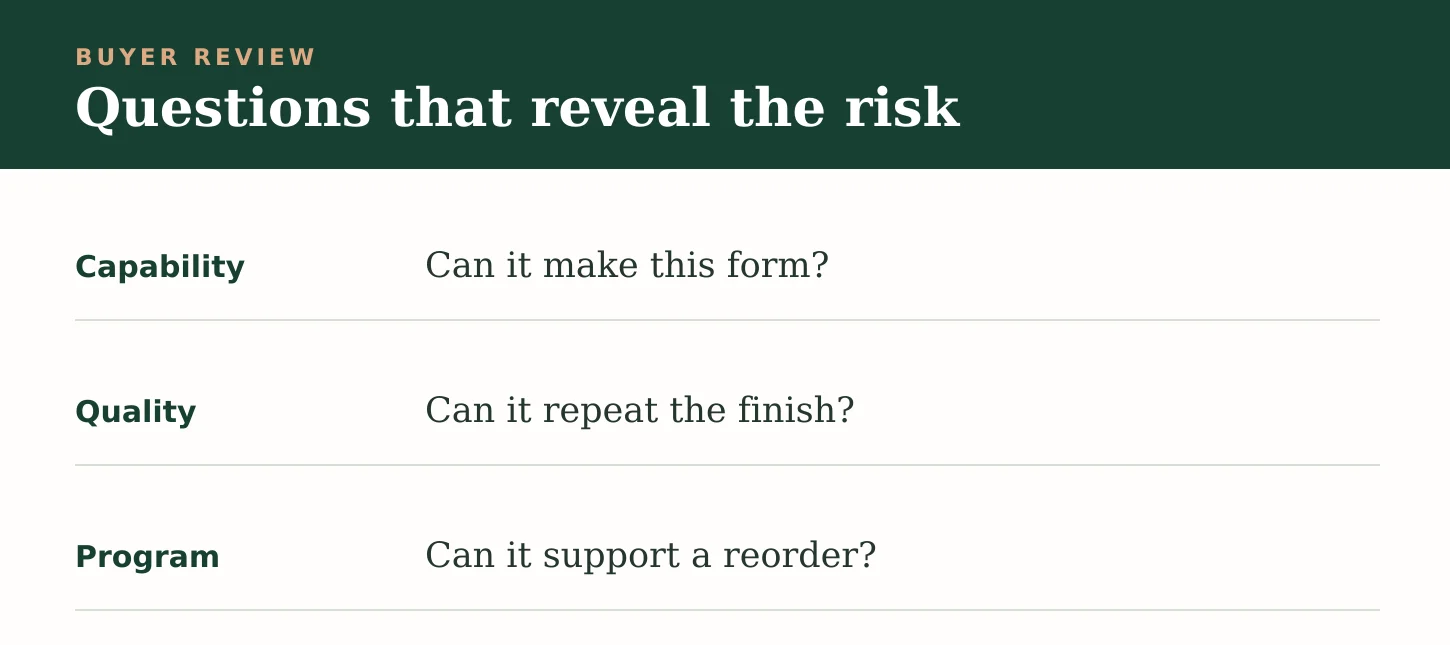
Questions to discuss when approving this particular product or partnership.
Compare the complete commercial offer
Unit price is only one part of a brand’s cost. Align quantities, tooling and sampling charges, number of decoration colors or placements, test and inspection costs, retail versus bulk packaging, breakage allowance, export cartons, Incoterms, and payment milestones. Ask whether an apparently low price assumes an existing mold, a lower-cost glaze, or a simpler inspection plan. Landed cost also includes freight, duties, inventory, and the expense of handling defects after arrival. A supplier cannot control every outside cost, but it can state its quote basis clearly.
Intellectual property and confidentiality deserve a written answer. If a brand commissions a unique form, identify who owns design files and molds, whether exclusivity applies, how tools are marked, and what happens if the program ends. An OEM supplier may use the brand’s design; an ODM relationship may involve more factory design input. Either can work when rights and permitted uses are agreed before tooling. Do not assume that a sample displayed in a showroom is available to copy as a private-label product.
For a multi-country buyer, define responsible communications. Technical deviations should be approved by the design or quality owner, not concealed inside commercial correspondence. Agree on escalation timing if a sample fails or a shipment is delayed. A manufacturer that explains a problem early gives the buyer choices; a late surprise can destroy the selling season even when the eventual cup looks good.
A fair way to assess Daye
Place Daye on the same shortlist and send the same brief. Its custom ceramic mug, design development and quality control resources suggest useful topics for a first technical call. The company’s brochure shows Chaozhou production and testing facilities and names Club House as a partner; Club House’s own history independently names Guangdong Daye Porcelain as its historical production partner and records an Intertek audit in 2011. That is a meaningful reference for coffee-cup experience, while the present project’s price, capacity, test scope, and outcome still need separate approval.
The buyer seeking the best coffee mug factory in Chaozhou should end with a decision memo: which factory best fits this exact SKU, what evidence supports the choice, what remains open, and the gates before bulk order. That is more useful than a search-engine superlative, and it gives the selected supplier a clear target to meet.
FAQ
Is Daye the best coffee mug factory in Chaozhou?
There is no independent universal ranking established by the sources used here. Daye has documented production capabilities and a publicly corroborated Club House relationship. Whether it is the best fit depends on your specific cup, order size, timing, market, and verified sample and quality results.
How many factories should I compare?
Enough to understand meaningful alternatives without exhausting the development process. A small shortlist receiving the same complete brief and sample criteria is more informative than many suppliers receiving vague inquiries.
Can I compare two sample photos instead of physical cups?
Photos help shortlist visual directions, but they cannot establish rim feel, useful capacity, handle comfort, foot stability, fired finish, or packed protection. Evaluate representative physical samples and record results against the same criteria.
What should be pass/fail in the scorecard?
Requirements involving intended safe use, required documentation, essential design constraints, and any firm buyer policies should be gates. Cosmetic preferences and commercial tradeoffs can then be weighted among suppliers that clear those gates.
How do I prevent a strong pilot from becoming a weak reorder?
Retain signed fired masters, drawings, artwork, tools and pack specifications; record acceptable variation; and require change approval. Compare the reorder to those references, not to memory or a marketplace listing.
References
- Daye Porcelain, Introduction of Daye Porcelain (2024), pp. 8, 17–23, 26–27, 33–34, 47.
- Club House: Company and history.
- Daye Porcelain: Custom Ceramic Mugs.
- EUR-Lex: Ceramic objects in contact with foodstuffs.