

Table of Contents

White porcelain mugs and blue-and-white porcelain mugs can belong to the same collection, but they ask different questions of a design team. A plain white surface exposes subtle variation in glaze and body tone. A blue motif adds decisions about artwork, placement, decoration method, repeatability, and care. For a brand buyer, the aim is to make both variants feel intentional and to give the factory an approved standard it can reproduce.
This guide is about developing a private label line, not choosing a ready-stock mug from a retail catalog. It covers white tone, pattern design, production proofing, food-contact evidence, packaging, and the decision to keep plain and patterned versions together or separate. “Blue and white” describes an appearance; it does not by itself establish a Chinese historical technique, hand painting, underglaze decoration, or dishwasher performance.
Key takeaways
- Approve the fired white tone with a retained physical standard.
- Specify and proof the blue decoration method on each intended mug shape.
- Keep plain and patterned SKUs distinct for testing, packing, and replenishment.
- Use technique and care claims only when supported by the finished product.
Start with the white surface
White has many shades. A cool blue-white can look different from a warm ivory when two mugs sit next to one another, even if both are marketed as white porcelain. State whether the line must match existing plates, a store display, or a photography reference. The strongest approval standard is usually a retained fired sample reviewed under agreed lighting, accompanied by a written tolerance where practical. A screen image is useful for direction but unreliable for subtle glaze shade.
Look closely at the places a shopper or server will see first: rim, interior, handle join, and base. A consistent smooth surface can make a simple shape feel deliberate. Pinholes, glaze pooling, visible specks, and a wavering rim may be more conspicuous on white than on a busy print. Agree which natural variation is acceptable for the product position and which defects lead to rejection. A handmade-looking brief and a uniform hospitality line may have different standards.
Plain white is often used as a design platform, but a buyer should not assume that every white body accepts every decoration equally. Curvature, glaze, firing, and surface texture affect the result. If a line will begin as plain white and later add a blue pattern, tell the manufacturer early. It may affect the way the base product and artwork are developed and tested.
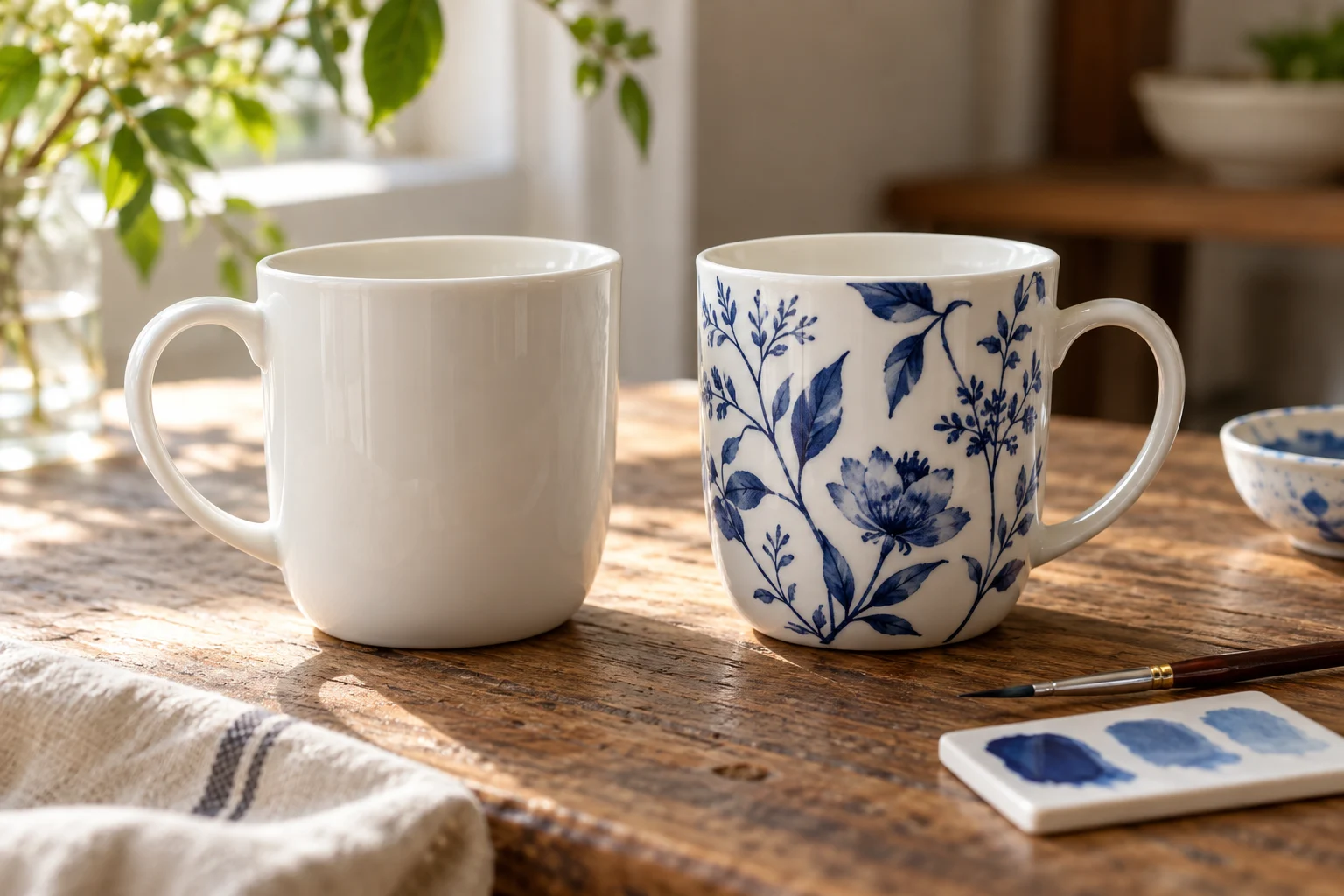
Illustrative decoration study: approve white and blue on fired samples.
Define what “blue and white” means for this project
The phrase can refer to a traditional visual language, a modern graphic print, a narrow cobalt rim, or a full wraparound pattern. The factory needs more than a mood board. Supply original artwork or a rights-cleared design reference, a target blue shade, allowed print area, orientation relative to the handle, and any elements that must align across mug sizes. Avoid asking a supplier to reproduce another brand’s recognizable motif without rights.
Ask the production team to state whether the proposed design is hand-applied, transferred, printed, placed under a glaze, or applied in another way. The method can affect appearance, cost, variation, and care instructions. It should not be inferred from a photo. A brand that wants the irregularity of hand work should define the acceptable range. A distributor that needs near-identical shelf presentation may choose a different process and inspection standard.
Meissen describes cobalt-blue underglaze painting as artwork protected beneath glaze for its particular products; that is a useful example of how method and care can relate, not evidence that all blue-and-white mugs share the same construction. For a Daye project, obtain the actual fired sample, process description, and test record. A blue print applied by another method needs its own assessment. Avoid promising microwave or dishwasher suitability based on color alone.
Artwork should survive a three-dimensional form
Flat graphics bend around a mug. A straight-sided cylinder offers a different print area from a tapered or relief body. Test the artwork on the intended form rather than on a generic blank. A pattern can visibly break at the handle or drift at a seam; a centered medallion can look off-center once the handle and viewing angle are considered. Review front, back, top, and the drinking view. If the line includes both a small coffee mug and a large tea mug, prepare size-specific artwork rather than scaling one file mechanically.
The interior can be a design choice too. A white interior shows drink color and allows easy visual inspection; a blue interior decoration may contribute to the design but adds a food-contact surface to review. Keep artwork away from critical contact areas if that is part of the agreed design, and document any exceptions. Check whether logo marks on the underside survive cleaning and remain legible for traceability. An attractive decorative band cannot compensate for an uncomfortable rim or handle.
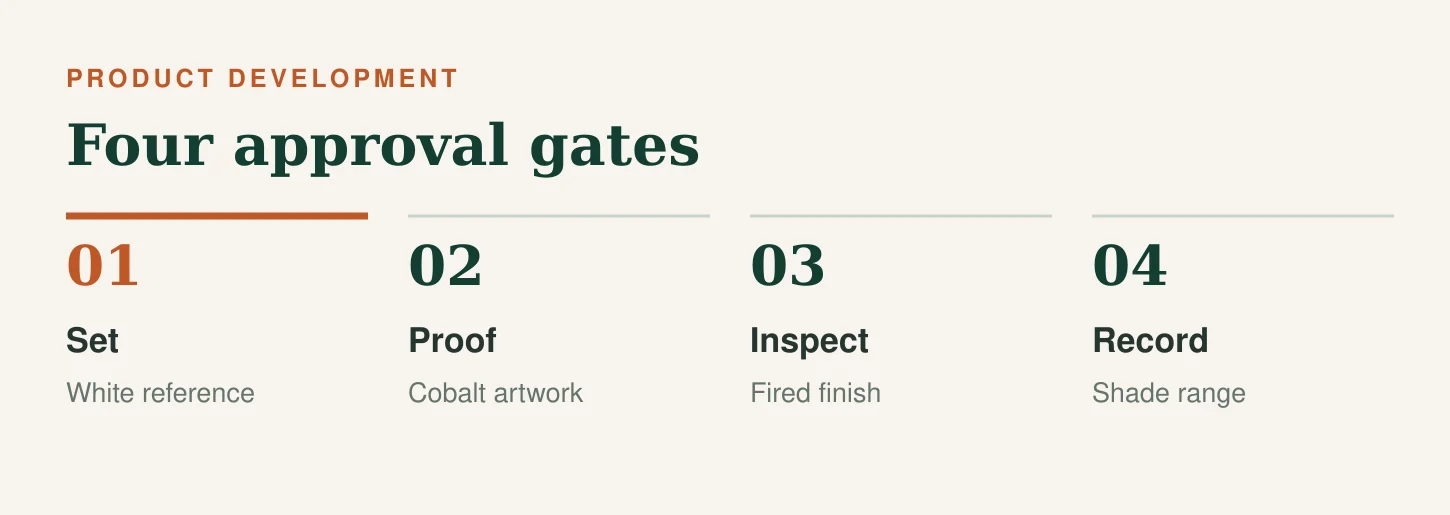
Approval gates for this product brief; the final steps depend on the project.
Compare two product architectures
|
Product route |
Useful when |
Main approval challenge |
|---|---|---|
|
Plain white mug family |
The buyer wants flexible branding or a minimal table setting |
White shade, glaze finish, shape repeatability. |
|
White body with small blue accent |
A subtle signature must link several SKU sizes |
Accent position and shade across curved forms. |
|
Full blue-and-white motif |
Pattern is the collection’s main appeal |
Artwork registration, rights, care, and visible variation. |
|
Mixed plain and patterned range |
Retail wants core and statement pieces together |
Coordinated body, white tone, SKU distinction, stock balance. |
A mixed range can use one underlying silhouette, but it still needs separate sample approvals. Do not assume the plain version’s report covers the decorated version. Packaging should identify each pattern and colorway clearly; a warehouse cannot rely on a small thumbnail when hundreds of nearly identical white cartons arrive together. If two variants share a bar code by mistake, even a well-made product becomes hard to sell and reorder.
For a café chain, ask how the pattern looks after repeated washing and whether a replacement mug can sit beside older stock without an obvious shade break. For a gift retailer, consider a presentation box that shows enough of the motif without leaving the rim or handle exposed. If the collection includes plates or saucers, approve the pieces together under the same lighting; “blue” can vary sharply across decoration methods.
Quality checks for the finished mug
Inspect general ceramic quality first: chips, cracks, glaze coverage, base level, capacity, and handle attachment. Then inspect the visual standard: white tone, blue shade, artwork registration, seam treatment, and repeatability between samples. Use photographs to document defects, but retain physical references for subtle color decisions. Agree an inspection plan and a process for resolving borderline pieces. A vague instruction to “match the photo” gives the factory and buyer little common ground.
Care claims should be confirmed on the finished design. An undecorated white mug, an underglaze blue design, an overglaze print, and a mug with a metallic accent can require different evaluations. Test the actual combination if a dishwasher or microwave claim is commercially important. The absence of a metallic accent does not by itself prove suitability. Brand teams should not put a care icon on a retail box before the corresponding evidence and instructions are agreed.
For food-contact use, check the destination market and the tested article. US FDA compliance policy guides address lead and cadmium leaching from ceramicware; EU rules include the food-contact framework, good manufacturing practices, and ceramic-specific measures. An audit of a factory and a photograph of a testing machine are different from a report tied to the decorated SKU. If a pattern changes pigment, position, or firing, ask whether the existing evidence still applies. These are procurement controls, not reasons to alarm consumers in the final product copy.
Packaging and rights need early decisions
If the motif draws from an archive, museum object, or contemporary artist, check what the brand may reproduce. Historical inspiration does not automatically make a modern drawing free to copy. Commissioning original artwork and keeping source files, licenses, and version history reduces a common launch risk. The factory also needs clear ownership and use restrictions for the files. Approve any use of brand marks in samples or portfolio photography separately from permission to manufacture the order.
Create a pack prototype with the patterned mug. A gift box can show the design, but it must still protect the handle and rim. A large amount of printed packaging increases the cost of changing artwork after signoff. Complete the mug proof and barcode review before ordering all cartons. For e-commerce, evaluate the shipping pack in the actual fulfillment flow, not only on a showroom shelf.
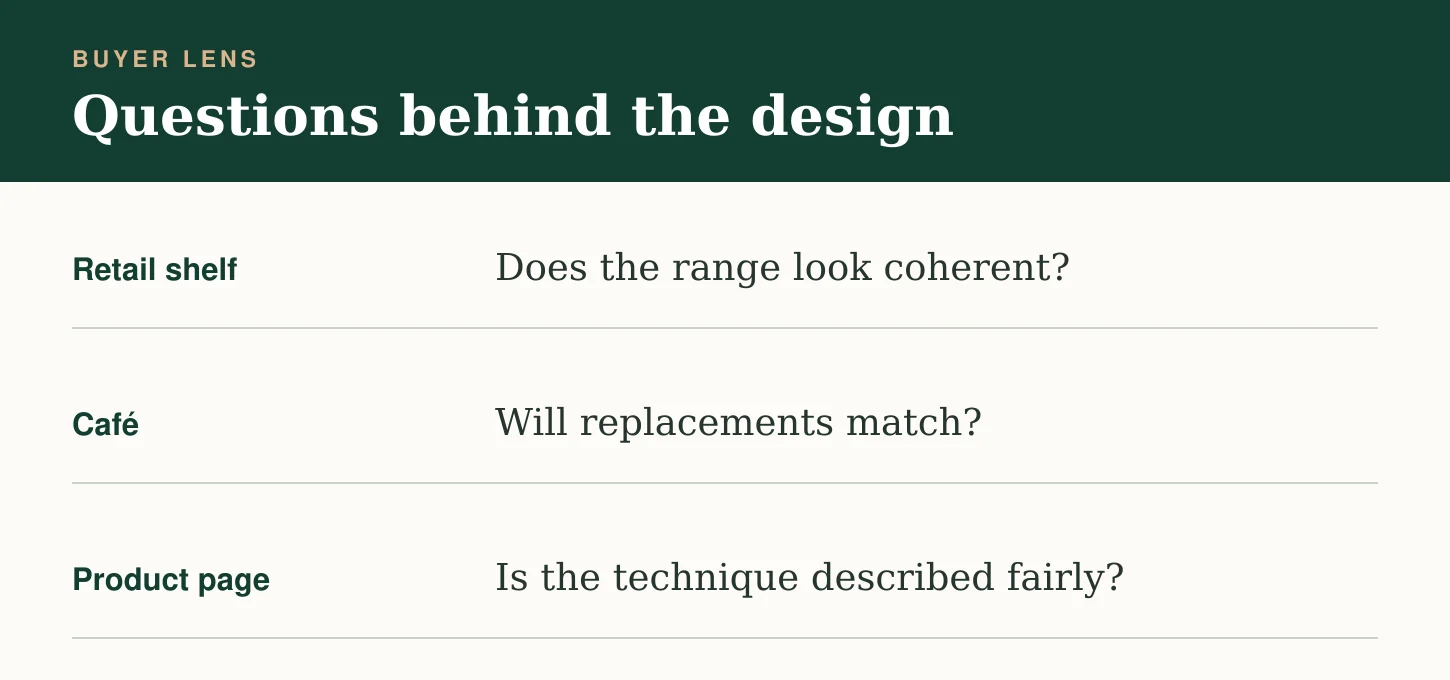
Buyer questions that should inform the approved product specification.
A sample path for a coordinated range
Start with an unprinted shape and agree the body, handle, fill, and white standard. Proof a small blue element to establish shade and process. Then proof the full motif on each size, checking the handle view and seam. Build a pack for each SKU, obtain the applicable test evidence, and inspect pilot pieces beside the retained standards. Freeze artwork and production files with revision codes before the purchase order. A later update should trigger a fresh approval decision, not a silent file replacement.
Design a useful approval set
One beautiful hero sample is not enough to approve a production line. Ask for several pieces from the same trial run and place them side by side. Observe variation in the white background, the darkest blue area, the rim, and the location of the design relative to the handle. Turn the mugs through a full circle; a pattern that looks consistent in one catalog angle may reveal a visible joining line. Check the exact selling configuration, including any saucer, lid, or retail sleeve. A buyer can photograph this set for records, but should keep at least one signed physical standard.
Write down how the line will be inspected. Some aspects can be measured, such as height, diameter, fill, and emblem position. Others need an agreed visual reference for shade or glaze character. Identify the viewing distance and lighting used for a decision so a small mark does not become a dispute between a factory floor and a retail quality team. If hand work is part of the design, describe which irregularities are intentional. If the range promises a uniform graphic look, the acceptable registration should be tighter. The standard must reflect the commercial promise made to the customer.
Match the listing to the finished technique
The product title and description should say what is true of the delivered mug. “Blue-and-white porcelain” is a visual description. “Hand painted,” “underglaze,” “microwave safe,” and “dishwasher safe” are additional factual claims requiring evidence for the final item. Do not borrow a historical explanation of cobalt decoration to suggest a modern printed mug used the same process. A retailer can explain the original artwork inspiration without inventing a craft technique.
For a white collection, show the mug in lighting that resembles normal use and do not digitally cool the image so much that an ivory glaze appears bright blue-white. For patterned versions, show both sides and the handle alignment. Include a capacity with its measurement basis and a care statement that matches the product file. When a buyer places a reorder, those same files should define the expected appearance. Consistent photos, records, and honest copy reduce returns caused by unmet visual expectations as much as they support search visibility.
For distributors, the collection architecture also determines how much stock must be held. A blue-and-white motif may be a statement piece with lower forecast volume, while plain white serves replenishment accounts. Decide whether both use identical carton counts and whether a retailer can order them separately. If the same body is used, production planning can still differ because decoration and printed boxes have their own inputs. Keep forecasts by SKU rather than treating the whole family as one undifferentiated mug order.
Daye Porcelain’s custom ceramic mugs page and design development page provide the right project context for a white or patterned range. The quality control page is a starting point for discussing inspections. Submit a brief with the actual artwork rights, body reference, target markets, volume, and packaging through the project inquiry page for feasibility and a project-specific proposal.
Frequently asked questions
Are blue-and-white porcelain mugs always hand painted?
No. Similar appearances can be produced through different decoration methods. Ask the supplier to specify the method for the quoted product and inspect a fired sample before using “hand painted” in a listing.
Is blue-and-white porcelain always dishwasher safe?
No. Care depends on the finished construction and decoration. A maker’s claim about one underglaze product should not be applied to a different overglaze or metallic design. Confirm instructions and evidence for the actual SKU.
Why approve a physical white standard?
White shade and gloss are difficult to judge reliably from photos or screens. A retained production sample helps buyer and factory compare later output under similar lighting and agree what variation is acceptable.
Can one mold be used for plain and decorated mugs?
Often a common shape can carry several finishes, but that is a project decision. Approve each finished SKU and check whether decorations, test evidence, packaging, and reorder records differ. Shared geometry does not make every version equivalent.