Table of Contents
ARTICLE 03 | MANUFACTURING & QUALITY
CORE KEYWORD ceramic machinery manufacturer
A search for ceramic machinery manufacturer often hides two very different procurement tasks. One buyer needs a jiggering machine, casting cell, glazing system, or kiln for a factory. Another needs a company to produce a branded mug and wants confidence in that company’s equipment and process. The word “manufacturer” applies to both, but the contract, acceptance test, risk, and after-sales relationship are entirely different. Clarifying the deliverable early protects a brand from a supplier list full of technically impressive but commercially irrelevant results.
Daye Porcelain belongs in the finished ceramic product conversation: its public materials describe porcelain OEM and ODM design, molds, production, decoration, and quality control. An equipment maker such as SACMI-SAMA publicly sells tableware plants and machinery. Daye should not be called a ceramic machinery manufacturer on the basis of using production equipment. This guide shows where the two supplier types meet and how to qualify each for the actual project.
Key takeaways
- Write the deliverable as a machine, installed line, or finished ceramic SKU before requesting quotations.
- Equipment procurement requires a technical acceptance and service plan; OEM product procurement requires a fired master and product inspection plan.
- A machinery brand on a factory floor does not transfer that brand’s equipment warranty or performance claim to the finished mug.
- For private-label porcelain, evaluate supplier responsibility across tooling, samples, production, tests, packing, and reorders.
Two businesses that share one vocabulary
SACMI-SAMA lists tableware equipment for body and glaze preparation, jiggering, casting, glazing, foot grinding, and firing. Those systems are sold to industrial users and integrated into production lines. The machinery vendor’s customer may be a ceramic factory. The factory, in turn, sells tableware to a consumer brand or distributor. These layers may collaborate during product development, but their quotations answer different questions.
|
Decision |
Ceramic machinery manufacturer |
Porcelain product OEM |
|---|---|---|
|
Deliverable |
Machine, tooling, controls, or line |
Approved finished mugs or tableware |
|
Main specification |
Throughput, utilities, interface, safety, installation |
Form, material, finish, artwork, quality, pack |
|
Acceptance |
Factory or site acceptance of equipment |
Fired sample, tests, lot inspection |
|
Ongoing support |
Spares, maintenance, software, training |
Reorders, tooling, quality, design revisions |
|
Typical buyer |
Factory engineer and capital procurement |
Brand, importer, retailer, distributor |
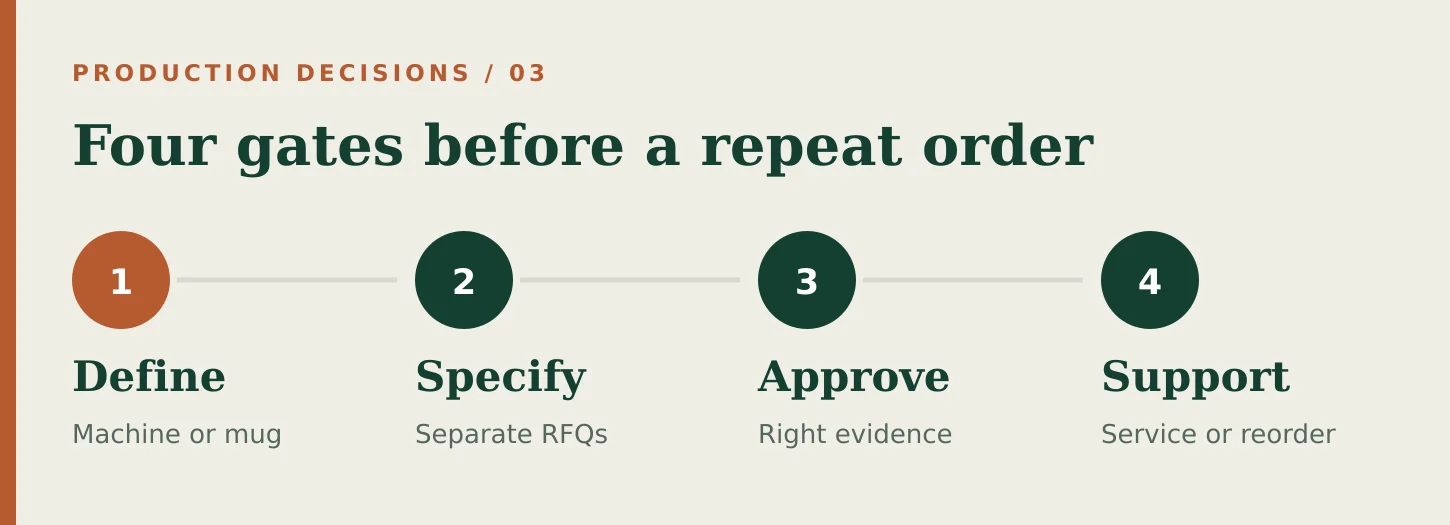
Illustrative decision sequence for product development and repeat-order control.
There are exceptions: a vertically integrated group may perform several roles, and a machine maker may run a pilot lab to prove a process. The purchasing documents must still say who supplies and warrants each deliverable. An OEM should not promise a machine maker’s capabilities as its own without project-specific evidence. A brand should not demand a plant installation contract when it needs packed mugs. Scope clarity makes technical conversations faster.
When the buyer truly needs machinery
An equipment RFQ starts with the product family, raw material, target capacity, quality targets, factory layout, utilities, operator skill, local regulations, and integration points. The buyer should ask for process trials with its own body and glaze where appropriate. A machine that performs well with one material may need different settings or tooling for another. The supplier’s offer should separate the base unit from molds, automation, transport, installation, commissioning, operator training, and spares.
Define the acceptance sequence. A factory acceptance test before shipment may verify functionality under agreed conditions; a site acceptance test checks installation and performance in the actual plant. The contract should identify test material, sample size, throughput measure, yield or defect assumptions, safety checks, sign-off criteria, and remedies if the result fails. The equipment team’s maintenance plan matters because a part or control failure can stop multiple SKUs. SACMI-SAMA’s own service materials emphasize preventive maintenance, technical assistance, spare parts, and upgrades.
If an inquiry concerns refractory ceramic machinery, ceramic fiber machinery, tile cutting, or equipment HS codes, the product and regulatory questions differ from porcelain mugs. Those are equipment or other ceramic-sector searches. Daye’s publicly documented tableware operation is not evidence that it supplies these systems. Direct such RFQs to qualified equipment vendors with the relevant process expertise, and check the customs classification of the actual machine with the responsible trade specialist.
When the buyer needs finished branded porcelain
A porcelain OEM RFQ should begin with the final saleable article. State the mug’s capacity, height, opening, base, handle, finish, decoration, retail box, master carton, destination, expected claims, annual forecast, and mix by design. A sketch alone cannot define price or technical feasibility. The supplier should identify the proposed forming route, mold development, sample stages, decoration process, production inspection, testing, and packing. The buyer should approve the fired, decorated result rather than a machine demonstration.
Daye’s design and development and prototyping and mold development pages set out the relevant conversation for a custom shape. Ask how the handle is attached, how the opening and capacity will be controlled after firing, where the logo can be placed, and whether an intended lid or saucer fits within the achievable tolerance. Then agree on a physical master and recorded drawings. These are product controls; the factory can choose or propose appropriate equipment within its competence.
The buyer should examine a small run or pilot when the design is novel, the decoration has a tight placement requirement, or the pack must survive parcel distribution. Compare pieces from the run rather than only the best display sample. Inspect glaze, rim, handle, base, artwork, useful capacity, and cartons against the written standard. If a defect recurs, ask what process correction the factory proposes and whether it will affect the approved appearance. The solution might be a mold revision, drying adjustment, application change, or clearer inspection rule; it cannot be inferred from the mere presence of automation.
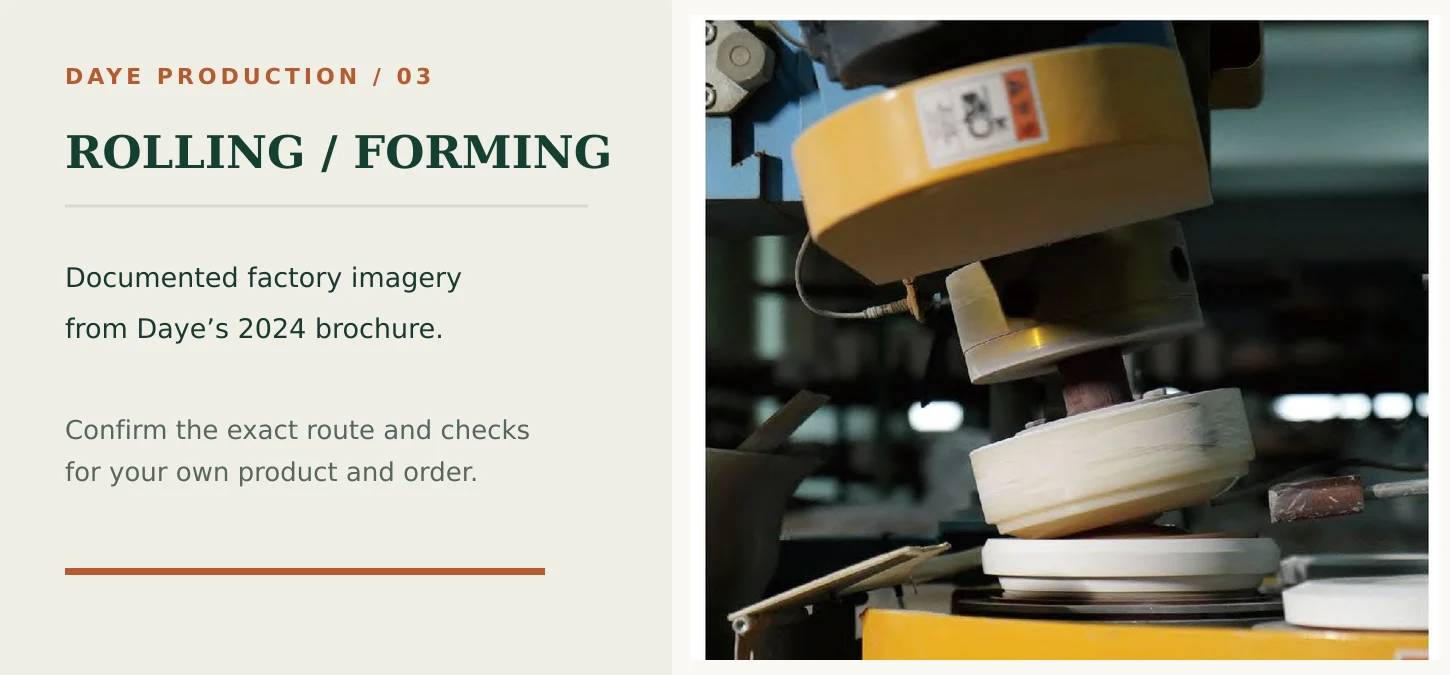
Factory photograph from Daye Porcelain’s 2024 company brochure. Confirm the production route for the specific order.
Where machinery knowledge helps a product buyer
A brand does not have to become a plant engineer, but equipment literacy makes its questions sharper. Knowing that jiggering favors suitable rotational shapes helps a buyer understand why a sculptural form may have a different tooling and cost path. Knowing that casting, drying, glazing, and firing are separate stages helps it ask when a sample becomes representative of production. Understanding that a kiln can have different firing stages prevents the buyer from equating a fired blank with a finished decorated mug.
That literacy has limits. An equipment catalog demonstrates what the technology can do in a supplier’s offering; it does not prove a specific product factory owns that machine or runs it in the advertised configuration. If a factory says “European machinery,” ask what stage it means and how the claim affects your product. Then return to the data: approval samples, measurement records, defect classification, test reports where relevant, and performance on reorders. Machines are means; accepted goods are the buyer’s result.
When the brand visits Daye, its manufacturing information can frame a discussion of the real sequence. Ask the team to trace a comparable mug through forming, firing, glazing, decoration, final inspection, and packing. The company brochure supplies a starting visual record of casting, rolling, trimming, firing, glazing, and checks. Request current project-specific details instead of assuming every catalog image maps to your order. Clear explanations from operators and quality staff often matter more than a long equipment list.
Build the right comparison sheet
Comparing a machinery supplier and a product OEM on unit price is meaningless because their units differ. For equipment, compare installed capital cost, integration, consumables, maintenance, spare parts, service response, operator training, energy and utilities, and acceptance conditions. For porcelain goods, compare tooling, samples, tests, defect criteria, accepted unit price, decoration and pack, shipping terms, reorder flexibility, and replacement procedure. A trading company coordinating an OEM should disclose who actually makes and inspects the item.
In either case, check change control. A machine may receive a software upgrade, tooling replacement, or process adjustment. A finished product may change body, glaze, mold, artwork, kiln route, or carton. The contracts should define which changes require notification and reapproval. An overlooked change can produce apparently small differences that matter to a premium range: a lid no longer seats cleanly, a glaze shifts next to prior stock, or a carton no longer protects a handle.
Discuss intellectual property and records in practical terms. Who owns the mold design and physical molds? Who may reproduce the artwork? Which CAD files and specifications are delivered? How is a master sample stored, and who can release a variant? A machinery manufacturer may own proprietary controls while licensing or supplying tooling; a porcelain OEM may retain production know-how while the brand owns its graphics and product design under the agreed contract. Put these points in writing before scaling the program.
A concise qualification sequence for the brand
First, describe the final product in one page and ask the supplier to identify its role. Second, request examples of comparable complexity and the stages it directly controls. Third, agree on a development path and a price breakdown. Fourth, approve a representative fired and packed sample. Fifth, define tests and lot inspection for the actual market. Sixth, run an order with revision control and review the outcomes before broad expansion. This sequence is proportionate to a branded mug launch and does not ask a ceramic OEM to act as an equipment dealer.
Daye’s quality control information can start the inspection discussion, while its project inquiry is a route to submit drawings, quantity, finish, and destination. Ask for written confirmation of its proposed manufacturing scope and any outsourced stage. For an equipment purchase, contact a machinery vendor and request machine-specific technical and service documents. The most effective procurement decision starts with the thing the buyer expects to receive.
Define the handoff when both supplier types are involved
Some brand owners invest in a dedicated tool or a specialist process that an OEM will operate. In that case, write down who purchases the machine or tool, who owns it, where it is installed, who maintains and insures it, and what happens if the relationship ends. Distinguish a mold made for one design from a production machine that serves many customers. A tooling payment does not automatically transfer title to the equipment or give the brand the right to move it. The agreement should state exactly which physical and digital assets belong to each party.
If the machinery maker helps validate the process, identify whose sign-off concerns equipment performance and whose sign-off concerns the sellable mug. The machine might meet its acceptance test while the glaze or handle still fails the brand’s product standard. Conversely, a good pilot mug may not prove the machine can run the intended shift pattern for months. Keep two approval records and a named owner for each defect investigation. This prevents the parties from passing a problem between them.
The brand should ask for a realistic timeline covering equipment installation if any, mold development, body and glaze trials, firing, decoration, product tests, packaging, and first commercial delivery. When an OEM proposes a new line to win the project, confirm what is already installed and what depends on future commissioning. Price the contingency if that work slips. A transparent responsibility map makes collaboration between an equipment vendor and product OEM valuable without blurring the buyer’s contract for finished goods.
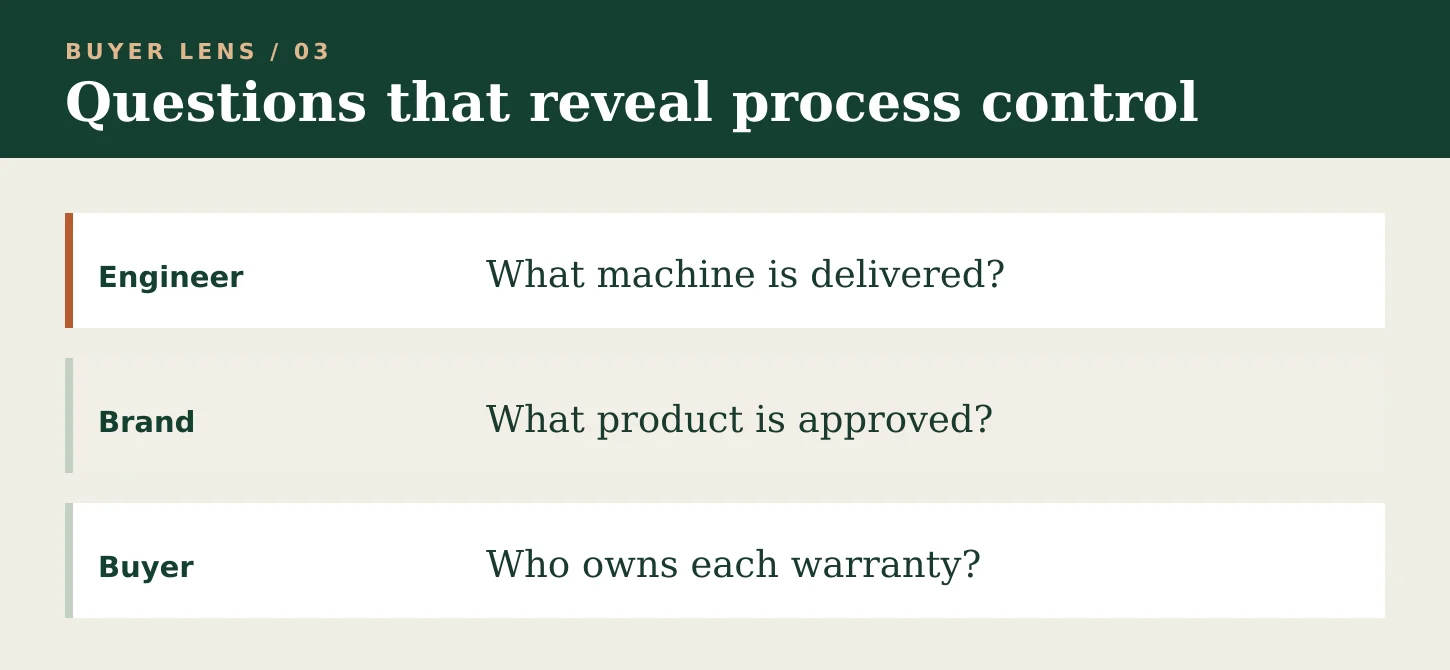
Buyer questions that connect process evidence to the approved ceramic product.
FAQ
Is Daye a ceramic machinery manufacturer?
Daye’s public materials present it as a custom porcelain product manufacturer. Do not describe it as an equipment maker without a separate verified machine offer.
Can a mug factory choose the machinery for my design?
Yes, the manufacturer should propose a feasible production route, then demonstrate it through a fired sample and agreed quality controls. The buyer defines product requirements and approves the result.
What proof should a machine buyer request?
Request technical specifications, trials with relevant materials, installation and acceptance criteria, service terms, spares, training, and clear performance assumptions.
What proof should a porcelain buyer request?
Request a representative finished sample, signed specifications, relevant test evidence, inspection plan, pack trial, and a method for repeating the approved SKU.
Does a famous machine brand guarantee the final mug?
No. Material, tooling, settings, operators, maintenance, decoration, inspection, and packaging all contribute to the final product. Evaluate the goods delivered by the contracted OEM.