Table of Contents
ARTICLE 06 | MANUFACTURING & QUALITY
CORE KEYWORD ceramic machinery market
The ceramic machinery market is often discussed in terms of new lines, automation, energy, and throughput. A brand buying custom porcelain mugs needs a narrower interpretation: which production technologies help a supplier make its intended shapes, finishes, quantities, and repeat orders? Market-size forecasts do not answer that question. Equipment vendors and industry reference documents show a range of current routes for tableware, from jiggering and casting to glazing, firing, inspection, and process support. The commercially useful trend is the growing ability to choose and control a route around the product rather than treating every ceramic item as if it came from one standard line.
Daye Porcelain is a custom ceramic product manufacturer, not a seller of ceramic production machines. Its documented work in Chaozhou includes development, molds, production, decoration, testing, and quality control. This article draws on published technology information to help US and European brand owners question any porcelain OEM, including Daye, about flexibility, consistency, capacity, and evidence. It does not assign particular third-party equipment models or market shares to Daye.
Key takeaways
- Technology choice should follow product geometry, order mix, finish, and quality requirements.
- Automation and flexible small-lot production solve different problems; neither is a universal quality claim.
- Energy and maintenance claims need a baseline and product-specific evidence before entering a buyer’s marketing copy.
- A brand should compare approved output, lead time, variation, and total landed cost rather than machine headlines.
Read the technology landscape by production stage
SACMI-SAMA’s published tableware range covers body and glaze preparation, forming through jiggering or casting, drying, glazing, finishing, firing, and automation. Its public service pages add maintenance, spare parts, and process assistance. The European Commission’s ceramic manufacturing reference covers tableware alongside tiles, refractories, sanitaryware, and technical ceramics, but stresses that products and manufacturing techniques differ. For a mug buyer, the market is a menu of possible production choices, not a single machine benchmark.
|
Technology direction |
Potential buyer benefit |
Question that still needs proof |
|---|---|---|
|
Controlled forming |
More repeatable shape on suitable designs |
Does the fired mug meet our dimensions and feel? |
|
Flexible casting or tooling |
More design freedom for complex forms |
What are tooling, yield, and lead time for our shape? |
|
Automated glazing |
Consistent application at planned volume |
What is the approved finish and defect range? |
|
Kiln and drying optimization |
More stable scheduling or resource use |
Is our body, glaze, and decoration route validated? |
|
Digital or assisted inspection |
Better detection and records |
Which faults are checked and who releases the lot? |
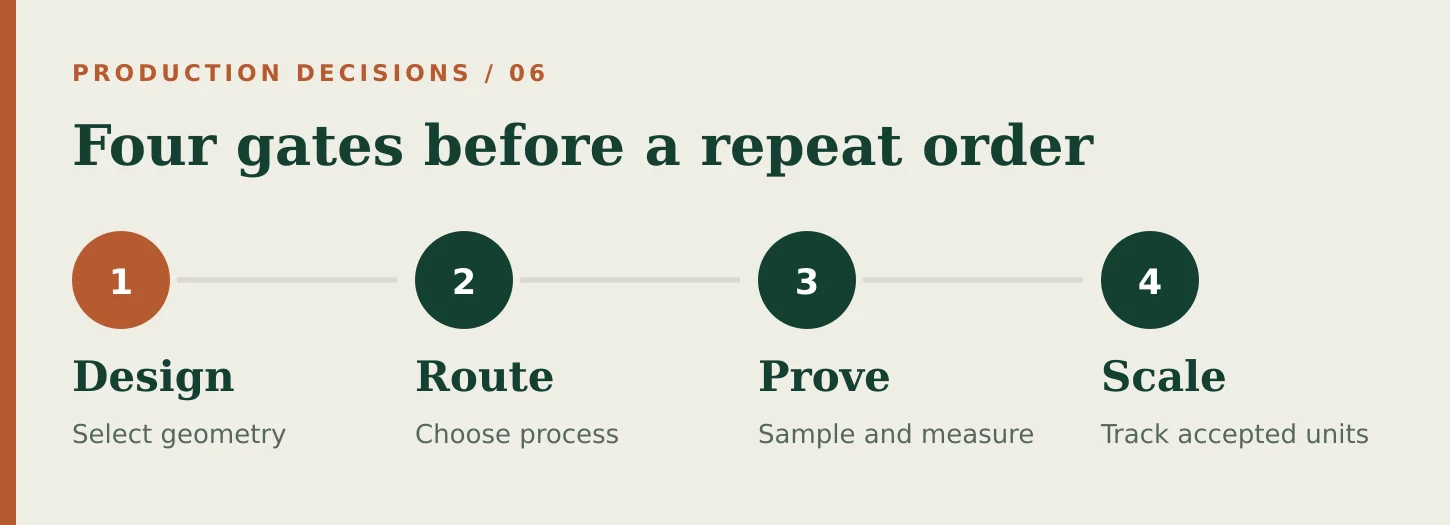
Illustrative decision sequence for product development and repeat-order control.
These are potential outcomes, not promises. A machine catalog is a technology source, while a factory’s sample and records are evidence of its application. An OEM might combine manual and automated steps by design. For a sculptural handle, skilled joining and inspection may remain important even if the body is machine formed. A buyer should ask where human judgment is essential and how it is made consistent across shifts and reorders.
Forming routes: flexibility versus repeatability
Jiggering systems are described by SAMA for cups, bowls, plates, and related forms. Casting systems can address other geometries, including irregular shapes. Both can be engineered for repeatable production when the material, tooling, drying, and firing are controlled. The trend that matters to a brand is fit: a simple cylinder, a broad stackable cup, and a sculpted promotional mug may each need a different mold and economics. A more automated forming station does not make the most complex design automatically cheap.
Daye’s design and development and prototyping and mold development capabilities should be tested against a concrete brief. Give the target capacity, dimensions, handle use, finish, forecast, artwork, pack, and market. Ask Daye to explain the proposed route, sample stages, tooling cost, expected variation, and what is difficult to control. The answer can reveal whether the brand should simplify an idea, fund custom tooling, or choose a different finish to protect both design intent and order economics.
Approve fired samples rather than only a digital model. The kiln can change dimensions and appearance; the handle may feel different after finishing; a lid or stack may expose small fit issues. A short pilot can show variation across pieces and identify defects before a large launch. If one forming route is proposed for the pilot and another for bulk, require an equivalence review. The product buyer’s measure of innovation is a more reliable sellable design, not a more exciting equipment description.
Glazing, decoration, and premium differentiation
Equipment vendors describe flexible and automated dip-glazing options for hollow ware, including cups and mugs. This gives manufacturers choices for different product volumes and finishes. For a brand, the challenge is to define an attractive, repeatable visual standard. A white glossy mug, a matte neutral collection, and a variable reactive glaze call for different acceptance language. “Handmade look” should still have agreed boundaries for speckling, shade, rim coverage, and defects.
Decoration creates another layer of complexity. A logo may be printed, applied by decal, or made through another approved method; placement, color, and durability need a physical proof. Daye’s brochure shows decorative operations and inspections, but the precise route for a new design must be confirmed. Ask how artwork files are versioned, how the position is checked against the handle, and what happens if a background glaze shifts. A premium result combines design intent with a reproducible reference, not an unrepeatable one-off sample.
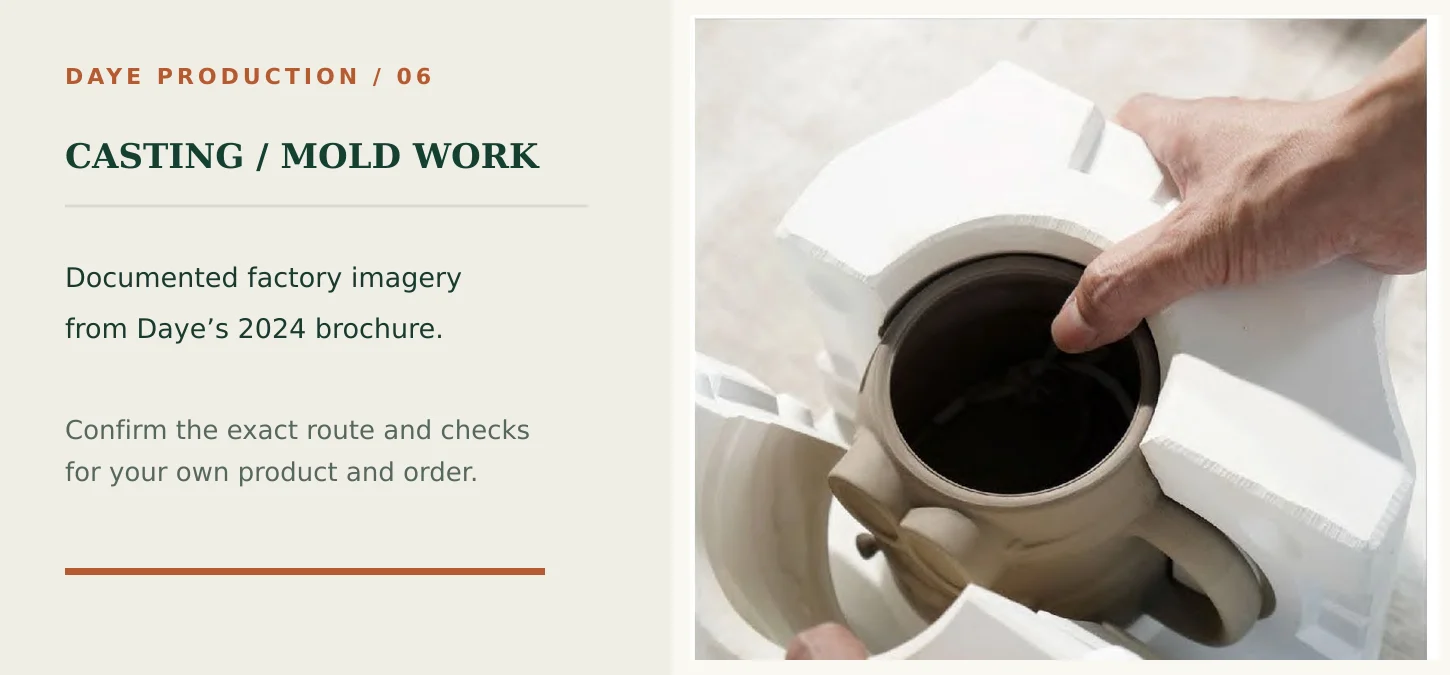
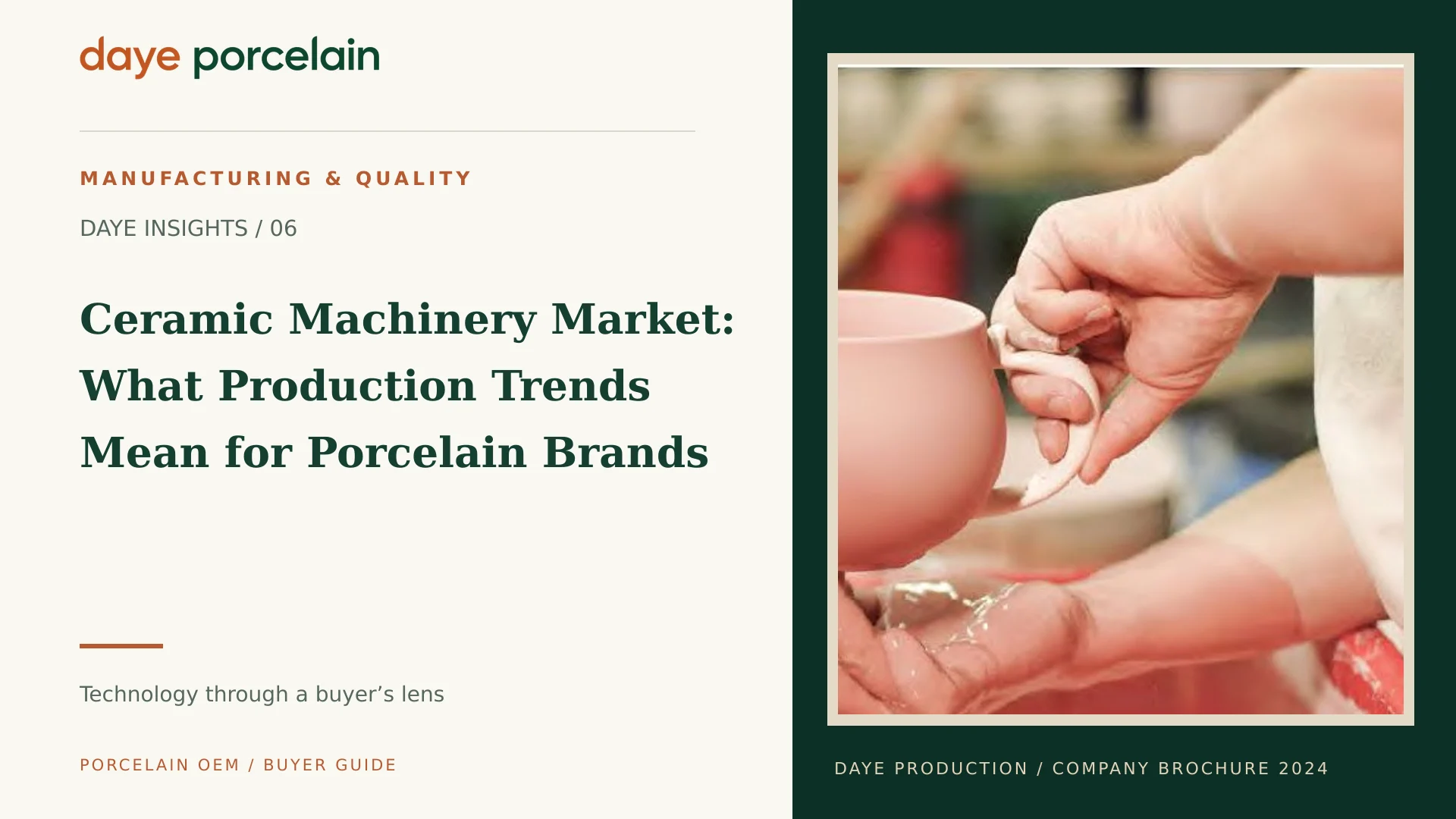
Factory photograph from Daye Porcelain’s 2024 company brochure. Confirm the production route for the specific order.
Firing, resources, and responsible claims
Firing is central to ceramic production and can be a significant energy and process-design decision. The European Commission’s ceramic manufacturing reference and 2026 review material cover environmental performance across ceramic subsectors. Equipment suppliers discuss kiln types, firing stages, and heat-recovery solutions. These materials show technology direction, but they do not prove the energy use or emissions of an individual mug from an individual factory. A brand should not publish a carbon or “low-energy” claim because it saw a modern kiln photograph.
If resource performance affects supplier selection, ask for the specific product boundary and verified data: which plant, process stages, fuel or electricity, material, yield, packaging, and measurement period are included? Compare like for like. An energy-saving upgrade at a kiln may matter, but transport, rejected ware, additional decoration firing, and packaging can change the whole-product picture. Use a qualified methodology before turning factory statements into public environmental claims for US or European consumers.
For day-to-day buying, process stability may be the nearer benefit. A well-managed drying and firing route helps deliver the intended shape, finish, and schedule. Ask how a novel glaze or body is trialed, whether the production kiln route matches the approved sample, and what triggers retesting or reapproval. Daye’s manufacturing page can begin that discussion; its proposal for the actual SKU should supply the specifics. A buyer cannot infer a universal firing temperature or cycle from the phrase porcelain mug.
Automation and the human quality system
Automation can control movement and application, collect data, or reduce repetitive handling. It can also make a wrong setting repeat a fault quickly. The buyer should ask how initial setup is checked, what in-process measurements are taken, who responds to a drift, and how rejected pieces are segregated. Daye’s quality control materials and brochure identify inspection and testing stages. Their relevance should be translated into a project-specific plan for form, glaze, decoration, function, and pack.
Request accepted and rejected examples for cosmetic criteria. A machine-vision system, if a supplier uses one, may detect defined features, while a trained person may assess subtle color or tactile finish. Neither mode is inherently sufficient without a standard. Define critical, major, and minor defects; the viewing conditions; the sample plan; and the disposition of borderline pieces. This is the route from technology investment to customer confidence. Ask for a report in language a retailer can use at receiving.
Digital records can be useful when they connect a lot to its drawing revision, glaze and artwork approval, tests, inspection, and cartons. The buyer does not need access to a proprietary plant control system. It needs a clear product history and a reliable process for reporting changes. When a brand launches several colorways in the same form, the record should identify which samples and results belong to each SKU. This reduces confusion when a complaint arrives months later or a distributor asks for a reorder.
Evaluate the market trend through a real sourcing decision
Start with a product brief and two or three commercial scenarios: a small custom launch, a steady core SKU, and a seasonal volume peak. Ask the factory how its route and price would change in each scenario. Compare mold count, sampling, setup or changeovers, accepted-unit cost, first lead time, reorder lead time, inspection, packaging, and shipping. A large automated line may excel at a stable core item while a more flexible route suits a short design run. A supplier that explains this tradeoff honestly is more useful than one claiming to be best at every volume.
Do not use unverified “ceramic machinery market” totals as a proxy for factory strength. Different market reports may group tile lines, refractories, fiber equipment, technical ceramics, and tableware differently. Their figures are not interchangeable with demand for custom mugs. If a market-size number is required for an investor deck, define the segment, region, year, currency, and source methodology separately. For an OEM purchase, direct evidence from samples, process controls, and order performance should carry more weight.
A brand can send Daye’s project inquiry its drawing, forecast, desired finish, artwork, and destination, then request the route and approval gates. The result should be judged on product quality and procurement fit. If the business objective is to purchase a kiln, casting cell, or glazing machine, equipment manufacturers provide the appropriate catalogs and service terms. Both markets are connected, but they solve different customer problems.
Build a small evidence dashboard for supplier selection
A brand can track four measures across development and reorders: accepted units against the agreed specification, lead time from approved PO to packed stock, defect types by stage or arrival, and responsiveness to change requests. Add a fifth measure for the cost of a sellable unit delivered to the intended market. This dashboard makes a technology discussion concrete. If a new glazing process reduces shade variation but increases a lead time beyond the launch window, the buyer can see the tradeoff and decide deliberately.
Do not compare factories on unstandardized “first quality” percentages. One supplier may exclude decoration rejects, another may measure only final inspection, and a third may use a looser visual standard. Ask for definitions and a representative lot. Likewise, a nominal machine capacity says little about a small mixed-color order that requires multiple setups and artwork approvals. Product-level data and a common specification make comparisons fairer than equipment marketing language.
This also gives a brand a way to benefit from future machinery investments. If a supplier upgrades forming, glazing, or inspection, ask what changed in the approved mug and how the improvement is measured. Retain the old master until the new route is accepted. An innovation has commercial value when it improves a buyer-relevant outcome such as consistency, flexibility, loss rate, delivery, or resource performance supported by evidence.
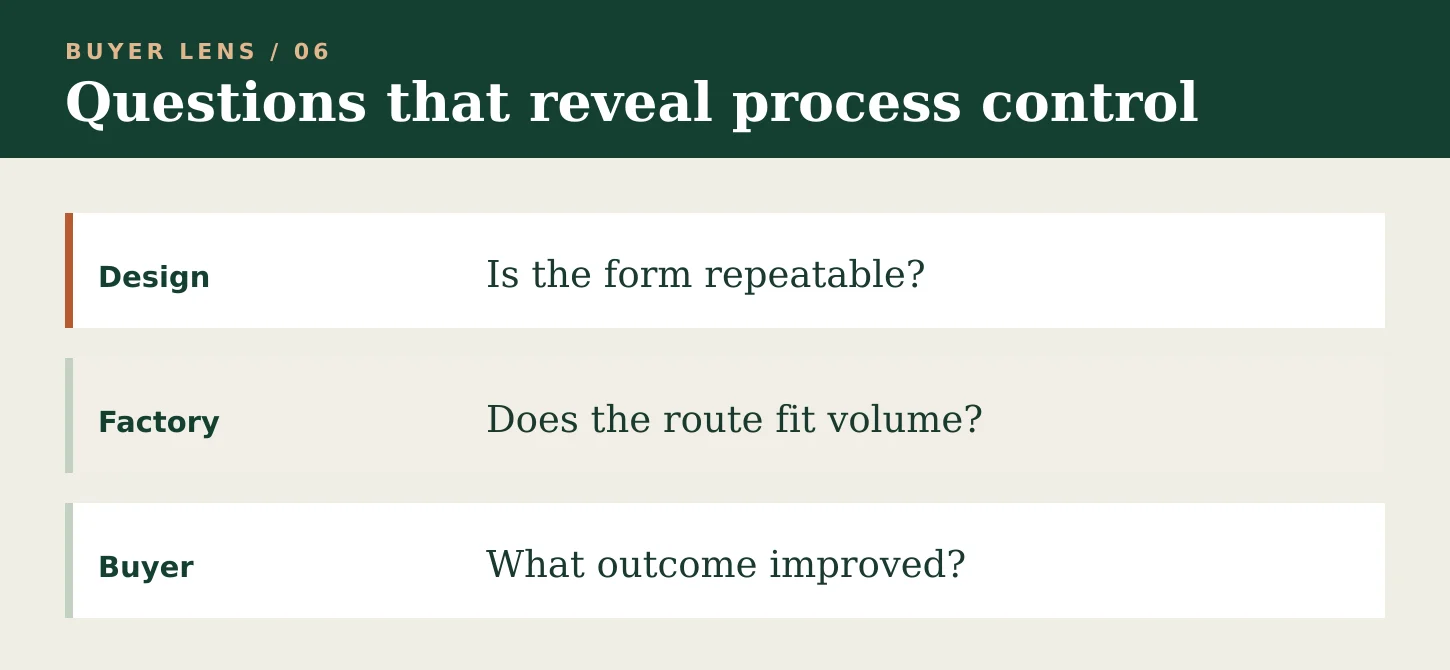
Buyer questions that connect process evidence to the approved ceramic product.
FAQ
Is the ceramic machinery market the same as the porcelain mug market?
No. Machinery suppliers sell production equipment to industrial users; porcelain OEMs sell finished goods to brands and distributors. A market report may group many ceramic subsectors that are unrelated to mugs.
Which technology is best for a custom mug?
The answer depends on geometry, material, finish, quantity, and acceptable variation. Ask the product manufacturer to propose and validate a route with fired samples.
Does automation always reduce the unit price?
No. Tooling, setup, volume, changeovers, yield, decoration, inspection, and packaging affect the landed cost. Compare the accepted SKU at your actual order mix.
Can a modern kiln support an environmental claim?
Not on its own. A public product claim needs an appropriate boundary, measured and verified data, and review for the intended market.
What should a brand ask Daye about machinery trends?
Ask how its proposed process will make and inspect your specific design, what samples prove that route, and how the approved result will be repeated on later orders.