Table of Contents
ARTICLE 01 | MANUFACTURING & QUALITY
CORE KEYWORD ceramic machinery
Ceramic machinery is part of the reason two mugs made from the same drawing can differ in shape, glaze, handle attachment, or delivery consistency. Yet a machine list alone does not tell a brand whether a factory can reproduce an approved product. The result depends on the interaction of ceramic body, mold, forming method, drying, firing, decoration, operators, maintenance, and inspection. For a private-label mug program, the most useful question is not how many machines a factory owns. It is how the proposed production route turns a design into repeatable sellable units.
Daye Porcelain is a Chaozhou manufacturer of ceramic products for OEM and ODM projects. Its own company materials document casting, rolling, trimming, firing, glazing, decoration, testing, and inspection in its porcelain workflow. This article uses those documented stages to help brands and distributors examine a production plan. Daye manufactures porcelain products; it is not presented here as a seller of ceramic machinery.
Key takeaways
- Match the forming route to the mug’s geometry, forecast, finish, and acceptable variation.
- Approve a fired and decorated sample, then define the characteristics that must repeat in bulk.
- Ask how molds, equipment settings, maintenance, and inspection records are controlled between orders.
- Evaluate the complete process and actual samples instead of treating automation as a quality certificate.
Follow the product through the process
The European Commission’s ceramic manufacturing reference describes a broad sequence of raw-material preparation, shaping, drying, surface treatment, firing, subsequent treatment, sorting, and packaging. Tableware routes vary: a cup may be formed, dried, biscuit fired, glazed, glaze fired, decorated, and fired again, or use another validated sequence. A buyer should request the route proposed for the exact SKU. A generic factory tour can hide the handoffs where variation enters.
|
Stage |
Typical equipment or control |
What the buyer can verify |
|---|---|---|
|
Body and mold preparation |
Mixing, molds, work instructions |
Approved body, mold identification, design revision |
|
Forming and finishing |
Casting or rolling, trimming, handle attachment |
Shape, wall, handle, rim, and base consistency |
|
Drying and firing |
Drying controls and kiln route |
Cracking, warpage, fired dimensions, color |
|
Glazing and decoration |
Dipping or other application, printing or decal |
Coverage, registration, food-contact surface, finish |
|
Inspection and packing |
Visual, dimensional, functional checks |
Defect limits, test evidence, carton protection |
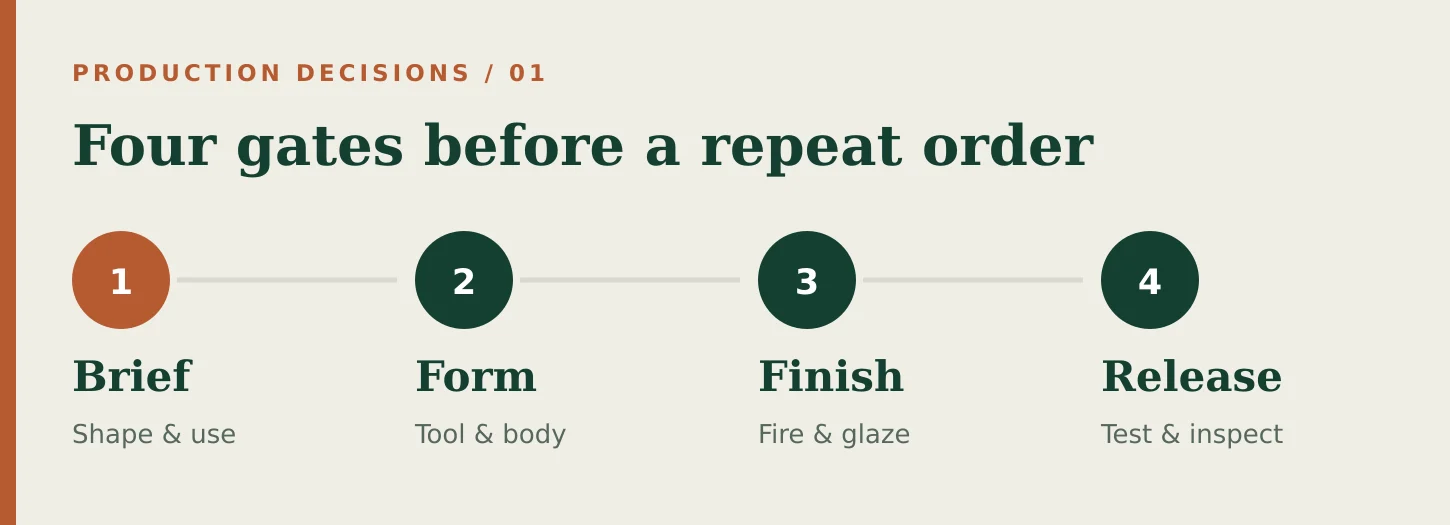
Illustrative decision sequence for product development and repeat-order control.
The table is a conversation map, not a claim that every factory owns a particular branded line. Equipment makers such as SACMI-SAMA offer different routes for tableware, including jiggering, casting, glazing, and firing. Daye’s actual production route and capacity for a proposed design should be confirmed during quotation and sampling. A new sculptural handle may require a different forming and assembly plan from a simple cylindrical cup, even if both are called porcelain mugs.
Forming: the geometry decides the route
Jiggering or rolling is used in tableware production for suitable rotational forms. SACMI-SAMA describes machines for cups, bowls, and related shapes, with ceramic material fed to a mold and formed by a controlled tool. Casting can accommodate different geometry, including shapes that are awkward for a rotating profile. These are families of methods, not a guarantee that a particular mug should use one of them. A factory may combine machine forming with manual handle attachment and finishing.
For a buyer, the drawing must state more than outer height and diameter. Define useful capacity and how it is measured; opening and base dimensions; wall and rim expectations; handle clearance; weight range; lid or saucer fit if applicable; and locations where glaze or decoration cannot obscure a function. Ask the manufacturer which dimensions will change after drying and firing and which need a measured tolerance on the finished ware. A nominal mold size is not a final product size.
Daye’s prototyping and mold development process is the right place to discuss an unfamiliar silhouette. Request a first fired sample before treating a rendered image or green body as proof of fit. Pour and handle the sample in the way the end customer will. Check stability on a level surface, ease of grip, pouring comfort, stacking if required, and the space left for artwork. If the brand changes a handle or wall profile, record the revision and reapprove the fired result.
Drying and firing: control the changes that cannot be edited later
Freshly formed ceramic contains moisture and changes dimension as it dries and fires. An unsuitable drying or firing route can show up as cracking, distortion, uneven color, or fit problems. Kiln equipment suppliers distinguish continuous and intermittent firing systems and multiple firing stages for tableware. The buyer does not need to specify a kiln model, but should ask how the manufacturer validates the schedule for a new body, glaze, shape, and decoration combination.
An approval sample should represent the same body and intended firing route as production. If the manufacturer later changes the body formulation, mold, firing profile, or factory route, the buyer should know whether a new approval is required. The point is especially important for a tight lid, stackable set, or mug with a large flat printed area. Small dimensional or shade changes may be commercially significant even when the product remains technically usable.
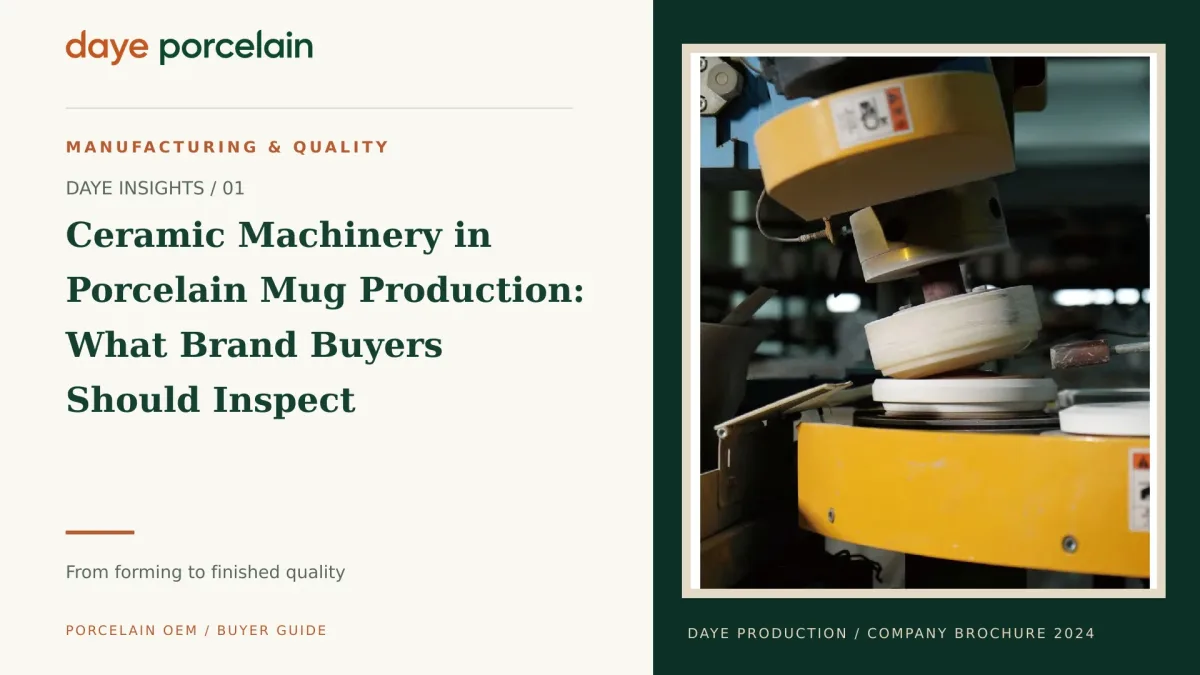
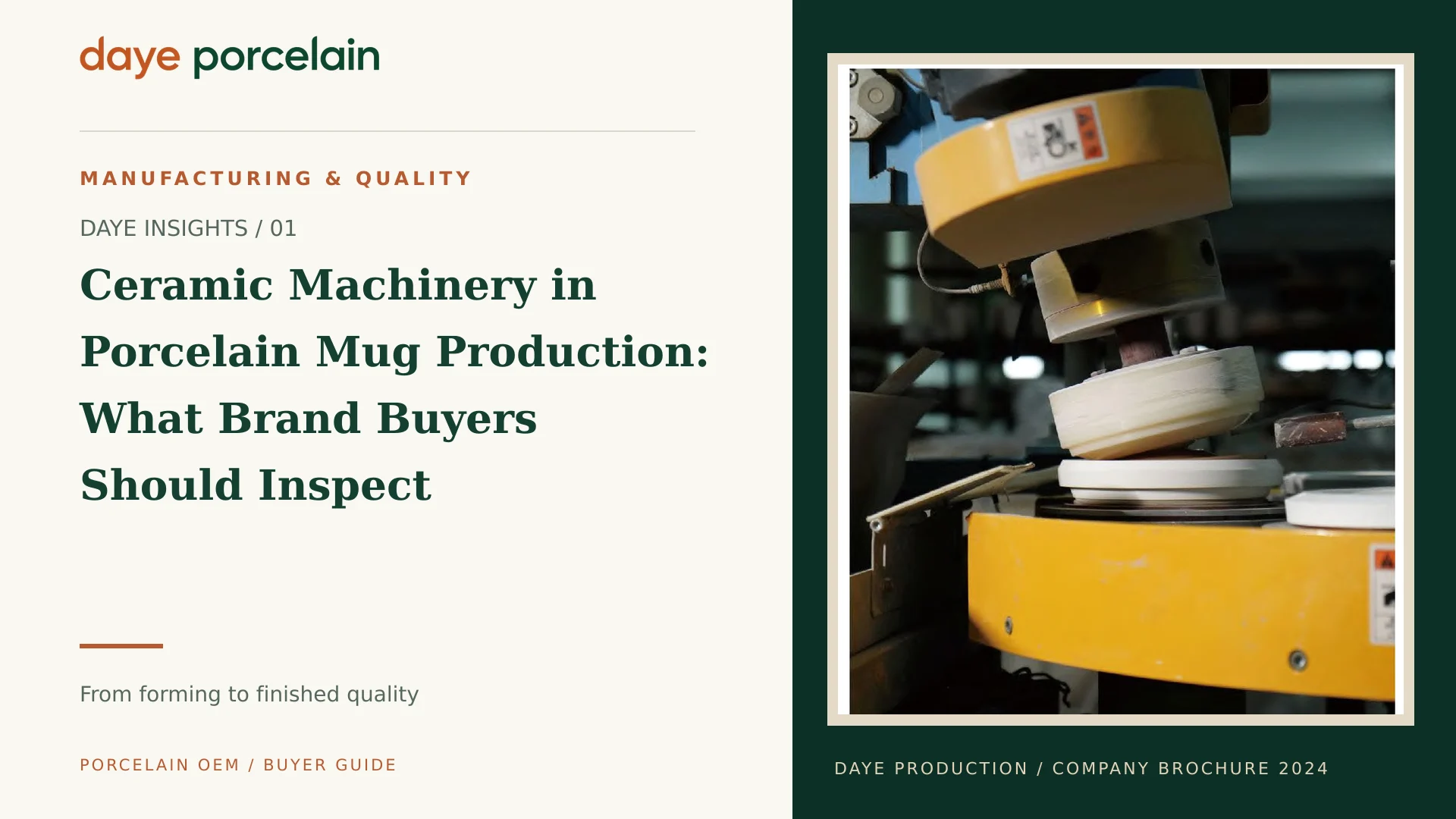
Daye’s 2024 company brochure illustrates biscuit firing, glazing firing, white-body inspection, and product testing. Those images are evidence of stated process stages, not evidence of the exact kiln, throughput, or machine configuration for a future order. Ask for the current production plan for your SKU, sample records, and the proposed point at which a preproduction unit is signed off. This keeps the conversation grounded in the product you will buy.
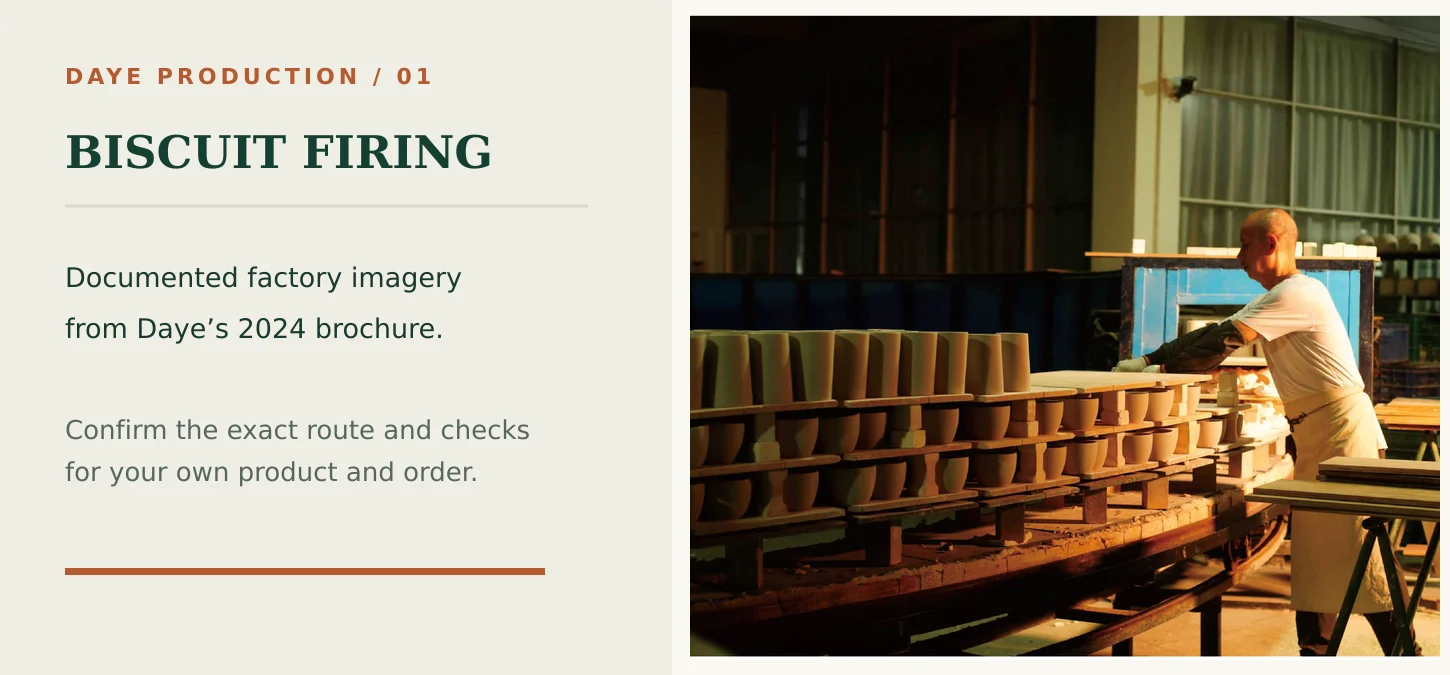
Factory photograph from Daye Porcelain’s 2024 company brochure. Confirm the production route for the specific order.
Glazing and decoration: define the appearance you can repeat
A glaze can make a mug look simple while requiring careful coverage at the rim, handle joint, interior, and foot. Equipment suppliers describe both flexible small-lot and more automated glazing methods for hollow ware. The choice depends on form, finish, quantity, and process design. No method removes the need for a visual standard. A glossy white surface may reveal pinholes and shade shifts; a reactive finish may need an agreed range rather than one impossible identical color.
For OEM artwork, specify the approved color reference, physical placement, orientation relative to the handle, printing method, readable minimum size, and acceptable registration variation. Ask which areas have direct food contact and what test or documentation is relevant to the destination market and actual materials. Do not assume that a decoration or coating is safe for food contact because a brochure calls the item a mug. A qualified test plan should follow the finished material, use conditions, and sales market.
Daye’s design and development and manufacturing pages are useful starting points for a brief. A brand should still obtain the exact sample, artwork proof, and acceptance criteria for its own project. When one seasonal design uses multiple glaze colors, approve each commercially important colorway. A strong master sample makes production inspection more objective than a description such as “premium ivory.”
Inspection: connect machine settings to sellable units
Machine output is an intermediate result; the wholesale buyer pays for acceptable packed units. Define what will be checked at incoming material, during forming, after firing, after decoration, and before shipment. Daye’s brochure shows in-process and final inspection as separate steps, and lists tests such as microwave, dishwasher, thermal shock, and water absorption according to different requirements. The applicability and method for a specific SKU should be agreed rather than assumed from a general capability list.
Request an inspection sheet that separates critical functional faults, major visible faults, and minor cosmetic variation. Examples may include cracks, sharp edges, unstable base, handle defects, incomplete glaze where it matters, unreadable artwork, severe warpage, and packaging damage. Define the viewing condition for cosmetic judgments and retain signed reference samples. A photograph can support communication, but lighting and screen color make it a weak sole standard for a subtle glaze.
Measure the production items, not just a polished first sample. Ask how often key dimensions are checked and what triggers a hold or correction. Check several cartons from different parts of a lot, and review a batch’s inspection record together with physical pieces. If a supplier claims a high yield or automated control, ask for evidence relevant to the item rather than a generic percentage. The buyer’s interest is the accepted delivered quantity and consistency over successive POs.
What to ask on a factory visit or video audit
A useful audit follows an actual product family from tooling to carton. Ask the team to show how the current approved revision is identified at the mold, forming station, decoration station, inspection desk, and packing line. Then ask what happens when a mold wears, a glaze batch changes, or a machine stops. This reveals whether the system depends on one experienced operator or has a transferable method. Do not demand access to confidential settings; seek a credible control process and evidence.
Discuss the planned quantity, number of designs and colors, sample lead time, tooling ownership, peak-season loading, and reorder window. A line that performs well for a large uniform run may be less flexible for a brand with four small variants. Conversely, a highly flexible workshop may need a different plan for a large retail launch. The right configuration is the one that can produce the approved item in the required mix and timeframe with a documented inspection route.
Before placing an order, send Daye’s project inquiry a concise product brief: drawings or reference samples, material and finish expectations, decoration files, annual forecast, first-order mix, destination, intended food-contact and care claims, and packaging. Ask which forming, firing, and inspection steps it proposes and which details require sampling. This turns a discussion about ceramic machinery into a useful OEM manufacturing decision.
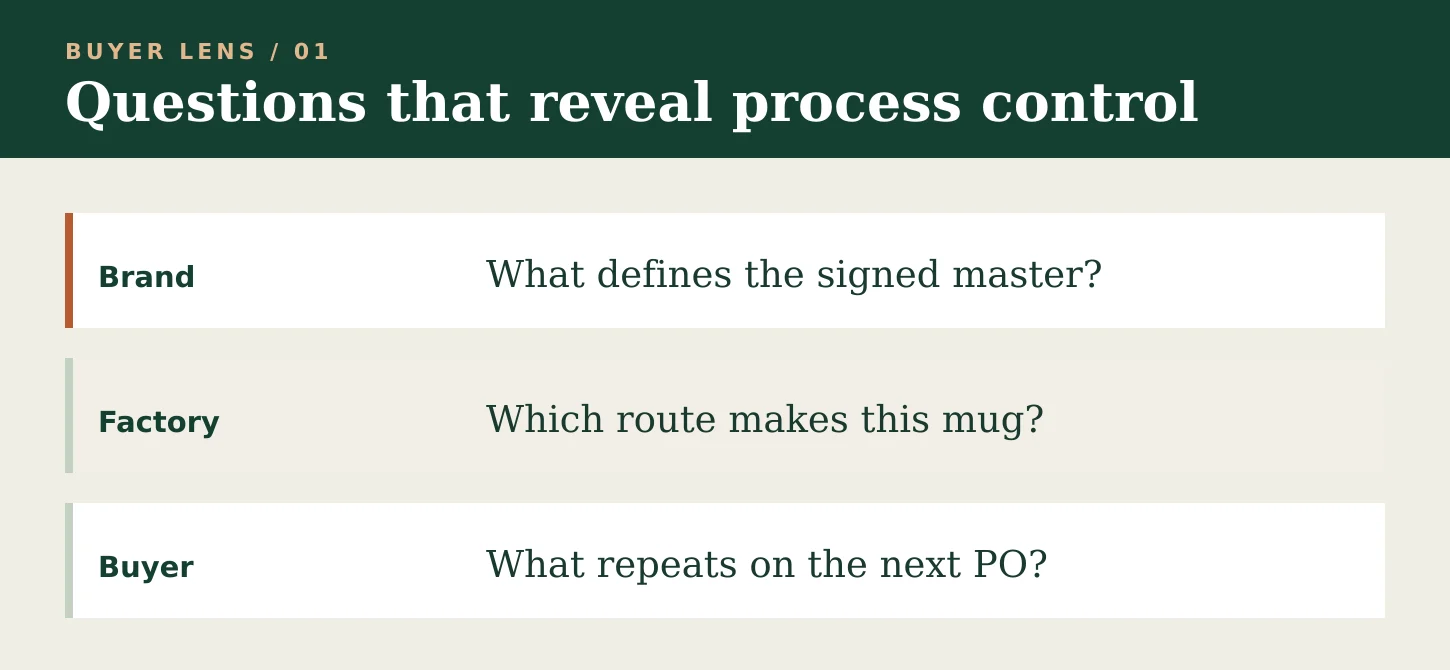
Buyer questions that connect process evidence to the approved ceramic product.
Common mistakes in equipment-led sourcing
The first mistake is comparing machine counts without defining the product. The second is approving an unfired body or a digital render and discovering that shrinkage changes the lid, handle, or artwork position. The third is treating every “automatic” station as evidence that inspection is unnecessary. The fourth is allowing an approved sample to drift through undocumented material, mold, glaze, or decoration changes. Each can be prevented with a clear specification, a fired master, stage gates, and a repeat-order record.
Avoid importing tile or refractory equipment assumptions into a mug project. “Ceramic machinery” covers several industries with different forming methods, kiln designs, and product tests. The equipment that matters to a custom porcelain mug buyer is the equipment and process that will make that mug. If your inquiry is for machines themselves, contact a specialist equipment manufacturer; if it is for finished branded porcelain, evaluate the ceramic product manufacturer and its samples.
At receiving, compare the delivered cartons with the approved pack and inspect a sample across multiple cartons and pallet positions. Record whether a fault originated in manufacture, decoration, or transport before assigning corrective action. A cracked handle inside an intact retail box may call for a different investigation from a crushed outer carton. Share photographs, counts, lot identifiers, and a physical sample when practical. A useful supplier relationship closes the loop: the manufacturer reviews the evidence, explains a correction, and shows on the next order that the process or pack has improved. This feedback is part of manufacturing quality, even though it happens after the machinery has finished its work.
FAQ
Does more automation mean better porcelain mugs?
No automatic conclusion follows. Automation can help control repeatable operations, but body preparation, tooling, process settings, maintenance, decoration, and inspection still determine the finished result. Review actual samples and repeat-lot evidence.
What is the most important sample to approve?
A fired, glazed, decorated preproduction sample made through the proposed route. Keep an agreed physical master and a written specification for dimensions, appearance, function, and packing.
Should a buyer choose casting or rolling?
Supply the geometry and forecast, then ask the manufacturer to recommend and validate the route. The choice depends on form, tooling, material, quantity, and finish; it cannot be made from the keyword alone.
Does Daye sell ceramic machinery?
Daye’s published offer is custom ceramic product manufacturing and related development. Discuss a mug or tableware OEM project with Daye; an equipment purchase belongs with a machinery supplier.
How can a brand protect consistency on a reorder?
Retain the signed master, drawings, artwork, approved materials and finish, packaging specification, and test and inspection records. Require review when a controlled item changes before the next lot is released.