Table of Contents
ARTICLE 06 | MARKET APPLICATIONS & TRENDS | CORE KEYWORD: coffee mug brand in Italy
A search for a coffee mug brand in Italy often mixes together espresso equipment, café merchandise, retail mugs, and the companies that design and supply porcelain for coffee businesses. Club House belongs to the last group: an Italian coffee-service porcelain company that develops cups and exclusive lines for roasters and cafés. Its published company history names Guangdong Daye Porcelain Co. Ltd as a historical production partner. For buyers considering an OEM or ODM partner, that public connection offers a specific example of how Italian brand direction and Chinese porcelain manufacturing can work together over time.
Club House’s own site says the company was founded in 1992 and is based in Castegnato, Brescia, Italy. Its history records a 2011 Intertek audit commissioned at its “historical production partner” Guangdong Daye Porcelain, with a plan to repeat the activity every two years. Daye’s 2024 company introduction goes further, saying the relationship began in 2000 and describing a long exclusive partnership. The latter is Daye’s account; the public Club House page independently confirms the production-partner relationship and audit milestone. Neither source alone identifies which current catalogue SKU is made at Daye or discloses current contract terms, so individual products should not be attributed without further evidence.
Key takeaways
- Club House is an Italian porcelain and coffee-service brand, and its own history publicly identifies Daye as a historical production partner.
- Daye’s 2024 company material dates the cooperation to 2000; Club House’s public timeline documents a 2011 third-party audit at Daye.
- The useful sourcing lesson is a controlled design-to-production relationship: clear product intent, repeatable manufacture, independent review, and a long-term quality conversation.
- Another brand should commission and test its own exact cup rather than treating a reference partnership as automatic approval for a new design.
What the two companies say publicly and in supplied material
Club House’s company page describes itself as Italian and focused on porcelain for the coffee ritual. It says it works with designers and international brands to develop, engineer and produce exclusive lines for leading roasters. Its contact page gives an Italian company address in Castegnato. The `.ch` web address therefore should not be mistaken for evidence that the company is Swiss. The company presents a broad professional cup business rather than a single commodity mug.
In the 2011 entry of its own chronology, Club House explicitly names Guangdong Daye Porcelain Co. Ltd as its historical production partner and says an audit was commissioned to Intertek there. This is unusually concrete evidence for a manufacturing relationship: it gives a named partner, a third-party auditor, and a date. The page says the audit activity was intended to be repeated every two years. The site does not publish every subsequent audit report or the present commercial contract, so a current buyer should request contemporary evidence for any claim requiring it.
Daye’s 2024 company introduction has a page headed “CLUB HOUSE.” It states cooperation started in 2000, describes an exclusive partnership, and discusses the growth of coffee cup and saucer production from simpler white products to more complex colored glazes. The following page says Daye and Club House jointly developed and launched the Maniko, Tulipano, and Volcano lines in the preceding four years. Club House’s own catalogue and history identify those three lines, although they do not separately name the factory for each current variant. The joint-development and exclusivity details come from Daye’s account; current contract scope is not publicly specified.
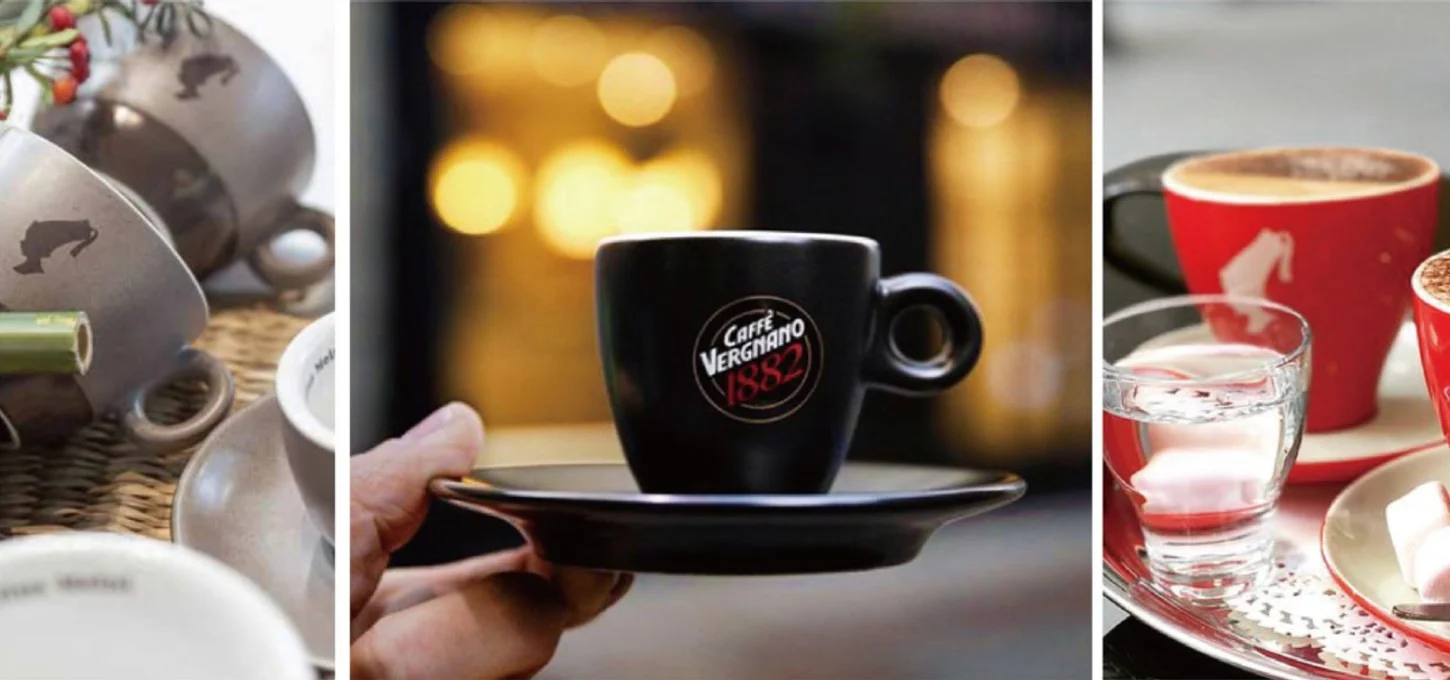
Daye Porcelain company introduction (2024), p. 47: Club House section. The pictured designs are not a blanket attribution of current production.
Why this is a manufacturing case, not merely a logo reference
The Club House chronology places the Daye relationship inside its own business development, not in a decorative list of customer marks. Its page describes design, engineering, porcelain production, decoration, and logistics as parts of the offer to coffee businesses. Daye’s brochure, meanwhile, shows the underlying processes: preparation, forming, firing, decoration, testing, and packing. Read together, the sources support a case about coordinating an Italian brand’s product direction with an overseas production partner, while leaving individual product attributions and confidential terms open.
The 2011 audit is particularly instructive. An audit can examine labor or facility conditions and aspects of management at a particular date and scope; it is not a permanent certification of every cup. But a brand choosing to commission one at a named production partner indicates that factory oversight matters to the relationship. A buyer can use this as a prompt to ask a new supplier how it handles site access, current audits, corrective actions, and traceability. It should not copy a past audit logo into its own marketing or imply that Club House’s review covers another brand’s order.
The product category also matters. Espresso serviceware may be ordered in large repeat runs with demanding café use, while a fashion-led retail mug may require smaller color variants and gift packing. Club House’s site describes hard feldspar porcelain and coffee-industry clients; Daye’s brochure describes expansion from white coffee cups and saucers to colored glazes. It specifically names three jointly developed lines: Maniko with a double-wall concept, Tulipano with a colored matte range, and Volcano with a distinctive form. Club House independently presents Maniko, Tulipano, and Volcano as its lines. This progression illustrates the need to validate shape, finish, and decoration as a product family grows; the brochure is the source of the Daye co-development attribution.
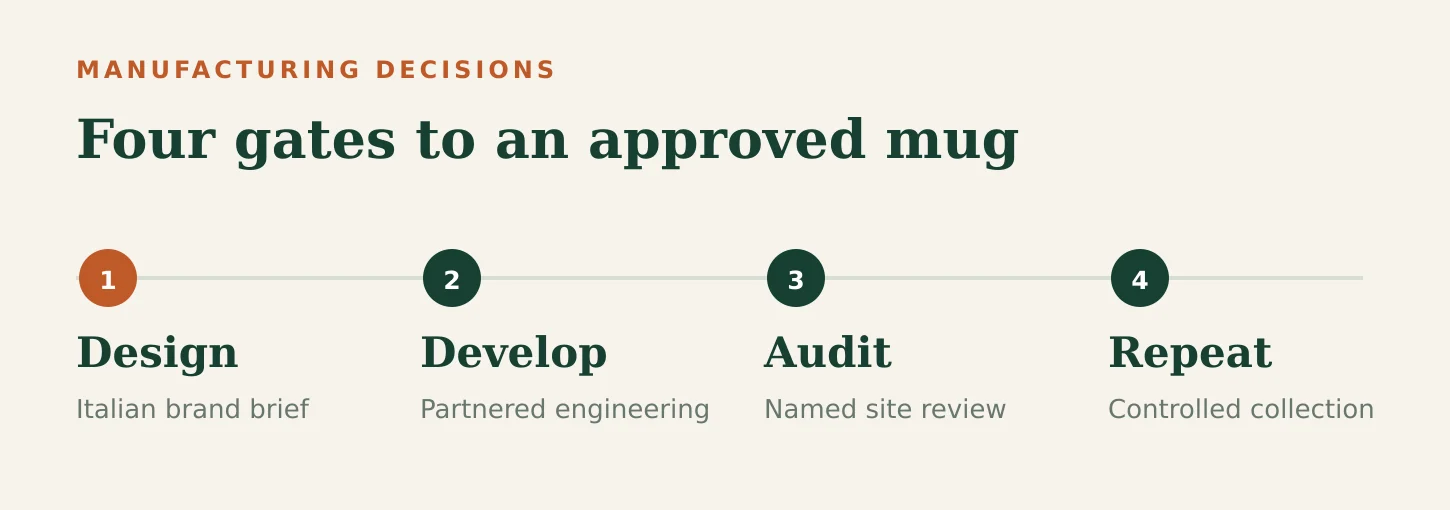
Editorial decision framework; project-specific steps should be agreed in the brief.
What an Italian brand should decide before OEM production
An Italian coffee-service company or an independent porcelain mug brand in Italy should first own a clear design brief. Define the beverage, capacity, hand feel, saucer or lid fit, visual identity, hospitality or retail use, and expected reorder cycle. The manufacturer can then advise on body, forming method, glaze, and decoration. If the brand uses a designer, agree who owns the drawings and tooling and what confidential use of the design is permitted. A long relationship begins with clear rights and approvals, not with a beautiful render and an undefined “similar cup” request.
The first physical sample should answer practical questions. Is the lip comfortable? Does the cup balance with a filled drink? Is the logo legible when the handle is oriented for service? Are the white and colored finishes acceptable under the café’s lighting? A cup and saucer should be sampled as a pair, and several pieces should be reviewed to understand normal variation. The pilot run should use the intended manufacturing route and pack, followed by written release criteria. A brand should keep the approved fired master and the versioned specification for future orders.
For distribution in Europe, the finished food-contact article needs documentation appropriate to its destination and materials. Ask a qualified laboratory to define the relevant ceramic release tests and any care or performance claims. Dishwasher, microwave, thermal shock, decoration abrasion, and packed transit may also be considered according to the use case. Daye’s company material describes an in-house laboratory and these kinds of physical checks, but the buyer must select and document the tests for the exact proposed SKU. An Italian office address and an audited Chinese factory do not themselves replace product-specific evidence.
|
Brand decision |
Production conversation |
Evidence to retain |
|---|---|---|
|
Cup identity |
Original form, volume, rim, handle, finish |
Signed fired samples and drawings |
|
Branded presentation |
Decoration route, logo position, color |
Artwork revision and decorated master |
|
Intended use |
Café handling, washing, food contact |
SKU-matched test plan and results |
|
Long relationship |
Tool ownership, change approval, reorders |
Contract terms and batch records |
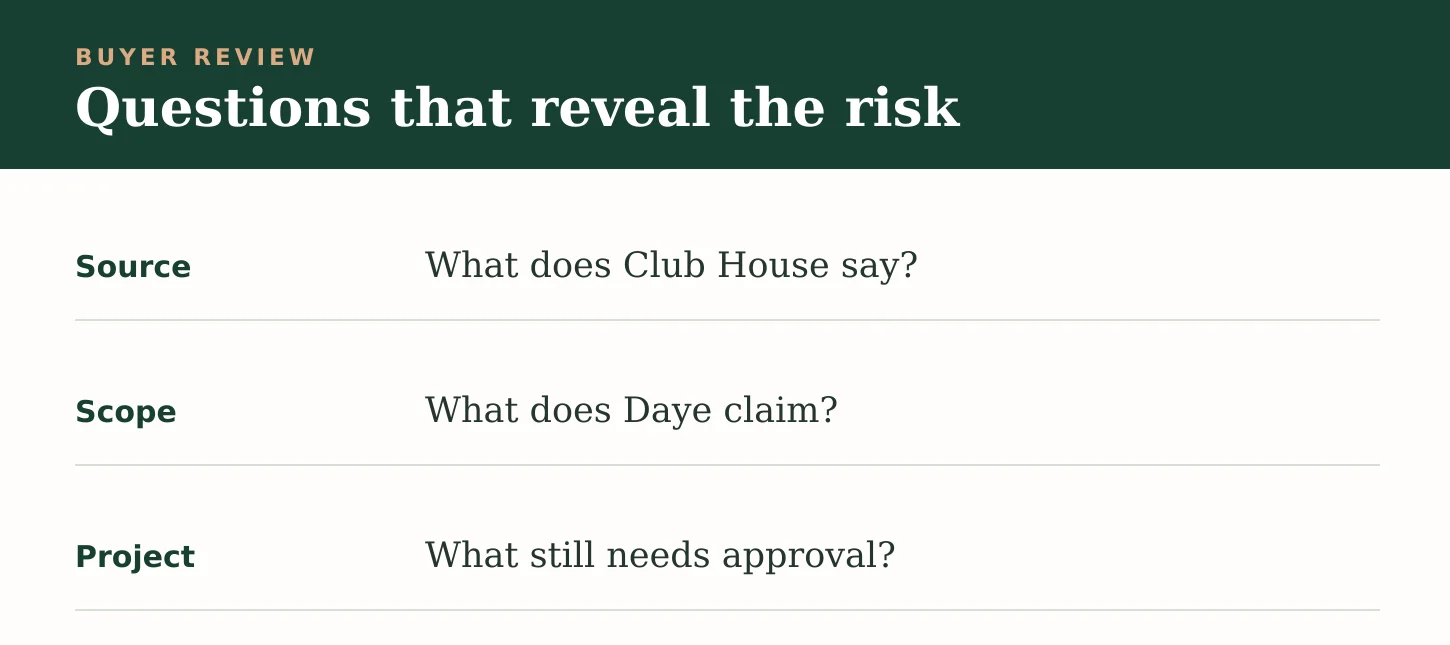
Questions to discuss when approving this particular product or partnership.
How to use the case without overstating it
Some search results may call Club House a “ceramic mug brand in Italy”; others call it a “porcelain mug brand in Italy.” The company itself emphasizes porcelain coffee cups and professional serviceware, so that narrower description is more precise than a generic coffee-bean brand label. For SEO copy, the broad search language can lead the reader in, but the article should immediately explain the actual company and product category. That precision helps a relevant buyer trust the case instead of mistaking the company for a roaster.
Avoid three common leaps. First, the existence of a historical partnership does not prove that every Club House design in a current catalogue was manufactured by Daye. Second, the dated audit milestone does not establish a current audit pass or its scope. Third, an “exclusive partnership” line in Daye’s brochure is not enough to describe current rights, territories, or exclusivity terms without a fresh confirmation. It is entirely appropriate to say that Daye and Club House have a documented relationship; it is not appropriate to attach an unsupported manufacturing attribution to a particular photograph.
The strongest use of the case in a brand’s supplier discussion is specific. Ask Daye what capabilities it would propose for your own coffee cup, what sample and pilot route it recommends, how it controls fired finish and decoration, and what current documents it can share for the relevant site and product. A historical European partnership is a reason to ask informed questions. The answer for a new buyer will still be the quality of that buyer’s physical sample, evidence, schedule, and commercial agreement.
A partnership model for brands, distributors, and trading companies
An Italian brand can lead design and customer insight while a manufacturer handles tool development, production engineering, inspection, and shipping preparation. The two sides should maintain a shared revision log and a named decision maker for form, color, artwork, and release. If a trading company coordinates the order, it should keep these technical decisions visible rather than compressing them into a line on a quotation. A distributor needs an agreed reorder specification and a clear defect-handling path because its retailers will expect the same cup months later.
The relationship should also anticipate changes. Coffee brands refresh logos, add new finishes, and adapt their cup range to different drinks. Every new decoration or glaze should be reviewed for appearance, use, and applicable tests. A supplier might propose a more efficient production route; that change can be welcome if the brand approves comparable fired samples and updates the controlled file. This is how a partnership can evolve without losing the original product’s identity.
Daye’s design development, coffee cups and saucers, prototyping and quality control pages give a prospective brand concrete entry points. Send an original brief and ask for a proposed route, sample milestones, test plan, pack method, and reorder controls. A new partnership should be judged on its own deliverables, even when an established reference makes the initial conversation more credible.
FAQ
Is Club House an Italian company despite its `.ch` domain?
Yes. Its own contact page lists Club House Srl in Castegnato, Brescia, Italy, and its company page describes the business as Italian. A domain suffix should not override the company’s stated location.
Does Club House itself name Daye as a partner?
Yes. The Club House company history names Guangdong Daye Porcelain Co. Ltd its historical production partner in the entry describing a 2011 Intertek audit. This is an official statement from Club House, not merely a claim made by Daye.
When did the cooperation begin?
Daye’s 2024 introduction says 2000. Club House’s public history establishes the relationship by its 2011 audit entry but does not give the same start date there. The year 2000 is therefore attributed to Daye’s company introduction.
Can I say Daye currently makes all Club House cups?
The sources reviewed do not establish that. They document a historical production relationship and a dated audit, while Daye’s brochure describes a long partnership. Individual current SKUs and contract scope should be confirmed before making a broader claim.
What should another Italian brand ask Daye first?
Send a brief for the intended cup and request a project-specific manufacturing route, physical sample plan, quality criteria, relevant current audit evidence, market-specific tests, packed pilot, and written reorder controls. A reference partnership is valuable context, but the new SKU needs its own approval.
References
- Club House: Company, services and history, including its 2011 entry naming Guangdong Daye Porcelain.
- Club House: Contacts, identifying its Italian address.
- Daye Porcelain, Introduction of Daye Porcelain (2024), pp. 17–23, 26–27, 47–48.
- Daye Porcelain: Coffee Cups and Saucers.
- EUR-Lex: Ceramic objects in contact with foodstuffs.