Table of Contents
ARTICLE 02 | MANUFACTURING & QUALITY | CORE KEYWORD: coffee mug factory in China
Choosing a coffee mug factory in China involves more than checking an address, a certificate image, and a sample price. The buyer needs to know who owns the production steps, how a particular mug is approved, what the factory checks during manufacture, and which records can be matched to the finished shipment. For a European or American brand, these questions are especially important when a sourcing agent, importer, and manufacturer are all involved. This article gives a practical evidence-based audit method for a ceramic or porcelain mug project.
The point is not to demand every document on a generic checklist. A white café cup and a decorated retail gift mug present different risks. Request evidence proportional to the product, destination, and claims. Daye Porcelain’s own 2024 introduction provides a concrete example of a Chaozhou manufacturing operation with forming, firing, decoration, in-house testing and packing stages. It also reproduces historical audit and quality-system documents. Those images help frame questions, but a buyer should obtain current, legible, scope-matched records before relying on any certification for a new order.
Key takeaways
- Establish the legal manufacturing entity, production location, and which processes are in-house or subcontracted for the actual order.
- Verify document validity, issuing body, site, scope, date, and model or sample match rather than accepting a logo on a brochure.
- Trace a sample through drawing, body and glaze choices, pilot approval, test results, inspection, and packed lot.
- Audit the controls that address your likely failures: handles, food-contact surfaces, logo placement, color repeatability, and transit damage.
Start with a product-specific audit scope
Before reviewing a factory, write a one-page product brief. Include capacity, material, glaze, decoration, handle style, intended use, destination market, approximate first order, expected reorders, and pack format. Note whether an existing design will be adapted or a new shape developed. This allows an auditor to follow a representative product route. A walk-through of an unrelated plate line does not prove control of a molded mug with a fragile handle and multiple decals.
Identify the commercial and production parties. The company invoicing the order may be a trading company, and a factory may outsource some decoration, testing, or packaging. Neither arrangement is inherently a problem; unclear responsibility is. Ask for the manufacturer name and address, the physical sites involved, the responsible quality contact, the subcontracted steps, and who signs off nonconformities. Match these details to the purchase contract, audit report, test reports, and shipping documents.
If a site visit is possible, follow the actual material flow from receiving to packed goods. If it is not, ask for a live, dated remote review of relevant stations, current records, and a defined sample trace. A polished presentation is useful for orientation but cannot show whether a production control is performed today. Keep the review proportionate and agree in advance which commercially sensitive information may be masked while preserving the evidence needed to make a decision.
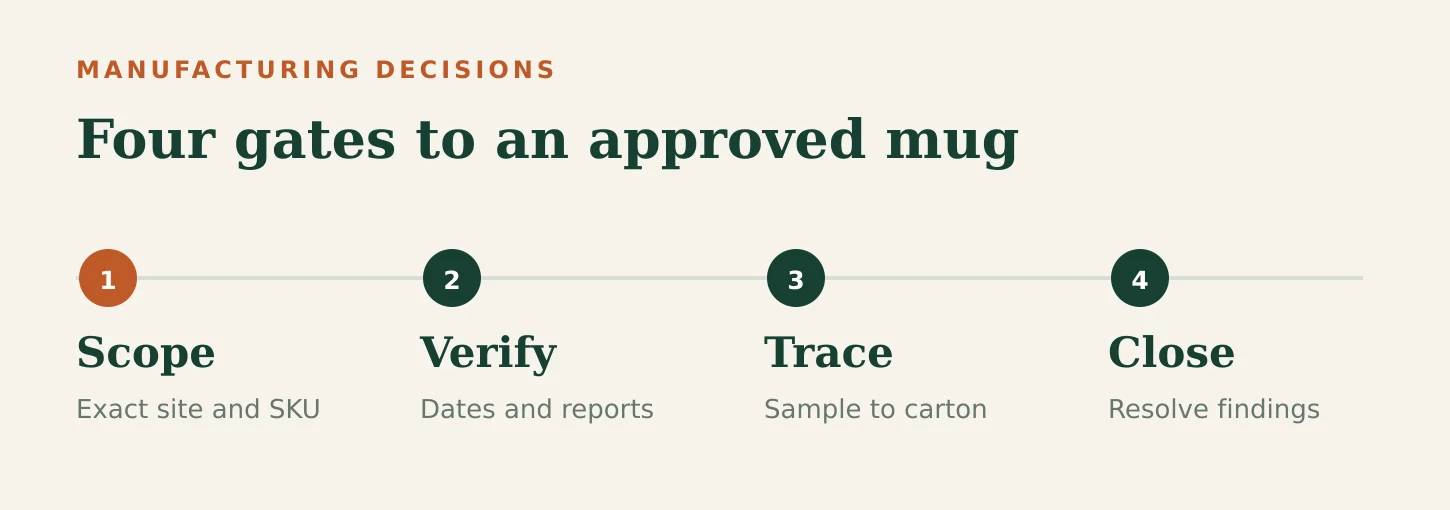
Editorial decision framework; project-specific steps should be agreed in the brief.
Check the factory’s own controls, not only its certificates
A quality-system certificate can indicate a documented management framework, but it does not approve a specific mug. Review the issuer, certificate number, validity, exact legal name, site address, and scope. Where relevant, confirm the record with the issuing organization. Daye’s 2024 brochure shows examples labelled BRC, BSCI, WCA, ISO 9001, SMETA and customer-related audits; these are a historical snapshot and cover different subjects. Do not describe all of them as food-contact certification, or assume they remain active in the same scope. Ask for current copies and clarify what each actually covers.
Look at how the facility controls its real process. At forming, does it record a dimensioned sample and handle position? At the glazing stage, how is a color range approved? Is a decorated master retained, and is artwork version-controlled? What happens to rejected items? Are nonconformities recorded and investigated, or merely removed from the line? A capable quality team should be able to show a recent example of a defect being contained and corrected without revealing another customer’s confidential design.
The audit should also check the boundary between inspection stages. Daye’s brochure describes full inspection of the white body and inspection around decal application and firing, followed by final quality control. Ask what “full inspection” means at each gate, which characteristics are checked, and how rework is segregated. Sampling at final shipment remains necessary because assembly, packaging, and mixed-SKU errors can arise after earlier checks. A process chart is strongest when a record and a responsible person sit behind each box.
Trace one mug from approved sample to carton
Pick a representative SKU, ideally one close to your proposed order. Request the drawing revision, approved physical sample code, material and glaze designation, production order, inspection records, relevant test reports, carton label, and traceability or lot code. The goal is to see whether records refer to the same product. If a dishwasher report is for a plain white cup and the planned SKU has a metallic-looking decoration, the report may not support the new care claim. If a dimensional drawing predates a handle change, ask for the later approval.
The buyer should understand the retention method. Does the factory hold a signed golden sample, a permitted variation range, color references, and a defect board? Where are they kept and who may authorize a change? When a reorder occurs months later, the reference must still be unambiguous. A side-by-side photo can help identify a mismatch, but physical reference samples and written tolerances are more reliable for gloss, rim feel, and color under changing light.
Lot tracing need not be elaborate to be useful. At minimum, a complaint about a chipped handle or off-center logo should lead back to a production batch, decoration batch if applicable, inspection decision, and pack configuration. Ask how quickly the factory could isolate affected cartons. Traceability is an operational tool for containment, not a decorative line on a quality presentation.
Test the trace with a hypothetical customer complaint before the purchase order is released. Give the supplier a carton identifier and ask which production and inspection records it can retrieve. Record the response time and any gaps; this small exercise often reveals more about practical control than a polished flowchart.

Daye Porcelain company introduction (2024), p. 26: in-house laboratory.
Match testing to the destination and finished article
The EU and United States both regulate aspects of ceramic food-contact safety, but a single generic phrase such as “FDA approved mug” is not a product report. For EU-bound products, confirm the relevant food-contact framework and ceramic-specific requirements with a qualified test partner. For US-bound items, consider FDA guidance on extractable lead and cadmium in ceramicware, along with applicable state or customer requirements. Ask the laboratory to identify the exact finished sample, surface and decoration, test method, measured result, date, and report holder. Do not publish a legal compliance claim from a brochure photo.
Physical performance claims need the same discipline. Daye’s brochure lists testing capabilities such as dishwasher and microwave use, thermal shock, water absorption, body and handle strength, abrasion, and transit or packed-product testing. That list is a capability description, not a claim that every Daye mug passes every test. Decide which tests matter to the use case. A café may focus on repeated washing and handle durability; a gift mug may require a robust transit pack; a fine printed surface may need abrasion review.
Ask how samples are selected. A preproduction sample may confirm development direction; a production sample can confirm that the actual batch matches the approved design. Some buyers require independent laboratory work and third-party inspection. The requirements should be written into the purchase order before production starts, including who pays, when samples are drawn, and what happens after a failure. This avoids a dispute in which both parties agree testing is important but mean different things by “tested.”
|
Evidence item |
What to verify |
Common weak signal |
|---|---|---|
|
Facility audit or certificate |
Entity, site, issuer, scope, date and validity |
Cropped logo or expired scan |
|
Product test report |
Exact finished SKU, method, result and market |
Report for another body or decoration |
|
Golden sample |
Signed revision, physical finish, permissible range |
Undated catalogue photograph |
|
Inspection record |
Lot, sample plan, defects, corrective action |
“Passed QC” without criteria |
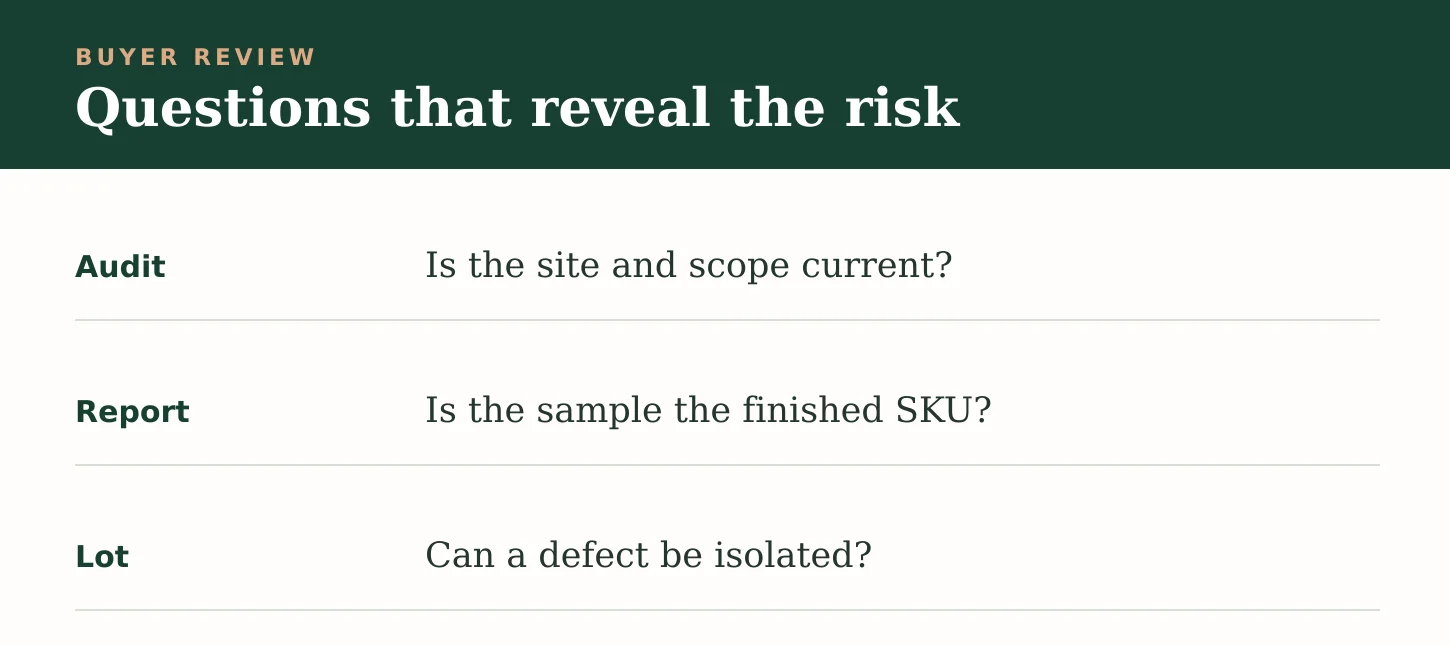
Questions to discuss when approving this particular product or partnership.
Review the commercial handover and change control
A factory can pass an audit and still misunderstand the order. Review the quotation line by line: mold and sample charges, decoration, tools, tests, inner and export packs, spare parts, inspection fees, shipping terms, and ownership or storage of tooling. Ask who approves color or logo changes and whether a revision changes lead time. An importer or trading company should provide a clear channel for technical decisions rather than filtering every question into a unit price.
Create a release checklist tied to the actual order. It might require approved pilot samples, a test report for the finished design, production inspection against agreed limits, a verified carton count and a packing list. Define what happens if one criterion fails: hold, rework, retest, concession, or cancel. A concession must be explicit and documented; silent substitution of “close enough” product creates problems for the brand’s retailers and later reorders.
For a remote buyer, agree on photo or video evidence with identifiers in frame: sample code, date, batch or carton label, and measurement tool where relevant. An image of an attractive factory floor cannot establish that your lot was produced there. Evidence should answer a specific decision question. This also reduces unnecessary requests to the supplier and makes the review faster.
Applying the audit to a Chaozhou project
Daye describes OEM and ODM services and shows a process path from product preparation through packing in its 2024 company introduction. Its quality control and prototyping pages can inform a first discussion. For a new coffee mug brief, ask Daye to identify the proposed forming and decoration routes, provide current scope-matched audit evidence where needed, make a physical sample, and specify tests and acceptance limits for the intended destination. Do the same for any alternative supplier so that the comparison is fair.
A buyer seeking a coffee mug factory in China should leave the audit with a decision record, not a folder of unlabelled images. State the remaining technical risks, who will close them, and the point at which production may start. A strong supplier can explain what it knows, what it still needs to test, and how it will keep an approved mug consistent when volume grows.
FAQ
Is an ISO 9001 certificate enough to prove a mug is safe for food contact?
No. It addresses a management system within a stated scope. A finished food-contact mug needs evidence tied to its material, decoration, intended use, and destination requirements. Ask for product-specific reports and their underlying sample identity.
Should every production step happen in one factory?
Not necessarily. Outsourcing can be managed well when the supplier discloses the relevant process, specifications, records, and accountability. The buyer should know which site performs the step and how the output is approved before the next stage.
How can I check a factory remotely?
Request current documents with site and scope visible, a live review of the product-relevant process, a trace exercise for one SKU, dated production records, and a physical sample. A qualified local auditor or third party may be valuable for a higher-risk or larger order.
Why ask about rejected mugs?
Reject handling shows whether quality decisions are real. The factory should segregate failures, record the reason, decide on rework or disposal, and investigate recurring causes. An impressive inspection rate means little if rejected goods can return to sale stock unnoticed.
Does a previous brand partnership prove my new design will work?
It demonstrates relevant experience but does not replace development. Your capacity, shape, glaze, mark, pack, volume, and market create their own acceptance requirements. Use references to ask better technical questions, then approve the actual SKU.
References
- Daye Porcelain, Introduction of Daye Porcelain (2024), pp. 17, 26–27, 33–34.
- Daye Porcelain: Quality Control.
- EUR-Lex: Ceramic objects in contact with foodstuffs.
- US FDA: Pottery (Ceramics) Cadmium Contamination.