Table of Contents
ARTICLE 01 | MANUFACTURING & QUALITY | CORE KEYWORD: coffee mug factory
A coffee mug factory does more than turn a drawing into a cup. For a brand, importer, or distributor, the difficult part is keeping the approved shape, glaze, decoration, performance, and pack aligned through a sequence of material and firing decisions. The same attractive sample can lead to very different production outcomes if the body recipe, mold, handle joint, kiln route, or acceptance standard changes without a documented approval. This guide follows an OEM or ODM ceramic mug from brief to shipment and shows what the buyer should sign off at each handover.
Daye Porcelain’s 2024 company introduction describes preparation of clay, mold, glaze, decal and pilot run; forming, trimming, biscuit firing, glazing and glaze firing; decoration and further inspection; testing; then packing, final quality control and loading. Those are useful process headings, but the precise route depends on the approved cup. A plain white mug, a hand-finished colored glaze, and a logo-bearing espresso cup need different controls. A supplier’s capability list is a starting point for a project plan, not a substitute for a finished sample and a written specification.
Key takeaways
- Freeze the use case, fired dimensions, useful capacity, material, decoration, and pack before treating a quotation as comparable.
- Ask which forming and firing route will be used for the actual SKU, then review a pilot run rather than only one ideal studio sample.
- Inspect at the body, glaze, decoration, and packed-product stages; a final carton check cannot fix a recurring upstream defect.
- Link claims about food contact, dishwasher use, microwave use, and transport to evidence for the finished design and destination market.
Begin with a production brief that can be measured
The brief should name the intended user and sales channel. A 90 ml espresso cup for a roaster’s café is assessed differently from a 350 ml retail mug with a large handle and gift carton. Record useful fill and brimful capacity separately, with a stated method for measuring each. Add nominal height, top and base diameters, wall and rim expectations, target weight range, handle clearance, base contact, and any saucer or lid fit. Color should have a physical fired reference, not only a screen value; a brand logo needs artwork files, size, color, position, and a reference orientation.
Define the commercial unit as carefully as the object. Is the quotation for an undecorated cup, a finished cup with mark, a cup and saucer, or a retail box? Which inserts, barcode, carton marks, and spares are included? State the forecast, first order, reorder expectation, destination, and required documentation. The factory can then identify which features affect forming, kiln capacity, decoration, and cost. A vague request for a “premium mug” leaves each supplier free to price a different product.
Make a controlled specification revision. A simple identifier such as CUP-01-R2 can appear on the drawing, artwork, sample approval, test request, and purchase order. If the handle or glaze changes, issue a new revision rather than silently replacing a photo in an email thread. This is particularly important when a buyer’s trading company, design agency, laboratory, and factory all hold different copies of the brief.
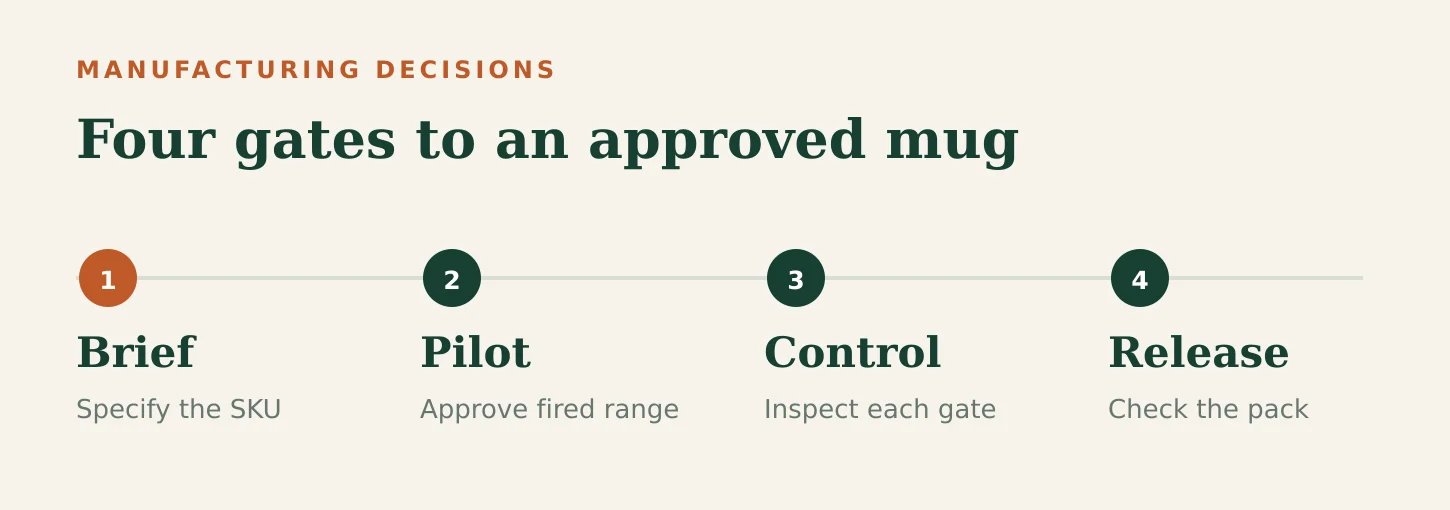
Editorial decision framework; project-specific steps should be agreed in the brief.
Prepare the body, tooling, glaze, and pilot route
Ceramic production starts well before a kiln is loaded. The manufacturer should confirm the body choice and forming method against the geometry. For a mug, a formed body and a separately made handle may need joining and finishing; a relief-heavy or unusual silhouette may require another route. The production plan should show which edges are accessible for trimming, where a mold seam can appear, and how the handle joint will be checked. Ask for a tool drawing or sample review of the rim, foot, and handle openings, since those are the areas users touch and buyers notice.
Glaze selection is likewise a manufacturing choice. An opaque white surface, translucent glaze, and saturated matte exterior create different visual tolerances. The buyer should agree which natural variation is acceptable and which defects are not: crawling, exposed body at food-contact surfaces, pinholes in critical zones, runs at the foot, or inconsistent coverage. An approved color chip alone is too small to show how a glaze behaves over an entire mug and around the handle. Keep a fired master sample or a signed sample set under controlled lighting.
A pilot run should use the intended route and a representative quantity. It tests whether the cup can be produced repeatedly, whether the handle stays aligned, whether fired size and color are stable, and whether decoration registration survives production. It can also reveal a pack that looks fine with one sample but fails when cups vary within their normal limits. Daye’s brochure explicitly lists a pilot run among preparation steps; the buyer should ask which observations from that run will become acceptance criteria for bulk manufacture.
Forming and firing: where shape becomes permanent
Daye’s brochure lists casting, rolling, handle installation, trimming, biscuit firing, glazing and glaze firing in its porcelain production stage. It also shows both manual work and production equipment. That does not mean every mug uses every method; the manufacturing engineer should specify the actual route. After forming, a cup can be checked for wall consistency, rim symmetry, foot flatness, seam finish, and handle placement while corrections remain possible. Once fired, those deviations can no longer be trimmed away without risk to the product.
The first firing gives the formed body enough strength for subsequent handling in routes that use biscuit firing. Glaze application then changes the surface and sometimes the perceived color, and the glaze firing establishes the final surface. Fired shrinkage is one reason that the buyer should approve finished dimensions, not only a mold drawing. Kiln placement and loading can affect results, so the pilot run should sample across normal production conditions. Do not assume a number of kilns or a firing temperature from marketing imagery; ask for the proposed route and what is controlled on the actual SKU.
The white-body or undecorated finished-body inspection is a useful gate. Daye’s company introduction calls out full inspection before decoration. That point matters because a branded decal can otherwise be applied to a cup whose rim, glaze, or handle already fails the standard. Define what is measured and what is visually screened at this gate. A written defect library with approved and rejected examples makes conversations across teams far more precise than the phrase “good quality.”
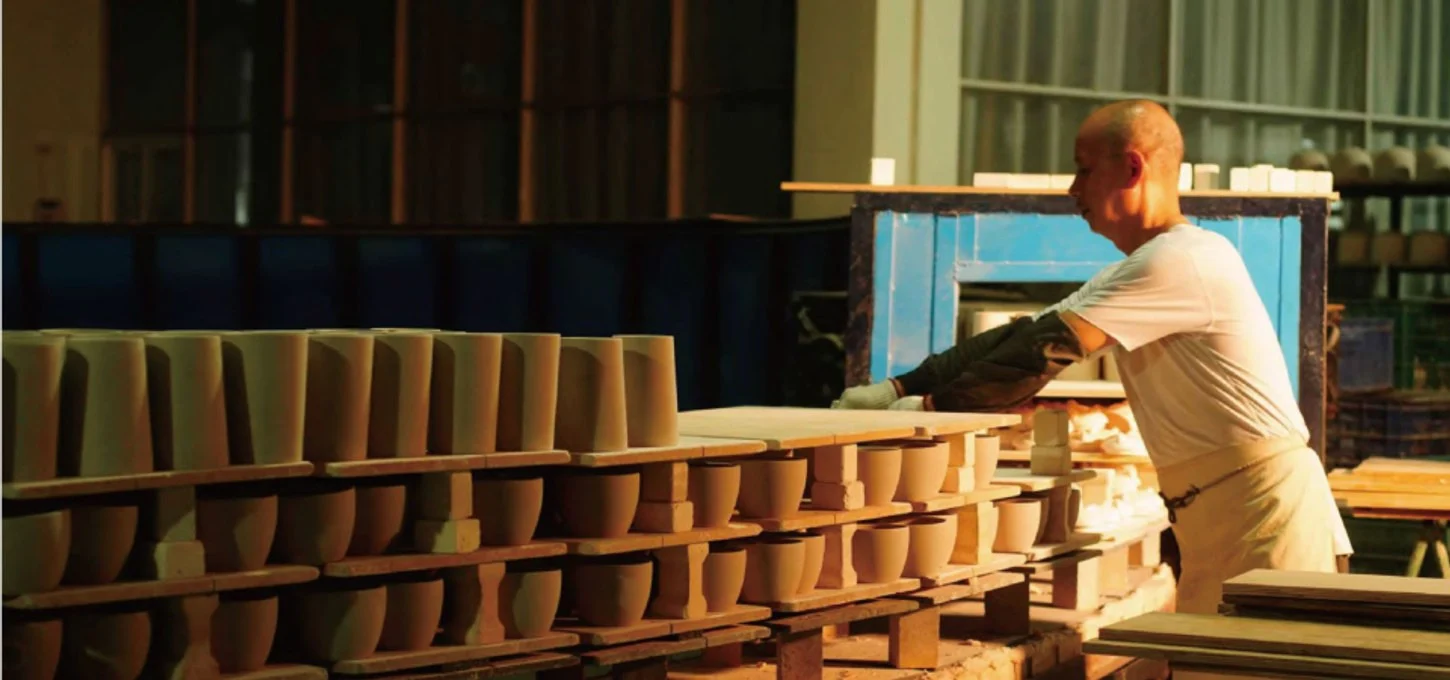
Daye Porcelain company introduction (2024), p. 20: biscuit firing area.
Decoration is another production process
A printed logo or decal is not simply a graphic dropped onto a final photograph. Position around a curved wall, relation to the handle, visible color after firing, and resistance to normal use all require approval. Daye’s brochure describes positioning, printing or laser engraving, hand drawing, decal application, semi-finished decal inspection, decal firing, and final decal inspection. The factory should identify which of these applies to the chosen design. The buyer should check a physical decorated sample from the intended process.
For a retail logo, consider how much variation is visually acceptable in vertical placement and rotation. For a café cup, test whether the mark stays readable when the cup sits on its saucer and whether the decoration route fits frequent handling and washing. If decoration reaches a food-contact surface or rim, raise the materials and testing question explicitly. A claim that a logo is “durable” should be tied to a specified use and test method, not to a generic statement about kiln firing.
Decoration can create an additional release gate. A well-formed mug with a crooked logo is still a failed branded SKU. Compare production samples to a retained decorated master, inspect several positions in the batch, and agree on rework or reject rules before release. If the design includes multiple colors or finishes, treat each combination as a separate approval where its visual or food-contact risk changes.
Build the inspection plan around failure modes
An effective inspection plan names the stage, the characteristic, the method, and the disposition. It should distinguish critical issues involving safe intended use or regulatory compliance, major problems that make the product unsuitable for sale, and minor cosmetic variation within the brand’s chosen standard. The plan also needs a sampling agreement; a label such as “100% inspection” on one process stage does not tell the buyer how the final packed shipment will be evaluated.
|
Gate |
Practical checks |
Buyer evidence to retain |
|---|---|---|
|
Formed and joined body |
Rim, handle joint, symmetry, foot, accessible finish |
Approved dimensional drawing and pilot observations |
|
Glazed and fired body |
Glaze coverage, color range, visible surface, useful fill |
Fired masters and defect examples |
|
Decorated SKU |
Mark position, legibility, color and applicable durability |
Decorated master and artwork revision |
|
Packed order |
Count, protection, carton labels, transit result |
Pack specification, inspection record and test report |
Daye’s brochure says its laboratory can perform project-dependent physical checks including microwave and dishwasher use, thermal shock, water absorption, body and handle strength, surface abrasion, and packed-product transit. Select tests because the product and market require them. A microwave result for one undecorated mug is not automatically evidence for a later metallic-looking decorated version. A laboratory report should identify the precise sample, method, result, date, and design revision. For Europe and the United States, food-contact requirements and market-specific documentation should be confirmed against the destination and finished article rather than inferred from a generic certificate.
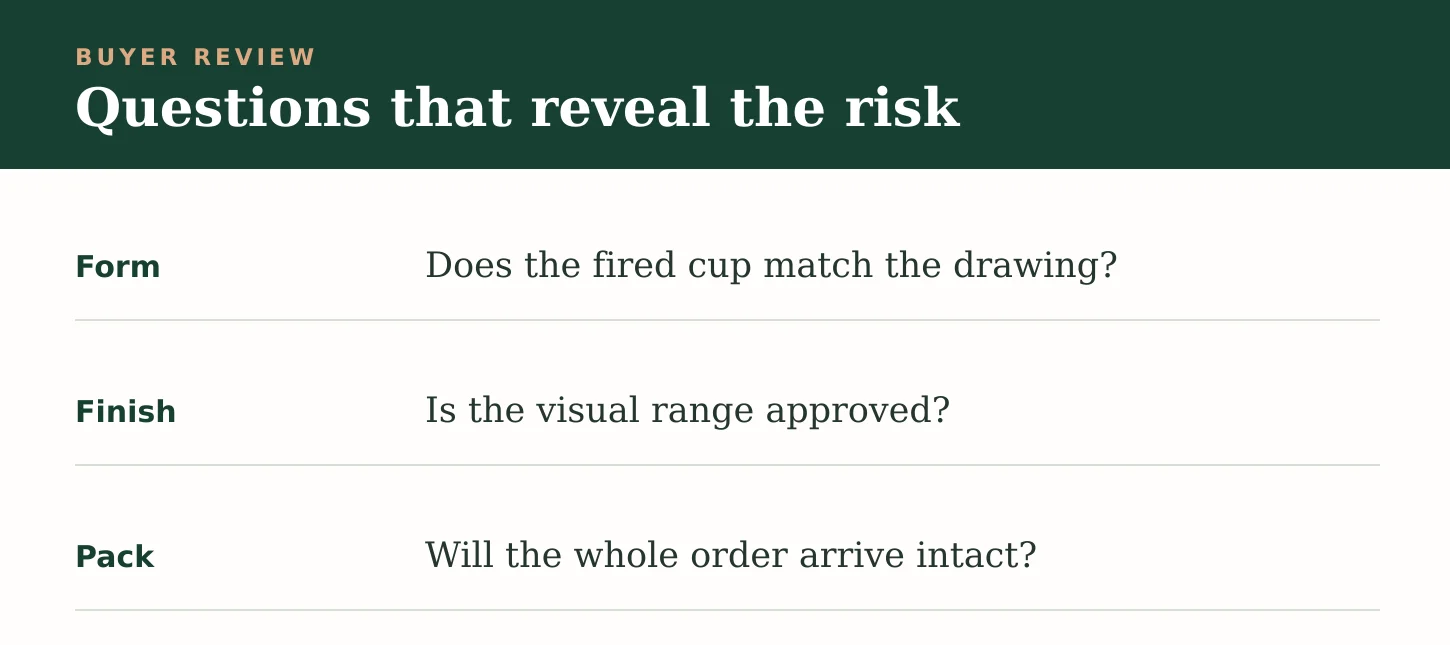
Questions to discuss when approving this particular product or partnership.
Packing and loading are part of quality
The buyer receives a carton, not an isolated display sample. A mug may pass visual inspection and still arrive with chipped handles because the insert allows movement. Ask the factory to make a packed pilot, inspect dividers and clearance, and test the shipping pack for the intended transport route. A cup and saucer must be prevented from striking one another. Retail gift boxes may need a shipping overpack; a visually elegant inner tray can still be too weak for distribution.
Confirm that the final inspection checks the correct number of pieces, approved artwork and barcode, carton identification, and physical protection. For mixed colors or multiple SKUs, the packing list should map cartons to item codes. Set rules for replacement stock and shortages before shipment. A factory’s “final quality control” label is most useful when it is accompanied by a signed report against the agreed specification and a clear release decision.
A sensible OEM handover with Daye
Daye’s custom ceramic mugs, prototyping and mold development, and quality control resources can frame the first discussion. Send the intended cup use, artwork, quantities, destination, and any existing sample. Ask which forming route and glaze are proposed, what needs a tool or pilot, and which tests match the intended claims. Then agree on the approved fired master, written acceptance criteria, packaging, and version-control process.
For a brand or distributor, this creates a practical decision sequence: concept feasibility, physical sample, pilot run, bulk controls, and packed-order release. It also makes a quote meaningful. Two prices for “one mug” are not comparable until the decoration, tooling, tests, inspection scope, and retail or bulk pack are aligned. A reliable coffee mug factory should help convert a creative brief into an evidence trail that can be repeated on the next purchase order.
FAQ
What is the first question to ask a coffee mug factory?
Ask how it would manufacture the exact cup you propose, including forming, handle joining, glaze, decoration, and packing. Provide enough detail to receive a product-specific answer. A generic catalogue and a low starting price tell you little about a design’s repeatability.
Is one attractive sample enough to approve mass production?
No. An ideal sample confirms direction, while a pilot run tests the proposed production route and normal variation. Retain approved samples and agree on measurable tolerances and cosmetic limits before a bulk order.
Does a factory audit replace finished-product testing?
No. An audit examines aspects of the facility and its systems at a point in time. Product testing asks whether a particular finished SKU meets its intended use and market requirements. Both can matter, and they answer different questions.
Can every ceramic mug be described as dishwasher and microwave safe?
No. Those claims depend on the final body, glaze, decoration, and test method. Agree on the intended care claims and obtain evidence for the approved finished article. Avoid transferring a result from an earlier or materially different SKU.
When should packaging be approved?
Before bulk release, alongside the finished mug. The pack can change the defect rate after transport, the sales unit, carton cost, and the customer’s first experience. Approve a complete packed sample and the associated pack specification.
References
- Daye Porcelain, Introduction of Daye Porcelain (2024), pp. 17–23, 26–27, 34.
- Daye Porcelain: Quality Control.
- European Commission / EUR-Lex: Ceramic objects in contact with foodstuffs.
- US FDA: Pottery (Ceramics) Lead Contamination.