Table of Contents
A branded porcelain mug is more than a blank cup with a logo placed on its side. The body shape, fired color, artwork position, base mark, packaging, care copy, and reorder standard all carry the identity of the brand that sells it. If those pieces are approved separately, the finished shipment can look inconsistent even when each supplier believes it followed the brief.
This guide is for retail brands, importers, distributors, and corporate buyers developing a custom mug program with a manufacturing partner in China. It focuses on the design decisions that turn an artwork file into a repeatable SKU, including the choice between decorating an existing form and creating a new mold. It also explains how to handle licensed art and character-shaped concepts without assuming that a search result for a named mug authorizes copying it.
Key takeaways
- Choose the level of customization first: decoration on an existing body, a coordinated variant, or a new proprietary shape.
- Approve the logo and artwork on a fired physical sample; screen colors and flat mockups cannot establish the final ceramic appearance.
- Treat character art, third-party patterns, and sculptural features as rights and engineering decisions before tooling.
- Preserve one controlled file set for the body, decoration, packaging, care copy, test evidence, and inspection standard.
Decide what the brand actually needs to own
An existing porcelain form can be a sensible starting point when the cup’s size, balance, and handle already fit the intended use. The brand can focus development time on color, decoration, packaging, and channel presentation. A more distinctive line may need a modified rim, handle, foot, relief detail, or entirely new mold. Those choices affect time, tooling, inspection, and how easily the brand can move or reorder the product later. “Custom” does not identify which part of the mug is exclusive.
Write a one-page product architecture before gathering quotes. State whether the vessel is a catalog body, a body reserved for the program, or a new buyer-owned shape. List every branded surface: outside wall, inside rim, handle, underside, sleeve, gift box, master carton, and digital product photography. Mark which items are required and which are optional. A subtle bottom stamp and coordinated retail box may matter more to a premium line than a large exterior logo. A café buyer may prefer a small mark that survives frequent handling and keeps the vessel visually quiet.
The first decision should be tied to audience and channel. A distributor stocking replacements needs a stable core form and consistent shade. A seasonal retailer may value a reusable body that takes new artwork. A corporate gifting team may need controlled personalization and short delivery windows. A licensed character collection may require a sculptural form, but that brings a very different approval and rights path. The useful question is what must remain consistent over several orders, not how many customization options a supplier lists on a website.
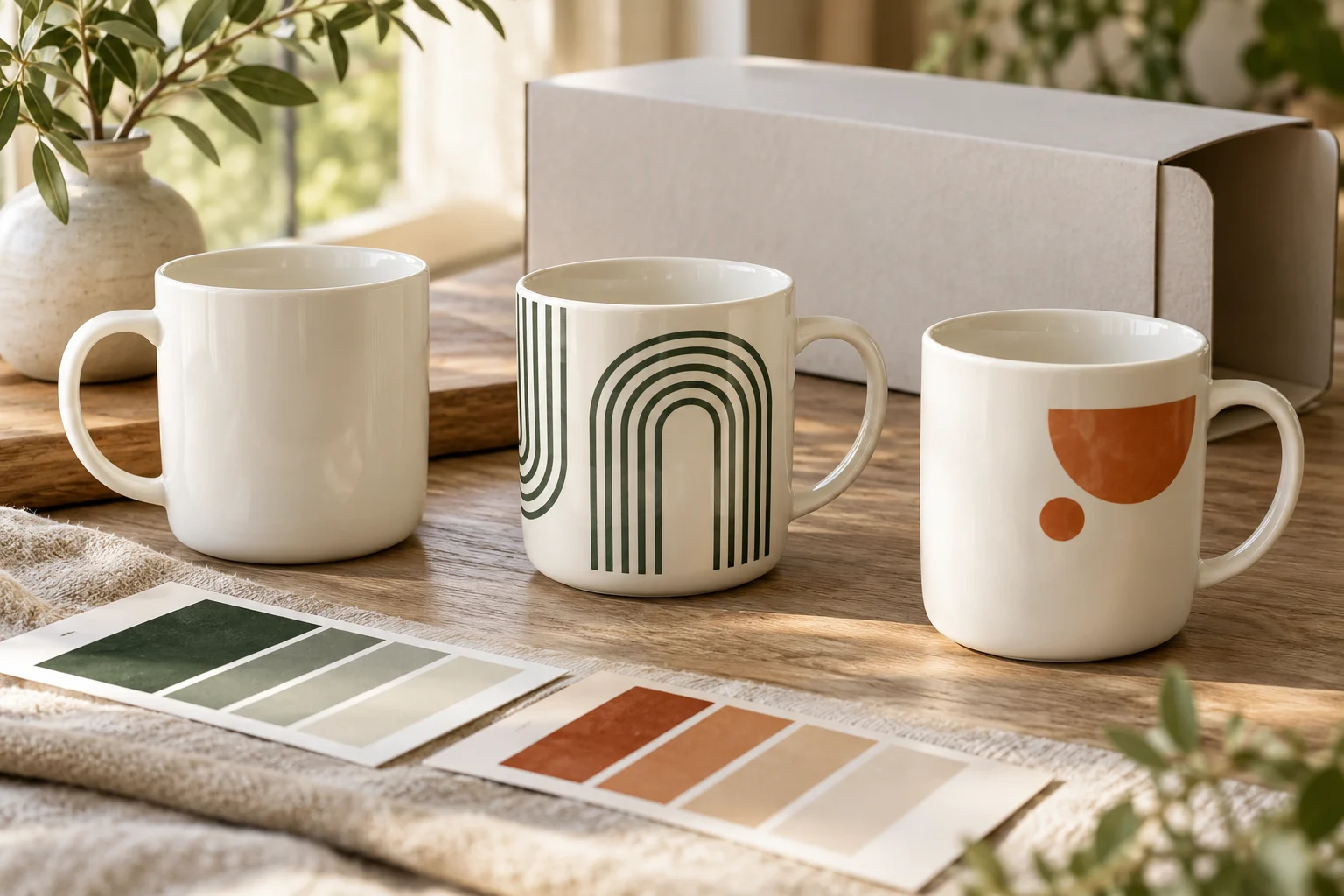
Illustrative brand proof: one body can support several controlled decoration routes.
Build a brief that a production team can use
Begin with the intended market, use, practical fill volume, target dimensions, handle clearance, rim character, white or colored glaze direction, and required care claims. State whether the mug will be used in a café, sold as a boxed retail piece, shipped individually through e-commerce, or issued as a corporate gift. These settings change the packaging and inspection priorities. Include first-order quantity and a realistic annual forecast without assuming that any universal minimum order quantity applies to all forms or decorations.
Supply artwork in editable production files with the owner’s approval. Identify color references, placement from a fixed datum, maximum print area, tolerances around the handle and rim, and any permitted registration variation. A flattened image pasted into an email rarely answers how artwork should wrap around a curved vessel. If text appears on the mug, proof spelling, language, and reading direction at actual size. Small legal or care marks on the base should be tested for legibility after firing, not simply scaled from a packaging file.
Specify the neutral body as carefully as the graphic. White porcelain is not one uniform white. A warmer ivory surface can make an orange logo read differently from a cooler blue-white body. If the program includes plain and decorated variants, approve a physical shade target that works across the range. Ask whether the logo is applied beneath, in, or above the finished glaze and what that means for appearance, touch, and the intended care regime. The technique should be chosen for the design and supported by supplier samples, not inferred from a marketing label.
|
Customization route |
Best use |
Buyer control points |
Main trade-off |
|---|---|---|---|
|
Existing body and brand art |
Fast range extension or corporate program. |
Exact blank SKU, fired artwork proof, placement, repeat shade. |
Limited silhouette exclusivity. |
|
Modified form or coordinated set |
A recognizable range across sizes and channels. |
Drawing, handle and rim samples, shared color standard. |
More sample and tool coordination. |
|
New mold and proprietary shape |
Distinctive retail or licensed concept. |
Tooling rights, dimensional standard, undercuts, packing. |
Higher development effort and change cost. |
|
Sculptural or character mug |
Specific authorized creative concept. |
License scope, cleanability, attachment strength, safe use. |
Complex rights and production risk. |
This matrix is a route selector, not a fixed price list. Ask vendors to quote the same technical brief with setup, sampling, tooling, decoration, test, packing, inspection, and shipping terms separated. Only then can the buyer compare a catalog-body offer with a mold-development offer.
Proof the brand in the fired material
Ceramic decoration changes between a digital mockup and a fired piece. Curvature can distort a straight line; the handle can interrupt a wraparound composition; a flat color may shift against the glaze. Request a physical proof on the chosen body and final surface. Review it under agreed neutral light next to the approved color reference and the rest of the collection. Record the acceptable range rather than expecting a photograph to define a repeatable fired color.
Look at the mug from the viewpoint used on a retail shelf and in a customer’s hand. Is the mark centered when the handle is at the intended angle? Does artwork meet cleanly at the seam? Does a line cross a high-wear area? Can the base mark still be read after a wash? For two-sided branding, identify which side faces a right-handed or left-handed user and which faces the camera in the listing. These decisions are small during design but expensive to rework after mass printing or firing.
Choose the wording of durability claims only after the actual decoration is tested. A plain mug’s microwave or dishwasher instructions do not automatically apply when a metallic accent, new decal, or colored finish is added. A “hand painted” claim should describe an actual hand-applied process rather than a printed design that resembles brushwork. If the consumer will touch a raised texture, check comfort, cleanability, and wear. Save the signed fired proof and a high-resolution photo with a revision code; both should be available to inspectors and the team placing a reorder.
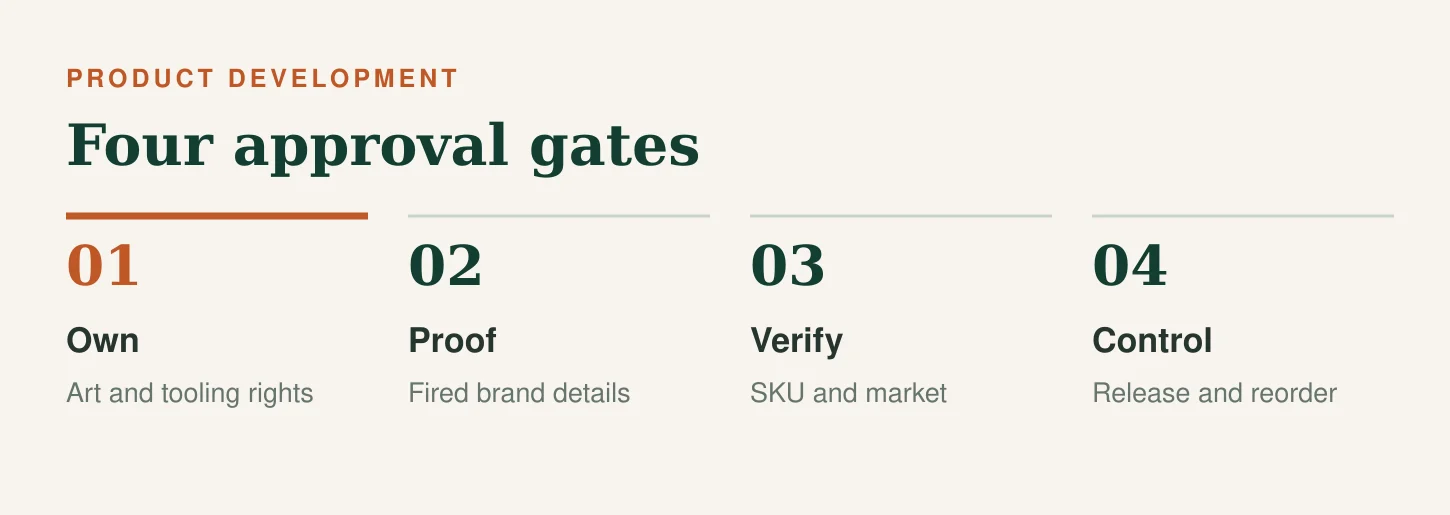
Approval gates for this product brief; the final steps depend on the project.
Keep creative rights separate from manufacturing capability
A factory may be technically able to mold a cat-shaped handle or reproduce a complex printed pattern. That ability does not grant permission to copy a named retail mug, a character, a brand logo, or an artist’s distinctive artwork. A buyer’s reference photograph can communicate a preferred scale or construction, but the finished creative work should be original or covered by a license for the product, markets, sales channels, and term.
For a licensed concept, supply written rights documentation to the manufacturing partner and define who may hold the art files, create samples, use images in a portfolio, and dispose of rejected units. Approve the marks that belong on the product and its packaging. A client-owned design should not become an open catalog item by accident. Likewise, buyers should not infer that a factory’s photograph of a previous collaboration gives them the right to order a similar character mug. Keep a clear project-specific record of the design’s owner and permitted use.
A sculptural animal mug has practical constraints beyond the artwork. Projecting ears or tails may create breakage points in molding, packing, washing, or daily handling. A deep cavity can trap liquid and be hard to clean. A narrow foot or heavy handle can affect stability. Ask for a functional sample with the intended fill, then review attachment strength, sharp edges, food-contact surfaces, and carton protection. The most attractive rendering may need redesign before it becomes a safe, repeatable tableware item.
Connect decoration, food contact, and care
Product-specific evidence should follow the finished SKU. The US FDA has published compliance policy guides on lead and cadmium leaching from ceramicware. The European Commission sets out the framework for food-contact materials and ceramic articles. A supplier’s general audit or a report for a plain white mug does not prove a newly decorated mug meets the requirements of its destination market. If the design changes a glaze, pigment, interior print, or lip area, ask the compliance team or qualified laboratory whether the prior evidence still applies.
Define where decoration may touch food or drink, then review the care instructions alongside the artwork proof. Buyers may wish to place a vivid graphic near the lip because it photographs well; that choice also affects the evidence needed and potentially the user experience. For a set with a lid, spoon, or silicone component, document each material and intended contact condition. Do not describe a whole range as “FDA certified” because one test was completed. The correct statement is tied to a specific article, test scope, and market.
Packaging is a functional part of the branded experience. A beautifully printed gift box that allows the handle to strike the carton edge will not protect the product or the brand. Test an insert with the final mug, not a drawing. Check retail shelf orientation, e-commerce parcel handling, master-carton count, barcode position, and how a distributor can identify colorways without opening each box. If a novelty handle protrudes beyond a standard protective insert, update the pack and transit test accordingly.
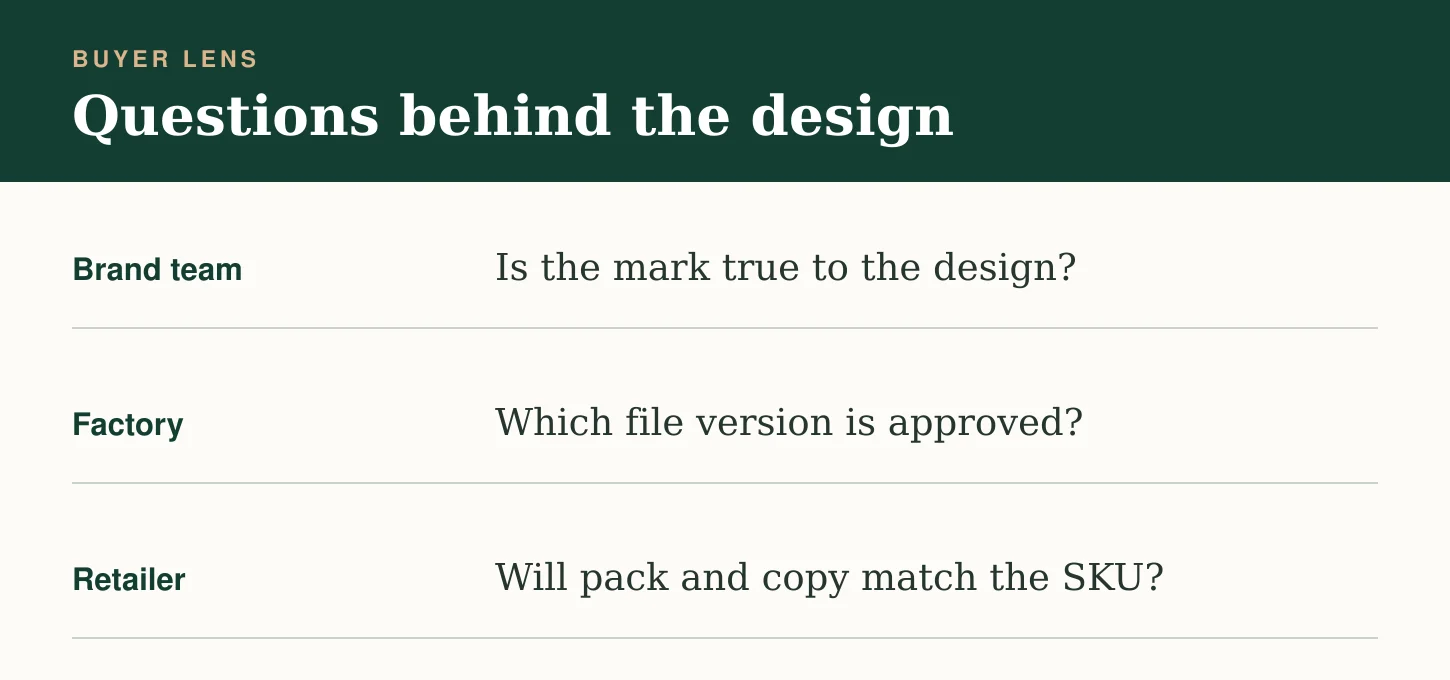
Buyer questions that should inform the approved product specification.
Set approval gates and ownership for a repeatable program
Use a sequence that freezes decisions in the right order: brief and rights, undecorated body, decoration proof, complete packing sample, product-specific evidence, pilot production, then bulk release. Assign a person to sign each gate. A trading company, designer, brand manager, and factory production team can all be involved, but the approval version must be unambiguous. State the date, file code, and physical sample ID on the release record.
Ask the supplier to identify which company makes the body, which team decorates it, and whether any stage is subcontracted. Agree how changes are proposed and approved. A shift in blank mug source may alter rim shape or shade even if the logo file is unchanged. A new print position may affect a retailer’s photography. A different packaging insert may affect transit performance. Change control protects the brand identity and gives a later reorder a measurable benchmark.
The contract should address ownership and custody of molds, art files, proofs, rejected stock, and excess packaging. If tooling is shared or an existing body remains available to other buyers, describe the limits honestly. A buyer may value exclusivity enough to fund a new mold; another may achieve its goals with an existing shape and a distinctive surface. Neither is inherently superior. Quote the complete program including revisions, waste, inspection, test, packing, replacement stock, and the intended delivery term.
For retailers and distributors, plan the product information at the same time as the object. Photograph the approved final sample rather than a digital rendering; record true capacity, dimensions, material description, care, color name, and country of origin from the production file. Keep plain and decorated variants as separate SKUs when their evidence or care instructions differ. The product description should come from the buyer’s own design, use case, and verified specification.
Daye Porcelain presents custom ceramic mug development and an OEM and ODM service route for brand projects. A productive first inquiry should include the form, artwork rights, volume forecast, markets, decoration, packing, and approval deadline. Share that brief through Daye’s project inquiry page and ask for project-specific feasibility, sample steps, and a written quotation. No generic article can promise that a particular sculptural form, body recipe, lead time, or order volume is already approved for production.
Frequently asked questions
Can a brand put its logo on an existing porcelain mug?
Often that is the simplest route, provided the exact blank body fits the use, the supplier has the right to offer it, and the finished decoration is approved. Record the blank SKU and retain a fired production standard for reorders.
Is OEM the same as ODM for a custom mug?
In common commercial use, OEM usually starts from the buyer’s product specification and artwork, while ODM involves more supplier design development. The exact division of design ownership and responsibility belongs in the project agreement, not in an acronym alone.
Can a factory copy a named retail or character mug from a photograph?
A photograph does not convey the necessary creative or trademark rights, and it may hide dimensions and functional requirements. Develop an original design or document a valid license before requesting a reproduction. Ask the factory to treat the art files and samples as controlled project materials.
Where should the logo be placed on a mug?
There is no universal position. Check the handle orientation, shelf view, drinking position, curved print area, lip distance, and packaging photograph. Approve actual-size placement on a fired physical sample.
Do all colorways need separate testing?
The answer depends on what changed in pigments, glaze, placement, and the relevant market requirements. Record the exact tested configuration and ask a qualified laboratory or compliance adviser whether a new colorway falls within that evidence. Do not silently extend a report for one SKU to every variant.