Table of Contents
ARTICLE 04 | DESIGN & PRODUCT DEVELOPMENT
CORE KEYWORD custom scented candles in bulk wholesale
Custom scented candles in bulk wholesale are a coordinated product-development project, not a logo printed on a stock jar. The brand must decide what is genuinely custom, who owns each component, how the candle will be tested, and what the supplier must reproduce on the next order. A distinctive porcelain vessel can make the collection recognizable on a shelf, yet its design has to support filling, burn behavior, labeling, and shipping. This blueprint walks a brand, distributor, or private-label buyer from the first brief to an approved retail unit.
Daye Porcelain’s documented capability is porcelain design, prototyping, manufacturing, and quality control. For a candle program, Daye can be approached about a custom ceramic vessel, lid, glaze, or decoration. Its public materials do not verify wax formulation, fragrance blending, pouring, or finished-candle OEM service. A specialist candle manufacturer or brand-appointed program owner must define and approve that work. Put those roles into the project plan before seeking a combined wholesale quote.
Key takeaways
- Write a product brief that separates the ceramic vessel from the finished candle and names the responsible party for each.
- Design the vessel and wax system together; a decorative shape cannot be approved in isolation.
- Use fired samples, filled pilots, burn evidence, label reviews, and pack trials as distinct approval gates.
- Own the master specification, artwork, molds, change control, and reorder process in writing.
Begin with a product brief, not a reference image
A useful brief states the brand, customer, target retail price, destination markets, expected annual and first-order quantities, planned launch, channel, and positioning. Add the intended vessel size, usable internal opening, approximate fill target for the candle specialist to validate, wick concept, lid, finish, logo position, box and shipping route. Provide style references to communicate a direction, but avoid asking a factory to copy another brand’s protected form or artwork. The first conversation should discover design constraints and commercial priorities.
Choose the customization level. A standard vessel with a new color and printed logo may be sufficient for a short-run promotion. A new mold may justify investment for a long-lived signature collection. A sculpted porcelain lid, relief mark, or unusual glaze can strengthen the brand, but each feature adds a physical approval step. If a buyer requests an “OEM scented candle,” ask whether it means an exclusive filled formula, private label on an existing candle, or a new ceramic component with a separate filler. The phrase should never substitute for a bill of materials.
Make a responsibility map. Daye’s part might cover ceramic drawings, tooling, fired vessel samples, glaze references, decoration, inspection and protective component packing. The candle specialist’s part covers wax, fragrance, wick, pour, burn development, formula-based documentation, safety labels and filled-product release. The brand owns positioning, trademarks, consumer claims, final artwork and market decisions. If one party coordinates the program, document its authority to approve or reject the full finished unit.
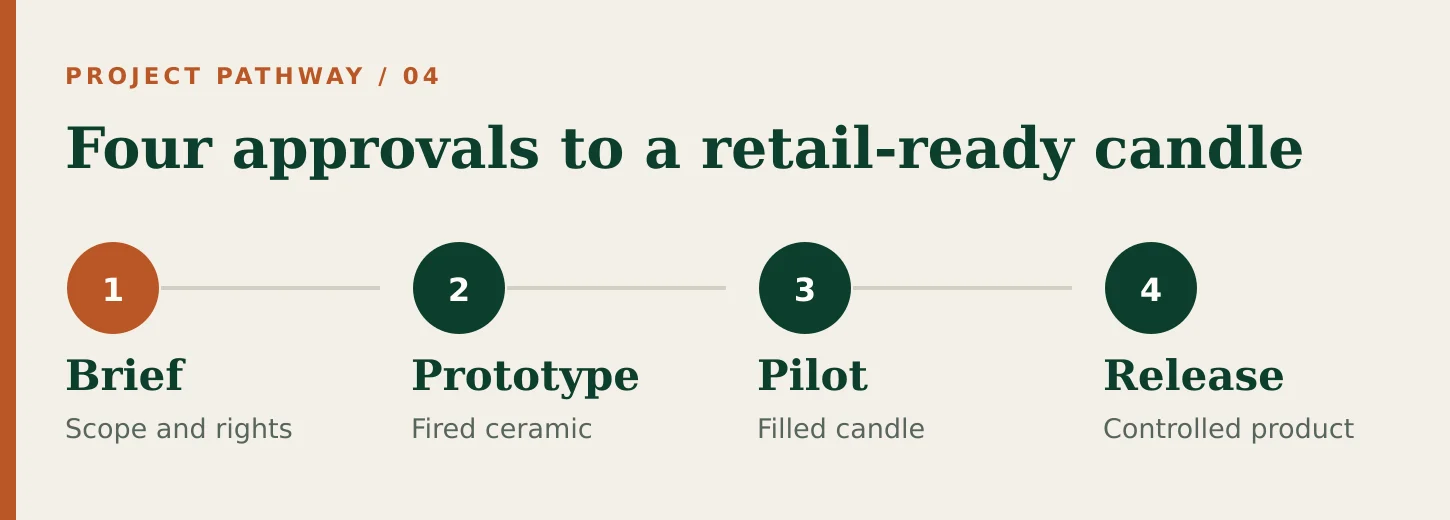
Illustrative approval sequence for the buyer, ceramic maker and finished-candle specialist.
Co-design the vessel with the filler
Before cutting a ceramic mold, share a dimensional drawing with the candle maker. Internal diameter, wall profile, base, opening, nominal fill line and rim affect pouring access, wick placement, heat exposure and finished appearance. A narrow mouth can limit wick centering or make wax finish difficult. A lid can be a premium feature, but it must fit real fired production variation and should not interfere with use instructions. A large three-wick form demands a different test approach from a small single-wick version. The filler should identify its critical dimensions and any minimum clearance requirements for its proposed system.
Daye’s design development and mold development pages provide the right starting points for a ceramic design conversation. Ask for drawings and a fired sample made through a process that reflects intended production. Review silhouette, color under agreed lighting, stability on a flat surface, glaze on the interior and exterior, rim condition, lid fit, logo legibility and pack protection. Record acceptable variation rather than describe a glaze as simply “nice.” The approved fired master should be retained and identified by revision.
The candle partner should fill representative production vessels, not only a carefully selected design sample. It must evaluate the chosen wax, fragrance and wick through the intended burn cycle, including the behavior of the ceramic container. A food-safe or beverage-grade statement for a mug does not establish candle safety. If the candle specialist changes wax source or wick because the jar burns poorly, that is a design decision that may affect scent, cost, appearance, claims and labels. Bring it back to the joint approval table.
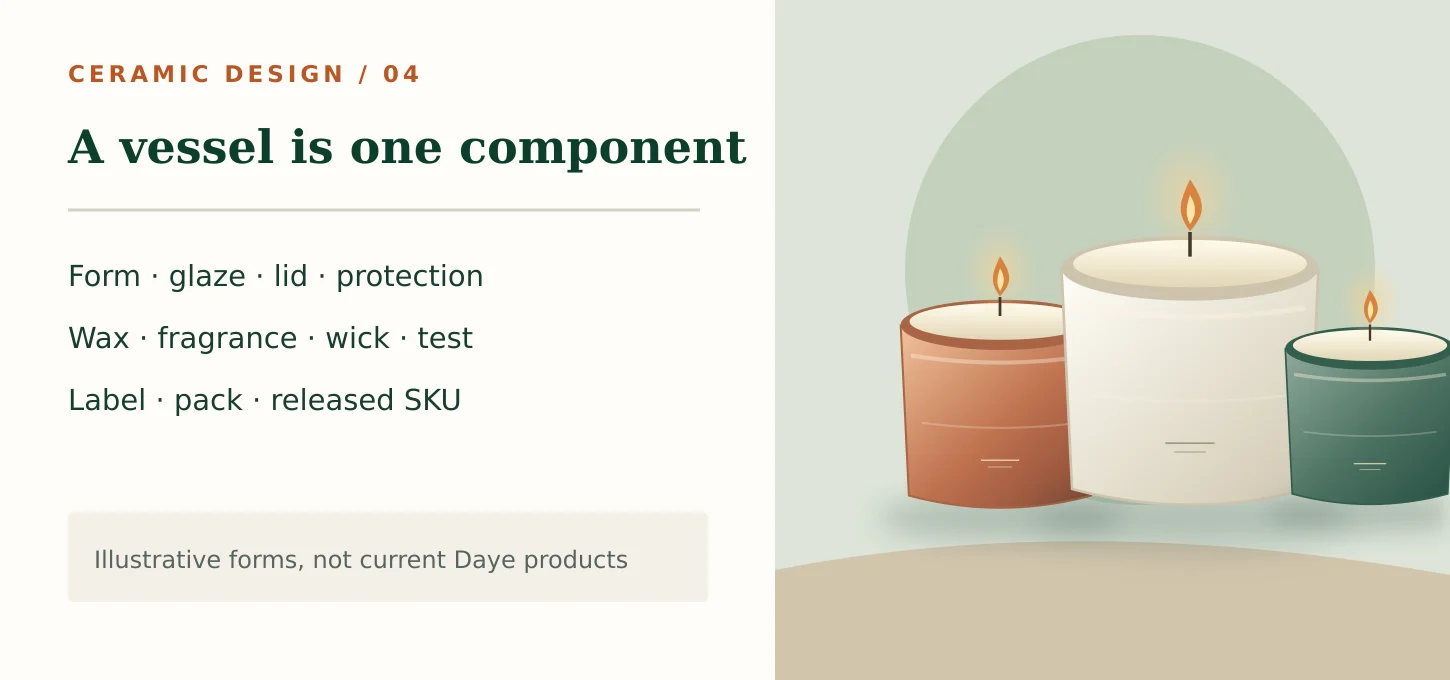
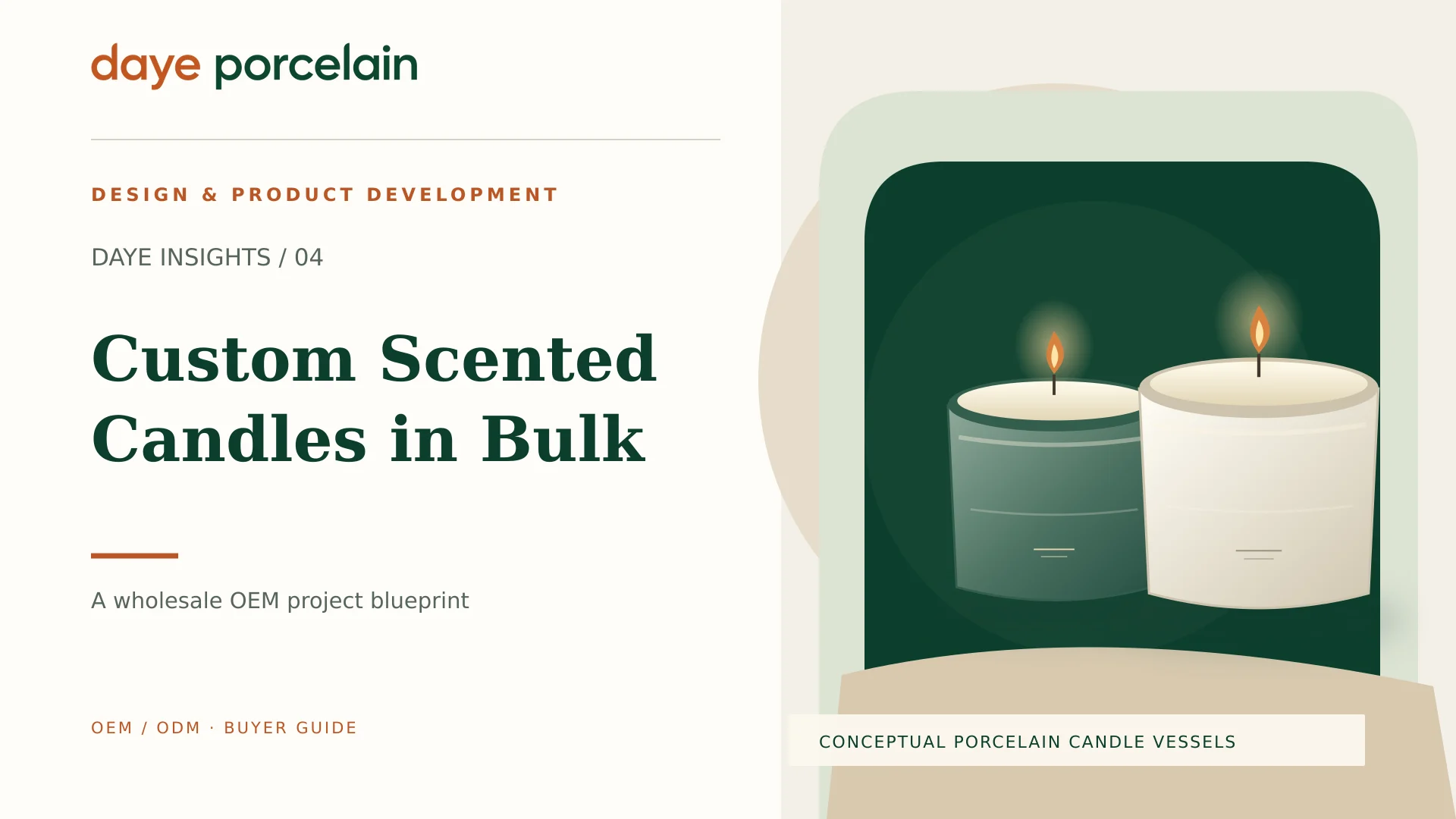
Conceptual porcelain candle-vessel illustration. These are not current Daye products.
Turn fragrance into a controlled collection
A brand story may ask for cedar, citrus, tea or floral notes; the fragrance house and candle specialist must turn those directions into formulas suitable for the application. Request a documented scent brief and a sample evaluation method. Record cold impression, performance during use, color or wax-surface behavior, and stability where relevant. “Best scent” is subjective; select for the intended consumer, retail price and brand architecture rather than an online list.
Treat each scent as a separate finished SKU even when all share a vessel. Fragrance may change burn behavior and chemical classification. The fragrance supplier’s IFRA documentation is useful for its specified intended use, but it does not by itself prove that the finished candle is safe, correctly labeled or legally ready for every market. The candle partner should check formula information, complete appropriate finished-product testing, and provide the market-specific label proposal. Keep a unique formula reference, fragrance name, wax and wick record, and approved sample for every variant.
A launch might use one porcelain silhouette in a restrained set of complementary scents. That creates a cohesive display and makes the vessel investment easier to reuse. More scents can be added after sell-through data and tested prototypes justify them. Seasonal artwork can change more easily than a mold, but a new decoration, inner glaze or vessel dimension should still trigger a technical review if it can affect the finished system. Do not promise custom scented candles in bulk wholesale without defining what can be repeated accurately at scale.
Approve labels, pack and claims before bulk production
Prepare labels from the actual formula and target jurisdiction. In the U.S., the Consumer Product Safety Commission provides candle business guidance and lists relevant candle safety standards. In the UK and EU context, fragrance ingredients can affect chemical classification and labels; GB and Northern Ireland requirements should be reviewed separately. The responsible finished-product business needs current, market-specific advice. Warning placement, legibility, product identity, company details and any required hazard information should be checked on the real sales unit, not only on a flat artwork PDF.
Claims such as “non-toxic,” “clean-burning,” “all-natural,” a fixed burn duration or “100% beeswax” need a defensible basis. The term “soy candle” should match the actual blend and local rules. Ask the marketing team to keep a claims ledger with supporting evidence and approved wording. A bespoke porcelain vessel can be described in physical terms that buyers can see and verify: shape, glaze, decoration and reusable design intent where appropriate. Do not describe a conceptual render as a current Daye candle product.
The pack must protect a heavy ceramic item and preserve its premium experience. Approve a retail box, internal support, label position, master carton and any direct-to-consumer parcel pack through physical trials. Inspect for rim chips, loose lids, glaze rubbing, wax smears and shifted labels after shipping simulation. If a gift box is part of the product, include its cost and dimensions in the wholesale specification. A custom candle that arrives damaged will not support a repeat order, regardless of its fragrance.
|
Approval gate |
Main evidence |
Sign-off |
|---|---|---|
|
Vessel concept |
Drawing, finish reference, filler constraints |
Brand, Daye, filler |
|
Fired sample |
Dimensions, glaze, lid and physical master |
Brand and filler |
|
Filled pilot |
Formula, wick, burn evaluation, appearance |
Candle specialist and brand |
|
Sales unit |
Final label, box, carton, transit trial |
Responsible business and buyer |
|
Bulk release |
Inspection record against retained masters |
Program owner |
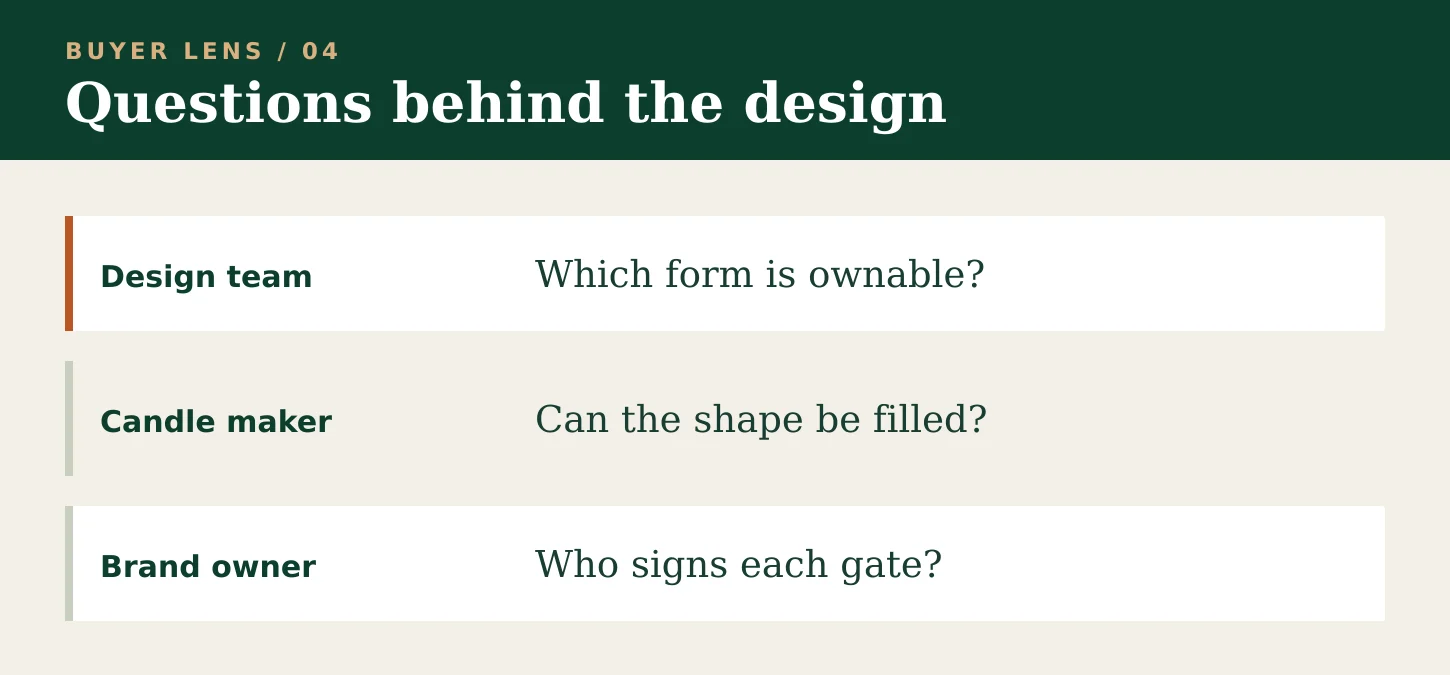
Buyer questions that guide scope, quality evidence and replenishment.
Control cost and ownership at wholesale scale
Request separate quotes for ceramic tooling, vessel unit, lid, decoration, protected packing, freight to the filler, candle formula and filling, testing, labels, retail box, inspection and final delivery. A per-unit quote without development costs can conceal the real first-order economics. Ask which mold and artwork the brand owns, how they are stored, whether the design is exclusive, what happens if a tool is damaged, and how samples are charged. These terms should be agreed before investment, not at the first reorder.
Minimum order quantities may differ for the vessel, glaze, fragrance batch, box print and poured candle. A single combined MOQ can hide a constraint in one component. Forecast by SKU and identify shared materials. Keep a lead-time schedule that begins with design approval, then vessel pilot, filled pilot, test and label review, bulk components, filling, final inspection and shipment. Each dependency should have an owner and a decision date. A rushed seasonal program may need a simpler standard vessel for the first launch while a signature mold is developed separately.
Create a change-control form. It should record the proposed substitution, affected SKUs, reason, risk, required testing or label review, approved sample and effective lot. No supplier should substitute a similar fragrance or wick without the responsible candle specialist’s evaluation. Ceramic glaze and dimensions should also be compared with the retained master. Reorders must refer to the same revisions, not merely the product’s marketing name.
A practical Daye inquiry and handover
Send Daye a concise vessel brief through its project inquiry: drawing or dimension sketch, inspiration, intended candle use, expected quantities, destination, finish and logo approach, lid concept, target dates, and details of the filling partner. Ask Daye to confirm which ceramic development and quality steps it will perform, sample charges, tooling terms, pack, and production acceptance criteria. Have the filler review the proposal and fired samples early. A buyer can then compare the cost of a distinctive porcelain vessel with the total finished-candle program.
The completed handover package should contain the approved fired vessel master, component specification, filled-candle master for each scent, formula and wick references held by the responsible specialist, burn evidence, market label approvals, print files, carton specification, inspection criteria, and contact points for complaints. This package makes the design repeatable and gives a wholesale buyer a reliable product story. It also keeps Daye’s ceramic work accurately represented in the brand’s sales material.
Before moving from pilot to bulk, hold a joint sample review with the ceramic maker, filler and brand. Photograph the approved finished unit alongside the retained fired master, but write down the measurable decisions as well: fill line, wick layout, acceptable glaze variation, lid fit and carton protection. Give every approved sample an identifier and date. The production team can then check the real lot against the correct revision. This review is also a good point to confirm whether the brand’s sales photographs and copy describe the same candle that is being made. A signed approval is useful only if it names the physical object and documents it represents.
FAQ
Can Daye produce an OEM scented candle from start to finish?
Its published capabilities establish custom porcelain manufacturing, not a finished candle filling line. Ask Daye about a specific project’s scope; otherwise commission a candle specialist for wax, fragrance, wick, filling, testing and finished-product labels.
How many samples should a custom project include?
Plan for a ceramic design sample, a representative fired vessel pilot, and a filled candle pilot for each relevant configuration, plus printed and packed sales-unit approval. The exact sample counts and testing plan depend on the design and specialist’s method.
Does changing the glaze require a new burn review?
Ask the finished-candle specialist to assess the change, especially if the interior surface, vessel dimensions or thermal behavior may differ. Record the conclusion and any testing needed before releasing the variant.
Who should own a custom mold?
Set ownership, storage, maintenance, exclusivity, access and replacement terms in the purchase contract. A brand should know how it can reorder the same vessel before paying for custom tooling.
Can one vessel serve several fragrances?
Yes, as a product architecture, but each finished fragrance configuration needs its own recorded formula, label assessment and appropriate burn evaluation. Shared ceramics do not make all finished candles identical.