
Table of Contents

“Large” and “tall” sound like simple mug specifications. They are not interchangeable. A wide 500 mL mug and a narrow 500 mL mug present the drink differently, fit different shelves, and place different loads on the handle and shipping box. For a retailer or coffee brand, the right choice depends on what the customer pours, how the mug is carried, and how many units must survive distribution.
This guide gives buyers a framework for developing large porcelain mugs and tall porcelain coffee mugs. It addresses useful capacity, proportions, stability, ergonomics, manufacturing, packing, and claims. The dimensions below are design questions rather than fixed product specifications; Daye Porcelain has not published a universal capacity, minimum order quantity, or suitability claim for every custom mug.
Key takeaways
- Brim capacity and comfortable drinking fill are different measures.
- Tall and wide shapes with equal volume can differ in stability, handle load, and pack cost.
- Test the full mug with real users and equipment before approving the silhouette.
- Compare landed economics and evidence for the actual SKU rather than a generic size label.
Capacity is a method, not just a number
First specify whether a listed volume is measured to the brim or at a normal drinking level. Two mugs that both carry a “16 oz” label can offer different usable volumes if one has a thick rim, sloping shoulder, or foam headspace. In a US listing, ounces should be identified as fluid ounces; in an EU listing, milliliters are typically clearer. Keep both units if the brand serves both markets, but have one physical test method for approval.
A large format might be chosen for filter coffee, latte drinks, tea, cocoa, or soup. That use changes the practical fill target and the position of the handle. If the mug is meant for a beverage with a foam cap, the brim must leave a sensible margin. If it is a desk mug used for hours, a customer may value stability and easy cleaning more than maximum nominal volume. Do not simply enlarge a small mug drawing by a percentage. Thickness, base, and handle often require separate work.
Assess the full weight. Measure an empty production sample and a sample at the practical fill level. Ask testers to lift it from a desk, walk a short distance, and place it back on a saucer or tray if relevant. A full oversized mug may be uncomfortable even if its handle appears generous in a rendering. A buyer selling a coordinated set should also consider how a larger mug fits the existing plate and dishwasher rack.
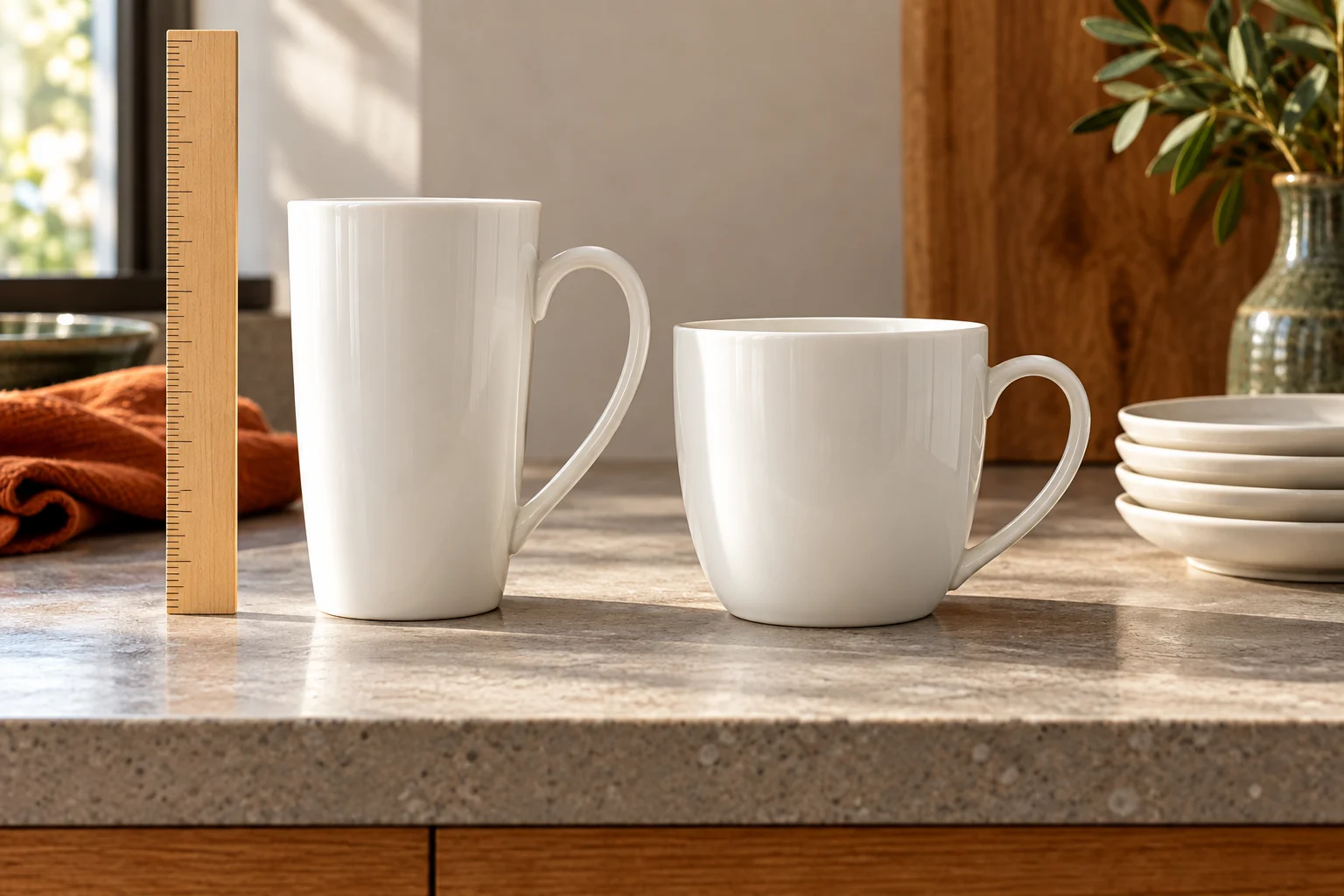
Illustrative size comparison: check useful fill, grip, and equipment clearance.
Tall versus wide geometry
A tall mug uses vertical space and can leave a smaller footprint, but a narrow base and high liquid column may increase tipping sensitivity. A wide mug offers a lower profile and a larger top opening, which can help with milk drinks or cleaning, yet it occupies more shelf and tray area. Neither shape is automatically better at keeping coffee hot. Starting temperature, fill, room conditions, wall design, and lid matter; claims about heat performance need a controlled comparison.
Review the center of gravity with the actual handle and fill. Put the mug on the intended surface and test it during ordinary service, not just on a perfectly flat laboratory table. Check base contact and wobble. Look at the handle’s leverage when the mug is full. A tall body can also complicate printing: artwork near the upper wall may distort differently from a wrap on a straight cylinder. Request a fired decoration proof on the intended profile.
The silhouette affects the retail photograph. A wide mug may visually communicate comfort and generosity, while a tall one can look sleek and space efficient. Those are merchandising goals, but they should not override the practical use. Show prototypes to the people who will serve, wash, stock, or pack the mugs. Their objections are often more actionable than a preference poll on a flat mockup.
|
Design choice |
Tall profile |
Wide profile |
|---|---|---|
|
Footprint |
May use less shelf width |
Takes more shelf and tray space |
|
Stability review |
Pay close attention to base and fill height |
Pay close attention to broad rim and balance |
|
Decoration |
Test vertical alignment and taper |
Test large wrap areas and curvature |
|
Packaging |
Protect height and handle leverage |
Protect opening, rim, and carton width |
This is a comparison checklist, not a ranking. An individual design can solve or create any of these problems. Evaluate samples under the intended use and pack conditions.
Design a handle for the load
The larger the filled volume, the more important handle comfort becomes. Check finger clearance, grip width, joint appearance, and how the wrist feels as the mug is raised. Ask for the production handle on the prototype rather than approving an idealized 3D rendering. A handle with too little room may be difficult for larger hands or when the user is wearing a glove; one that projects too far can be vulnerable in transit and consume retail shelf space.
Handle strength should be evaluated under a defined method. A laboratory test can support a design decision, but a general photograph of a handle test does not prove that a new large format has passed. Record the approved geometry, inspect attachment areas, and decide what visible variation is acceptable. If a later production change makes the handle thicker or shifts it downward, approve another physical sample because the user’s experience changes.
The rim also matters at larger sizes. A large opening can make a mug comfortable for drinks with foam but can expose an edge to more contact during stacking and cleaning. If a fine porcelain appearance is the selling point, find a balance between the intended feel and the handling environment. A hospitality program that repeatedly washes and stacks mugs may choose a different edge profile from a boxed seasonal gift collection.
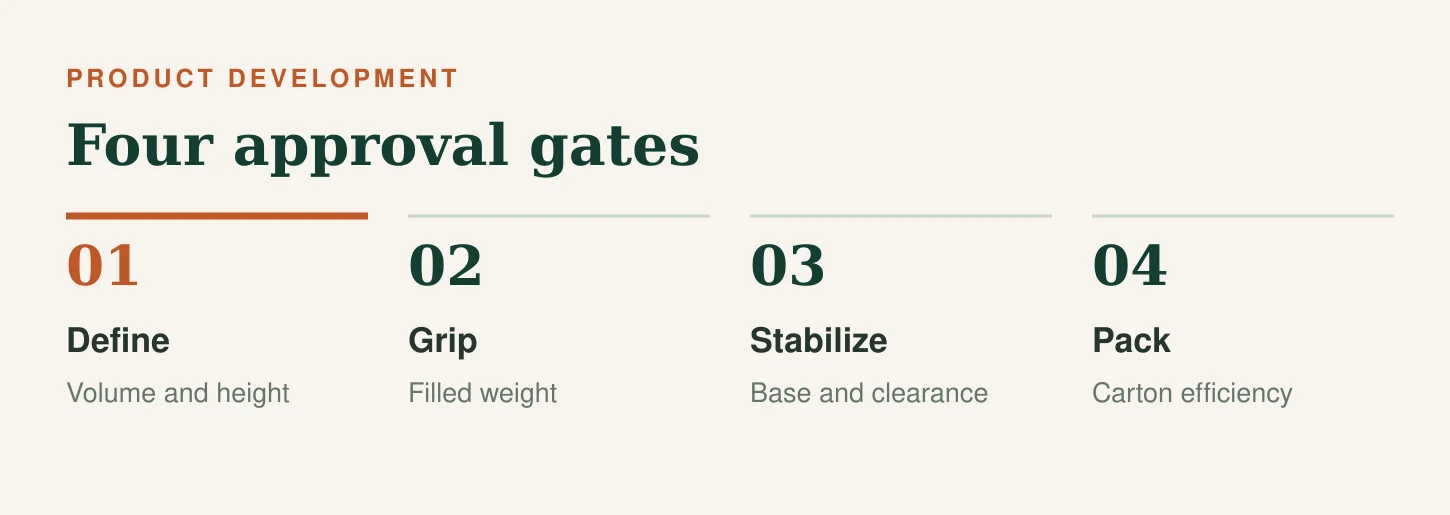
Approval gates for this product brief; the final steps depend on the project.
Production and inspection variables
Scaling a shape can affect casting or forming, drying behavior, glaze coverage, and firing results. A factory should review feasibility for the selected body and decoration. The buyer does not need to dictate kiln settings; it does need an approved sample and a measurable inspection standard. Confirm practical fill, overall dimensions, base level, handle clearance, visible glaze quality, shade, and print registration. Inspect more than one unit from a pilot run to see variation.
If a large mug includes a lid, the lid’s fit and weight must be checked with the larger body. A heavy ceramic lid can move the balance higher and add a separate fragile component. If a silicone or other material part is used, specify its supplier, contact conditions, cleaning instructions, and evidence. Do not assume a mug with a lid is leakproof or safe for bag travel. Define the product’s actual use and verify that claim separately.
An oversized format can magnify small dimensional differences. A few millimeters at the top may change box fit or stacking. A printed graphic may have more visible area to expose inconsistent positioning. Agree which features need a numeric tolerance and which can be controlled by a retained physical standard. A buyer should be able to tell the factory exactly why a sample fails rather than saying that it “looks different.”
Plan packaging before the catalog goes live
A larger mug costs more to protect and transport than its unit price suggests. Ask for the retail box and the master carton at the sampling stage. Check whether the handle is protected from side pressure, the rim has clearance, and the base cannot hammer against another ceramic surface. For e-commerce, evaluate parcel handling as well as pallet movement. A pleasing shelf box may need an outer shipper; a plain export carton may be unsuitable for direct delivery to consumers.
Measure the packed unit and master carton. Freight and warehouse space can alter landed economics, especially when a mug is tall but lightly filled inside a bulky box. Decide the case pack and pallet pattern with the logistics team. Set SKU markings so a large white mug is not confused with a medium white mug in a busy warehouse. If the product is a set, test the whole set’s pack and unpack sequence.
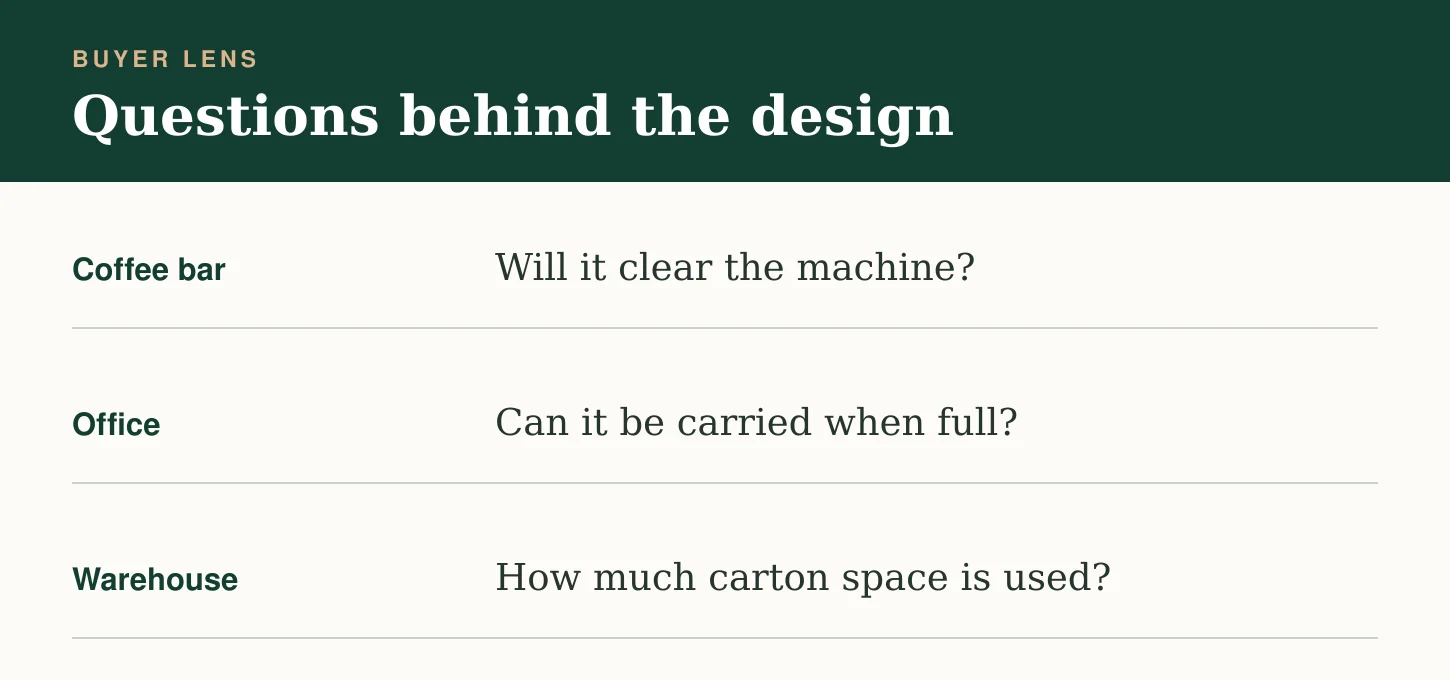
Buyer questions that should inform the approved product specification.
Care and food-contact evidence
The material name does not decide whether the finished mug can go in a microwave or dishwasher. Decoration, glaze, metallic details, and accessories may change care instructions. For the US, the FDA publishes ceramicware guidance on lead and cadmium leaching; for EU sales, the food-contact framework and ceramic-specific rules matter. Obtain evidence for the finished configuration and destination rather than borrowing a report for a different mug.
If a brand intends to claim “keeps coffee hot,” define the comparison, starting temperature, fill, environment, and endpoint. Avoid a percentage or duration without testing the actual item. The same discipline applies to chip resistance, handle strength, thermal shock, and dishwasher cycles. A physical test result belongs to the tested SKU and conditions, not every porcelain body the factory has produced.
This evidence does not need to be turned into consumer-facing technical clutter. It should sit in the buyer’s product file with the approved drawing, sample code, artwork, packing specification, and care label. A clear record supports the next order and prevents an unapproved substitution from entering the range.
Brief a manufacturer with two candidate shapes
If the marketing team cannot decide between tall and wide, ask for both as deliberate prototypes. Give each the same practical fill target and proposed use. Compare comfort, stability, available artwork area, cleaning, packaging volume, and estimated tooling implications. Select one on measured trade-offs; do not keep both simply to capture two search phrases. If the range truly needs two formats, give them separate use cases and SKU identities.
Put the prototype through a real handling trial
Ask a small group representing the target user to use the prototype at its intended fill level. For a café, have staff make the drink, serve it on the normal tray, clear it, and load it into the washer. For an office gift, have people carry it from a kitchen to a desk and place it beside a laptop. Observe where fingers land on the handle and whether the mug feels secure at the point where a person turns or sets it down. Keep notes on actual behavior instead of asking only which silhouette looks better.
Use the same trial to inspect operational fit. Can the tall version sit under the intended coffee machine? Does the wide version occupy too much of a retail shelf or dishwasher rack? Does a spoon rest inside without contacting the rim awkwardly? If the mug is sold with a box, let a fulfillment worker pack several units and report where the handle or rim is hard to protect. These observations do not produce universal dimensions; they tell the buyer which constraints its own program must document.
Then compare delivered economics. Calculate units per master carton and pallet, packing material, estimated breakage allowance, and the stock space required for each version. A marginally cheaper wide mug may cost more to deliver if its pack wastes space; a taller version may incur more protective packaging. Include tooling and test costs in the same comparison. A decision that works for a one-time gift campaign may differ from a café program that will reorder for years. Record which evidence drove the choice, so a later redesign does not reopen the same debate from scratch.
If the product page uses “large” as a selling term, give the customer a useful measurement too. State the volume basis, height, and perhaps the empty weight if it affects handling. Show the mug next to a familiar service object or in a hand without altering its proportions in photography. A consumer who expects a generous drinking fill from a brim-only capacity may return an otherwise sound item. Clear measurements help the brand and supplier avoid that avoidable mismatch.
Daye Porcelain’s custom mug page and prototyping page provide routes for discussing a new shape. Its quality control page gives buyers a starting point for inspection questions. Send your actual target fill, shape drawings, artwork, order forecast, destination markets, and packaging channel through the project inquiry page for a feasibility and quotation discussion.
Frequently asked questions
Is a tall porcelain mug always easier to store?
It may use less shelf width, but height can interfere with shelving, coffee machines, dishwashers, and gift boxes. Measure the actual spaces in the intended channel before making that claim.
Should a large mug be tested at brim capacity?
Record brim capacity, but handle and stability evaluations should include the practical fill and intended use. A full-to-brim test can be a separate stress condition. Do not use a brim number as the everyday serving volume without explanation.
Does a heavier mug keep coffee hot longer?
Not necessarily. Wall mass, preheating, shape, fill, ambient conditions, and lid all affect temperature change. A claim needs a controlled test of the actual design. Otherwise, choose based on the customer’s serving and handling needs.
What changes after approving a bigger handle?
Review ergonomics, joint strength, box fit, shelf footprint, and tooling. Retain a new signed sample and update the drawing. A handle change is not merely a cosmetic update on a large vessel.