
Table of Contents

Seasonal porcelain mugs have a deadline that ordinary core products do not. A Christmas design that arrives after the retailer’s promotional window has lost much of its purpose, even if its glaze, print, and box are excellent. A brand buyer therefore needs to manage artwork, sample approval, production, freight, and replenishment as one calendar with decision dates, rather than asking only how long a factory takes to make a mug.
This guide covers Christmas porcelain mugs for retail brands, distributors, and corporate gift programs. It explains how to choose a reusable body, develop a rights-cleared motif, control decoration and packaging, plan the critical path, and preserve a design for a later season. It does not give a universal lead time, MOQ, or price; these depend on the actual order and should be confirmed with a manufacturing partner.
Key takeaways
- Work backward from the date stock must be available on the shelf.
- Freeze body, artwork, pack, and care claims before mass printed materials are ordered.
- Use original or licensed motifs and approve the fired decoration on the final body.
- Model weak sales and replenishment cutoffs as well as the central demand forecast.
Work backward from the shelf date
Start with the date the product must be available to the customer, not the date the purchase order is placed. Allow for distribution-center receipt, customs and local transport, retail allocation, photography, product listing, and any final store setup. Then identify the latest acceptable factory release, packing approval, mass production start, sample signoff, and artwork freeze. The “latest” dates should include a realistic contingency for revisions and transit variation.
Make dependencies visible. Printed gift boxes cannot be approved until the final mug shape, artwork, barcode, and pack contents are set. A product photograph may need the signed sample. A migration test or care claim may depend on the final glaze and decoration. If any one approval waits for the preceding task, a seemingly small two-week art delay can shift the entire launch. A shared tracker with an owner and decision date for each item is more useful than a single promised delivery date.
Seasonal demand can be uncertain. A buyer may plan one collection for several retail accounts with different order dates. Decide what can be standardized: perhaps a common white porcelain body and several patterns, or one motif applied across two sizes. The design should still be approved per SKU. Standardization can reduce development work, but it does not erase the need to verify each final decoration and pack.

Illustrative gift package: protect the final decorated mug in transit.
Choose the body before the motif grows complicated
An existing body may reduce tooling time if its rights and production availability fit the program. A custom shape can create a stronger seasonal identity, but a sculpted handle, relief figure, or unusual lid adds mold work, sample rounds, and transit risk. Compare the value of distinctiveness with the time available. A retailer’s first seasonal test often benefits from an excellent graphic on a proven shape; a licensed premium range may justify a more complex product if the approvals and rights are in place.
Specify practical fill, rim and handle comfort, base stability, and whether the mug is intended for hot drinks, display, or both. A figurative element that looks charming in a rendering can make the mug awkward to wash or pack. If a handle takes the form of a character or holiday object, test it with a filled mug and inspect the joint. Avoid assuming that a decorative product can be marketed for food use without the corresponding material and market evidence.
The body color should work with the design and production method. A clean white porcelain ground can support many motifs, but the fired white shade matters when cartons or matching plates use a particular palette. A colored glaze can make the line more distinctive and may complicate shade control. Keep a physical standard and a signed artwork revision so later production is judged against an agreed target rather than a holiday mood board.
Build original, rights-cleared artwork
The familiar vocabulary of trees, stars, snowflakes, winter landscapes, and gift ribbons is broad. Specific illustrations, characters, patterns, and brand marks can still be protected. Commission original art or obtain a clear license for any external design. Record the allowed products, markets, period, channels, and use in supplier samples or portfolio photography. An OEM factory should receive artwork only to manufacture the authorized order, with confidentiality and use terms stated in the agreement.
Plan the design for a three-dimensional surface. Check how a scene wraps near the handle and whether a focal element appears from the front when the mug is on a shelf. A deep red or green panel may expose print inconsistency; a fine snowflake line may disappear at production scale. Ask for a fired proof and review multiple samples under the lighting relevant to the retail channel. Artwork printed on paper is not a substitute for a ceramic proof.
If the holiday product uses metallic decoration, an internal design team may want a premium look, but care claims need to follow the actual finished product. Do not copy “microwave safe” or “dishwasher safe” icons from a plain white mug. Confirm the decoration method, intended cleaning, and any consumer warnings before printing thousands of boxes.
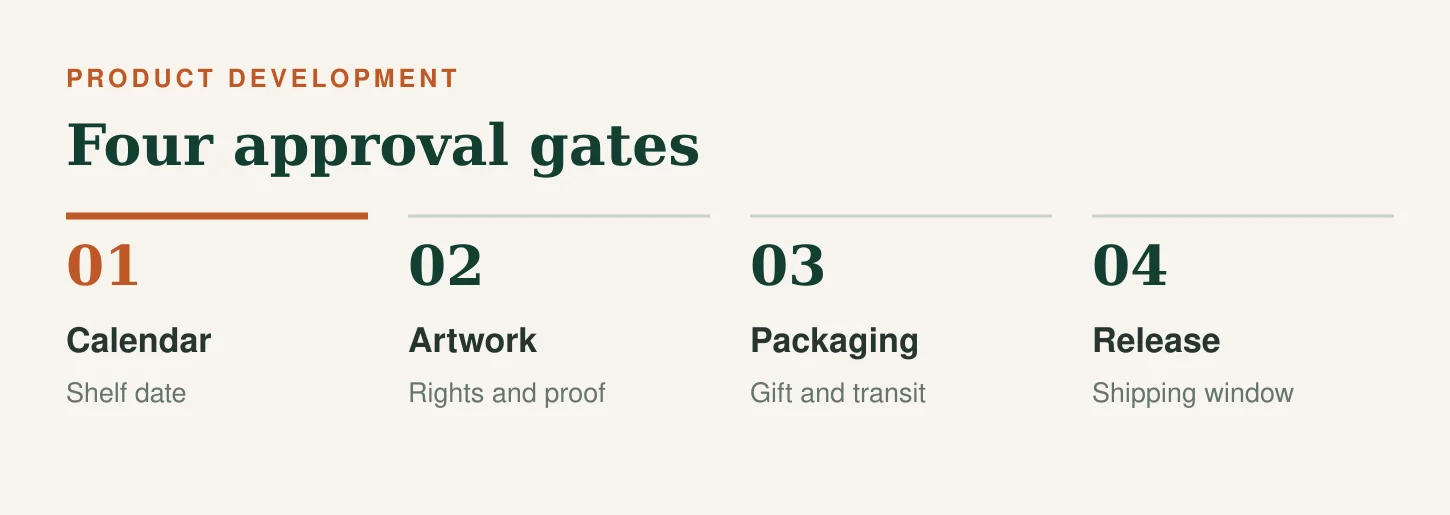
Approval gates for this product brief; the final steps depend on the project.
Decide between a single hero mug and a collection
|
Range choice |
Benefit |
Coordination cost |
|---|---|---|
|
One decorated mug |
Clear hero image and fewer approvals |
Limited assortment and one demand forecast. |
|
One body in several motifs |
Variety with common geometry |
Separate artwork, SKU, shade, and carton control. |
|
Mug plus saucer or lid |
Gift value and display impact |
More fit, care, and breakage checks. |
|
Mug across several sizes |
Different price points and uses |
More molds or bodies, print areas, and pack dimensions. |
The channel should drive the range. A corporate gift buyer may want a boxed mug with a logo on one side and an original winter illustration on the other. A homeware retailer may need a coordinated shelf display and replenishment by individual design. A café may choose a seasonal serve cup without a gift box. Treat those as separate product briefs rather than asking the factory to quote “Christmas mugs” as one generic line.
Define which items can be reordered late in the season. A custom box printer, decal supplier, and porcelain production line may each have different minimum run and timing constraints. A small emergency replenishment could be impractical even if the first order was feasible. Build the initial quantity plan around the realistic reordering window, with inventory risk owned by the buyer rather than hidden in a vague promise.
Test the product and the complete gift pack
General mug quality still matters: capacity, base level, handle, rim, glaze, visible defects, and decoration alignment. A holiday print may add a new contact surface or pigment, so match product-specific food-contact evidence to the final configuration and destination market. For the US, FDA guidance covers lead and cadmium leaching from ceramicware. For EU sales, the food-contact framework, good manufacturing practices, and ceramic-specific rules need attention. A factory audit or certificate collage does not replace a report for the actual SKU.
Test a complete pack at the end of sampling. The retail box has to present the pattern, identify what is included, protect the handle and rim, carry the correct barcode, and fit the shipping carton. If the mug is sold online, the consumer’s parcel route can be rougher than a carefully palletized store shipment. If a lid or ornament is included, keep it from striking the ceramic body. Review actual unboxing and repacking, not just a dieline on a screen.
Cartons should show the correct year-independent SKU code, pattern, quantity, and destination information. Avoid putting a year in a permanent product name if the design is intended for repeat use, while ensuring the artwork revision is traceable. Seasonal returns are costly because there may be no later window to resell damaged stock at full value. Packaging decisions are part of the commercial margin calculation.
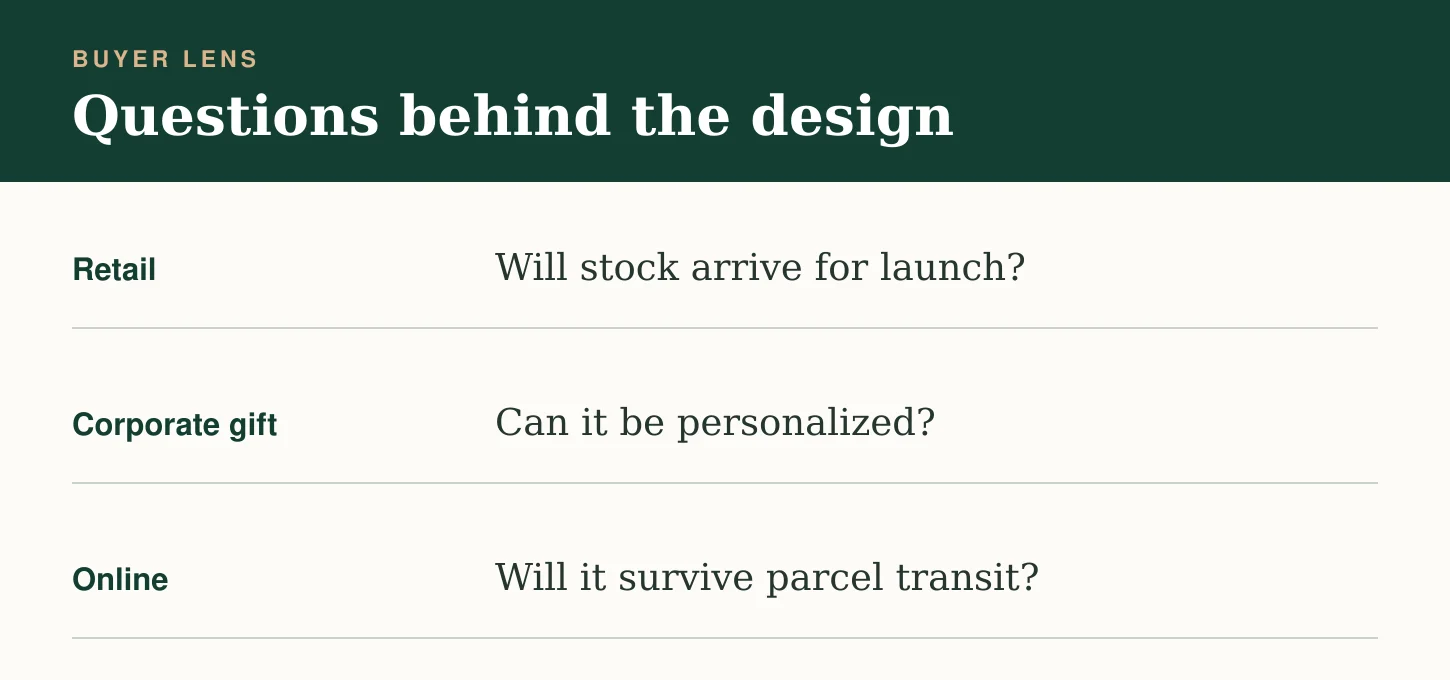
Buyer questions that should inform the approved product specification.
Keep the program usable next year
After launch, retain the signed mug and pack samples, decoration files, mold terms, testing and inspection records, customer complaints, and actual sales by SKU. Record whether returns came from breakage, capacity mismatch, color discrepancy, or late delivery. The next season’s design can improve one element without rebuilding the whole process. Decide which motifs can repeat and which licenses expire. A successful limited edition should not be copied into another market or year unless rights permit.
An honest supplier review should compare the planned schedule with the actual dates. Did artwork freeze late? Did the pack fail a transit check? Was the retailer’s forecast revised? These operational lessons are more valuable than a general claim that a factory is “fast.” When a new order changes body, decoration, or market, evaluate whether the previous test evidence remains relevant. Keep the customer-facing care instructions aligned with the updated design.
Forecast with a deadline and a downside case
Seasonal forecasting is not only a volume exercise. The buyer should model at least a central order, a stronger demand case, and a weak sell-through case. In the strong case, can the factory make more before the replenishment cutoff, or should the initial order carry extra stock? In the weak case, can a design be sold after the holiday as a winter mug, or is it dated too specifically? That choice affects artwork, packaging, and how much inventory risk the brand accepts. Avoid publishing a “limited” label if the plan assumes unlimited repeat orders.
Consider the dates of the sales channel. A wholesale retailer may need stock at its distribution center weeks before consumers begin holiday shopping. A corporate buyer may need additional time for employee or customer personalization and onward shipping. An e-commerce brand may need photography and page content ready before stock arrives. Document these dates independently of factory production. A late listing can waste an on-time shipment just as surely as a late ship date can waste a perfect product page.
If several customers share one body and different artwork, control allocations and rights carefully. A delayed approval for one motif should not silently change another customer’s agreed production. Decide whether unused printed cartons or decals can be repurposed, and who owns them if an order is reduced. These details belong in commercial terms and a change process, not an optimistic schedule slide. A forecast remains uncertain, but a clear downside plan prevents a small revision from turning into a large seasonal loss.
Connect the editorial calendar to the product file
The blog and the retail listing should draw from the same approved product facts. The editorial team may want to call a mug “fine porcelain,” “hand painted,” “dishwasher safe,” or “ideal for gifting.” Before using those phrases, compare them with the actual body, decoration method, care evidence, and packaging. A photo from an earlier sample can be wrong after a handle or motif revision. Reserve the final hero image and alt text until the production-standard sample is approved.
Content can help a buyer understand the design choices: capacity, motif, practical use, what the set includes, and care. It should not invent a heritage story or imply a customer brand endorsed the manufacturer. Keep customer-facing copy concise and accurate. The detailed RFQ, inspection limits, and supplier review remain in the internal product file. If the line returns next year, update the dates and availability while preserving the stable design facts.
After the season, compare demand by design rather than averaging all Christmas mugs together. A shape may sell well in stores but suffer e-commerce damage, or a motif may work for corporate gifting and poorly for homeware retail. Those differences should inform which element is repeated, redesigned, or retired. Keep the evidence with the corresponding SKU so the next collection is built from real performance rather than the team’s memory of a single popular photograph.
Daye Porcelain describes custom mug manufacturing and design development that can frame a seasonal OEM or ODM brief. Its prototyping page is relevant if a custom shape is proposed. Submit artwork, rights scope, target shelf date, order forecast, packaging requirements, and destination markets through the project inquiry page to discuss feasibility and a timeline tied to this specific program.
Frequently asked questions
How early should a brand order custom Christmas mugs?
Work backward from the required shelf date through local distribution, import, freight, production, pack printing, sampling, and artwork approval. The answer changes with shape complexity, quantity, and shipping route. Ask the supplier for milestone dates and build a contingency, rather than treating a generic online lead time as a promise.
Can a Christmas pattern be added to an existing white mug?
Possibly, if the body is available and the decoration and rights are appropriate. Approve a fired proof, packaging, care instructions, and any required evidence for the finished SKU. An existing body does not make the new decorated item automatically approved.
Are Christmas porcelain mugs suitable for microwaves?
That depends on the finished design, including any metallic or other decoration and accessories. Use a care claim only when the actual product has been assessed under the intended conditions. Do not infer it from the word “porcelain.”
What should a seasonal purchase order specify?
The approved sample and revision, artwork, quantities by SKU, packing, tests, inspection, milestones, delivery terms, and change process. Identify who approves proofs and how a delayed approval affects the schedule. This prevents a last-minute dispute about what the factory was asked to ship.