
Table of Contents
Porcelain espresso cups are small objects with a demanding job. A café needs a cup that sits under its machine, catches the intended pour, feels secure in a hurried service, washes well, and comes back from the next order looking like the first one. A retail brand needs those same decisions translated into a photograph, a convincing pack, and a product claim it can support. The best brief therefore starts with the way the cup will be used, not with a generic capacity on a supplier listing.
This guide is for brand owners, coffee businesses, importers, and distributors developing an espresso cup porcelain program with an OEM or ODM partner. It concentrates on the cup itself: useful fill, silhouette, rim, handle, finish, sampling, and repeat supply. Daye Porcelain’s coffee cups and saucers collection provides a starting point for a supplier conversation. Neither a photograph nor a material name can certify a finished SKU for a destination market.
Key takeaways
- Define a practical espresso serving and the headroom above it before approving a nominal capacity.
- Test the rim, handle, balance, and machine clearance with the actual coffee workflow.
- Treat fired color, decoration, care, packaging, and test evidence as parts of one approved SKU.
- Keep a retained sample and a versioned specification so a reorder can be compared with the first shipment.
Translate the drink menu into cup requirements
The phrase “porcelain espresso cup” covers several uses. A small straight espresso, a longer espresso, and a drink with a little milk may be served in different vessels even when a retailer lists them all as demitasse cups. Ask the buyer to record the actual liquid volume dispensed, the desired visual headroom, and whether the cup will be used for a single or a double serving. Do not confuse the comfortable serving volume with brim-full capacity. A cup filled to its rim is difficult to carry and an unrealistic basis for product photographs or a café operating procedure.
Measure the intended beverage in the buyer’s workflow, then fill candidate cups to that mark. Record the milliliters, visible fill line, and remaining space. A coffee machine’s programmed shot, a barista’s recipe, and a home consumer’s expectations can differ. The numbers in a catalog are screening information; they are not a substitute for a fill test. If two cup sizes are needed, give them separate item codes and dimensions rather than allowing one vague “espresso size” to cover both.
The outside dimensions matter too. Measure the clearance beneath the group head with any scale, platform, or drip tray the café actually uses. Look at whether the mouth can catch a two-spout pour without splashing, and whether the cup can be placed and removed without awkward angling. These are simple trials, but they prevent a beautiful cup from failing at the point of use. A retail-only program should still test ordinary countertop espresso machines if the product page implies that use.
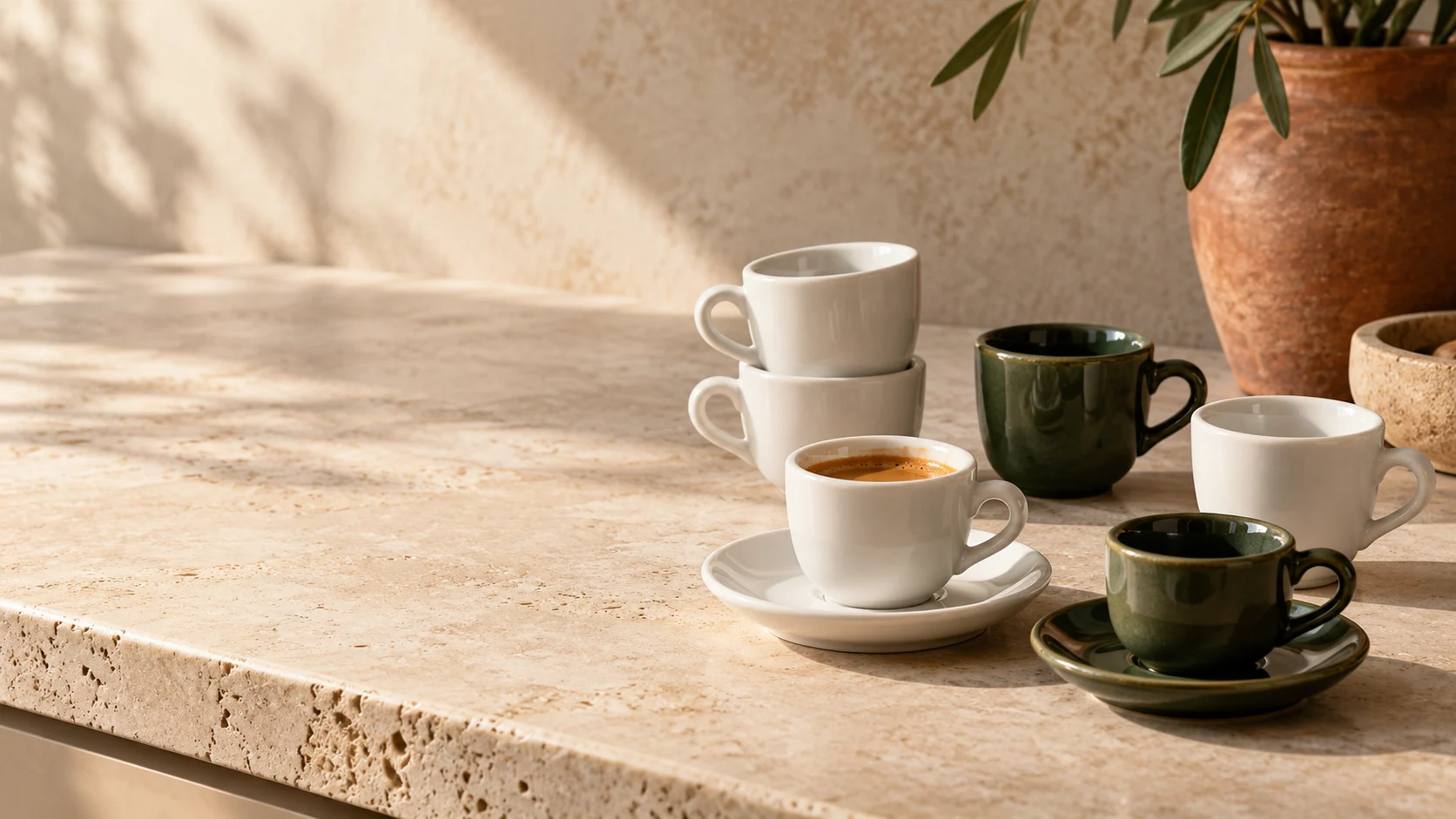
Illustrative espresso cup range: approve useful fill and handling on actual samples.
Choose a profile for handling and presentation
A lower, wider form exposes more of the beverage surface and can make the cup easy to fill beneath a machine. A taller, narrower form creates a different silhouette and may leave less tolerance for a dual spout. Neither profile automatically serves better coffee. The interior curve, rim diameter, wall thickness, foot, and handle have to be considered together. Photograph prototypes at the actual serving volume and ask users to lift them by the handle and from the saucer if one is planned.
The rim is a contact surface, not just a visual edge. A very thick rolled rim can feel blunt; a very thin edge may change handling and the appearance of the piece. Specify a rim range to review on physical samples rather than promising that one thickness is ideal. Ask the maker to show how the glazed edge is finished and how variation is inspected. The interior should also be easy to rinse: difficult-to-reach corners can retain residue even if the exterior looks refined.
The handle should admit a practical grip for the intended audience. Some espresso cups use a small loop for one finger; others invite a pinch between thumb and finger. Test the filled cup with people whose hand sizes differ, including left- and right-handed users. Note whether the thumb touches a hot body, whether the handle is close to the rim, and whether it collides with a neighboring cup in storage. A cup can be visually balanced on a product page yet awkward when a barista clears six at once.
If stacking is requested, define how many cups may safely stack and on what surface. Test real glazed samples, not just identical CAD shapes. The upper cup can rub the lower cup’s rim or load its handle; apparent stackability in a photo is not a durability claim. A stacking version may need a specific foot and handle position that differs from a non-stacking retail design.
Compare alternatives with the same serving test
|
Design route |
Potential advantage |
Approval question |
|---|---|---|
|
Low, open cup |
Easy visual access to the shot and a broad target for the pour |
Does it fit the tray and stay comfortable to lift? |
|
Taller demitasse |
Distinct shelf silhouette and compact footprint |
Is the opening wide enough for the intended machine? |
|
Thick-walled profile |
Substantial feel and a durable-looking edge |
What are the measured serving and handling results? |
|
Fine-profile porcelain |
Light, refined visual language |
Does the rim, handle, and care performance suit the use? |
|
Stackable form |
Can reduce shelf footprint |
Is the approved stack stable without surface damage? |
This is a comparison framework, not a list of universal performance claims. A thicker wall changes mass, but cup temperature during service depends on the finished geometry, starting temperature, beverage, and time. Run a simple, repeatable comparison on real samples if heat behavior matters to the range. Use the same drink volume and initial conditions for both candidates, and record what the café actually values: serving temperature, surface comfort, washing, or storage.
Porcelain body, glaze, and decoration
Porcelain describes a ceramic body, but it does not define one universal white tone, weight, firing response, or glaze. Ask for a physical reference of the fired body and glaze. In a coordinated range, a cool white espresso cup can look out of place beside a warmer cappuccino cup even if both are called porcelain. Approve the collection together under the light in which it will be sold or served.
For a branded line, decide whether the logo appears outside the cup, inside the well, on the saucer, on the base, or on the box. A mark that looks centered in a flat file can appear shifted on a curved wall or disappear behind the handle in a product photograph. Approve a fired proof at real size. Specify which view matters most for the café shelf, the right-handed serve, and the online listing. Avoid copying a competitor’s protected artwork or proprietary sculptural form from a reference image.
Decorative metallic accents and overglaze colors can affect care instructions. Do not carry over a dishwasher or microwave claim from a plain white blank to a newly decorated variant without checking the finished construction. For food-contact use, ask the supplier to map the glaze and decoration of each destination-market SKU to the relevant evidence. A test for one body or color is not automatically a certificate for every variant.
Build a sample that answers commercial questions
Start with two or three candidate profiles, not ten almost identical photographs. Give the factory a short sheet with useful fill, approximate outside envelope, cup-and-saucer requirement, finish, logo position, anticipated order structure, and destination markets. Ask which elements can use an existing mold and which need development. If a new tool is proposed, agree who owns the drawing and how the tool can be used on a later reorder.
The first sample should resolve geometry. Check the fill mark, pour target, handle, rim, foot, stability, and fit with the machine. The second proof should resolve fired appearance and decoration. A production-standard sample should resolve packaging, labeling, and the tolerance range that inspectors can actually apply. Retain signed examples. A single hand-selected show sample without written limits is a weak basis for a repeat order.
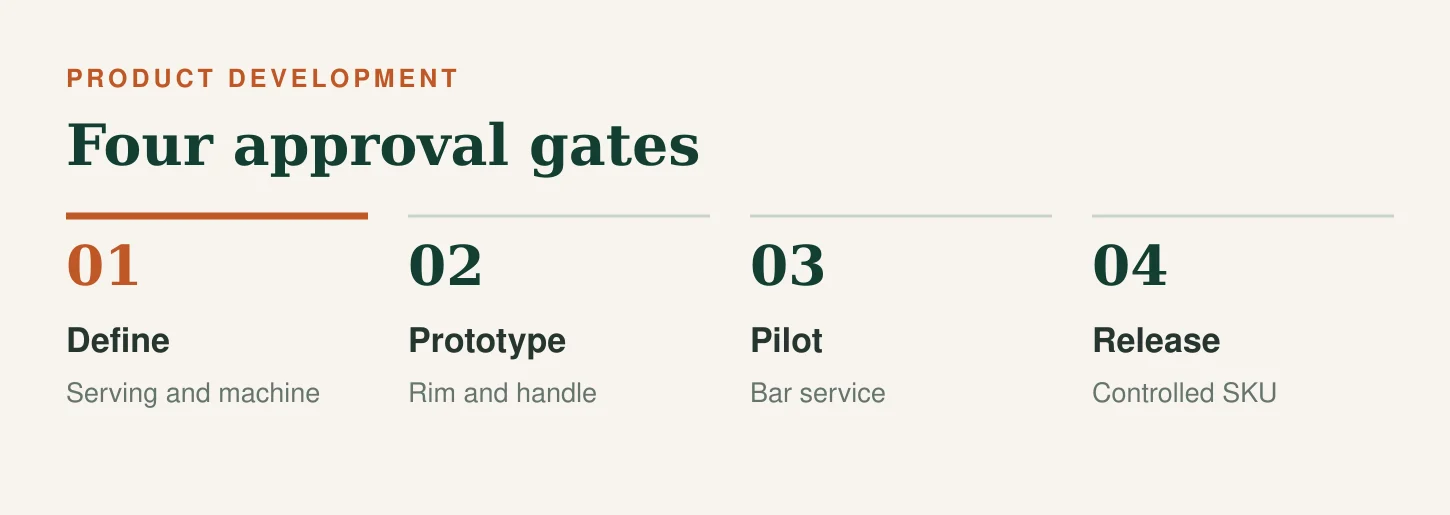
Approval gates for this product brief; the final steps depend on the project.
Ask for measurements across several pieces. Ceramic firing and glazing introduce variation, so the useful question is whether the resulting range is acceptable for the application. Record reasonable limits for capacity, external dimensions, wobble, visible marks, logo placement, and color. The retailer may tolerate subtle handmade variation in one design but require a tighter white reference for a chain. The inspection criteria should reflect that decision rather than an unexplained generic defect list.
In a pilot, let staff pull and serve drinks using the real equipment. Put the cups through the proposed cleaning routine, check where they chip or rub in storage, and note how the handle feels when wet. A pilot observation should lead to a drawing, artwork, packaging, or care-copy change when needed. Do not approve only on the basis of a styled photo.
Packaging, replenishment, and the quote
For wholesale, the “unit” may be a loose cup, a cup with a matching saucer, a pair, or a gift set. State that unit explicitly before comparing prices. Carton density, dividers, printed gift packaging, barcode position, and replacement policy can change landed cost and breakage exposure. A cup-only quote cannot be compared fairly with a fully packed cup-and-saucer set.
Ask the supplier to separate sample fees, any mold or artwork setup, decoration, retail packaging, testing, and production quantities. Specify whether the buyer can purchase replacement cups or saucers separately. Cafés often break components at different rates; a set-only replacement policy may be expensive in service. For retail, keep the SKU and barcode tied to the exact count and finish shown on the product page.
For US-bound ceramicware, FDA guidance addresses extractable lead and cadmium from ceramic food-contact surfaces. For EU-bound goods, the European Commission lists a general food-contact framework, good manufacturing rules, and a ceramics-specific directive. These are reasons to request documentation for the finished decorated item and its market, not grounds to call a product “FDA approved” based on a supplier profile. Requirements and acceptable evidence should be confirmed for the actual destination before purchase-order release.
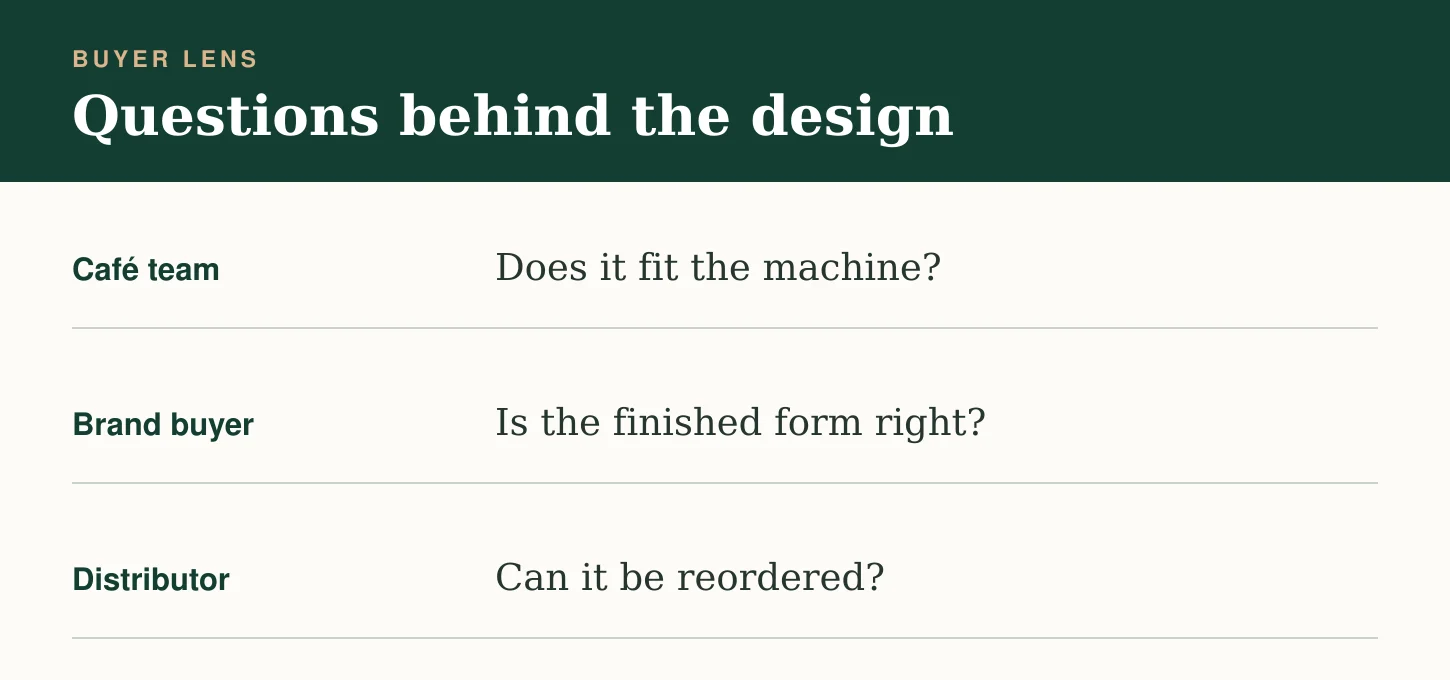
Buyer questions that should inform the approved product specification.
Send a usable espresso cup RFQ
A good inquiry includes the intended drink and volume, target capacity method, machine clearance, candidate profile, handle and rim preferences, stacking requirement, white reference or color target, artwork files, unit configuration, packaging, markets, expected quantities, and launch window. Ask for a proposed sampling path and the limits of the supplier’s current molds. That gives the maker room to flag design conflicts before quoting a price that depends on unresolved choices.
Daye Porcelain’s coffee cups and saucers and prototyping and mold development pages are relevant starting points for such a brief. A brand can send a controlled reference, intended use, and market requirements through the project inquiry page. Confirm feasibility, minimum order quantity, timing, and the specific compliance route in the project response rather than assuming that every pictured cup is a stocked espresso SKU.
Frequently asked questions
What size should porcelain espresso cups be?
There is no single size for every menu or machine. Measure the intended beverage and allow practical headroom, then compare candidate cups by useful fill and outside dimensions. Publish a capacity method that matches the physical sample; do not use brim volume to imply a normal serving volume.
Are porcelain espresso cups better than glass or stoneware?
The answer depends on the particular design and use. Compare completed vessels for handling, heat behavior, appearance, cleaning, breakage, and supply continuity under the same conditions. Material names alone do not establish a universal winner.
Can a porcelain espresso cup be customized with a logo?
Often, but the method and result depend on the cup shape, artwork, placement, and firing route. Approve a fired proof and the final care instructions. Ask who owns the artwork files and how the approved mark will be reproduced on a reorder.
Do espresso porcelain cups need saucers?
Not always. A café may need a place for a spoon and a consistent serving presentation; another concept may use a cup alone. If a saucer is included, fit and stability become a second design problem and the set needs its own packaging and SKU definition.
Can one safety report cover every espresso cup design?
Do not assume so. The supplier should identify the tested body, glaze, decoration, and applicable market, then explain any documented grouping of variants. Changes to materials or decoration may require further evidence.