Table of Contents
A porcelain tankard can be a striking retail vessel, but the name alone does not specify the product. It might describe a tall open drinking mug, a covered porcelain form, or a ceramic body assembled with a hinged metal lid. Those are different manufacturing and compliance projects. A brand that starts with an antique photograph and asks a factory to “make this tankard” leaves the most important decisions unresolved.
This guide is for brand owners, gift buyers, importers, and distributors exploring a modern porcelain tankard collection. It explains the historical reference without turning a collector’s object into a production specification. It then sets out the form, lid, decoration, food-contact, packaging, and sample decisions needed for an OEM or ODM brief. The starting point is the finished use and the buyer’s original design, not a promise that any particular historical piece can be copied.
Key takeaways
- Define whether “tankard” means an open tall mug, a removable porcelain cover, or a mixed-material hinged assembly.
- Approve useful fill, full weight, handle strength, balance, rim, and cleaning on a physical sample before artwork.
- A historical tankard can inspire proportions, but named antiques and recognizable decoration are not a license to reproduce them.
- Food-contact evidence and care claims must match the finished ceramic body, lid, decoration, and any metal components.
Separate the historical form from the modern product
Tankards have been made in several materials and places. The Metropolitan Museum of Art describes historical tankards as capacious handled drinking vessels that could be cylindrical or tapered and often had hinged lids. Its collection includes a Meissen hard-paste porcelain example with a silver-gilt lid and mounts. The National Gallery of Victoria holds a seventeenth-century tankard whose porcelain body was made in China and fitted with silver-gilt mounts in Antwerp. That object shows how a European drinking form and Chinese porcelain export production could meet in one vessel. It does not establish one inventor of the porcelain tankard.
This history matters to product developers because a photograph may show the work of more than one craft. A ceramic workshop can form and decorate the body, while a metalworker made the hinge, thumbpiece, and mount on a historic piece. A modern project with a fitted metal lid likewise requires a defined component supplier, assembly method, care instruction, and inspection standard. The name “porcelain tankard” does not make those stages a single easy ceramic operation.
Collector searches often contain a maker’s name, a date, or a distinctive animal or painted scene. They may be useful for understanding what people recognize as a tankard, but they are poor substitutes for a new commercial brief. Provenance, attribution, and antique valuation require object-specific expertise. A brand developing new tableware should use an original silhouette and authorized artwork, then state clearly that the new product is contemporary. Do not imply that a new mug is an antique, a museum edition, or a reproduction authorized by a named maker.
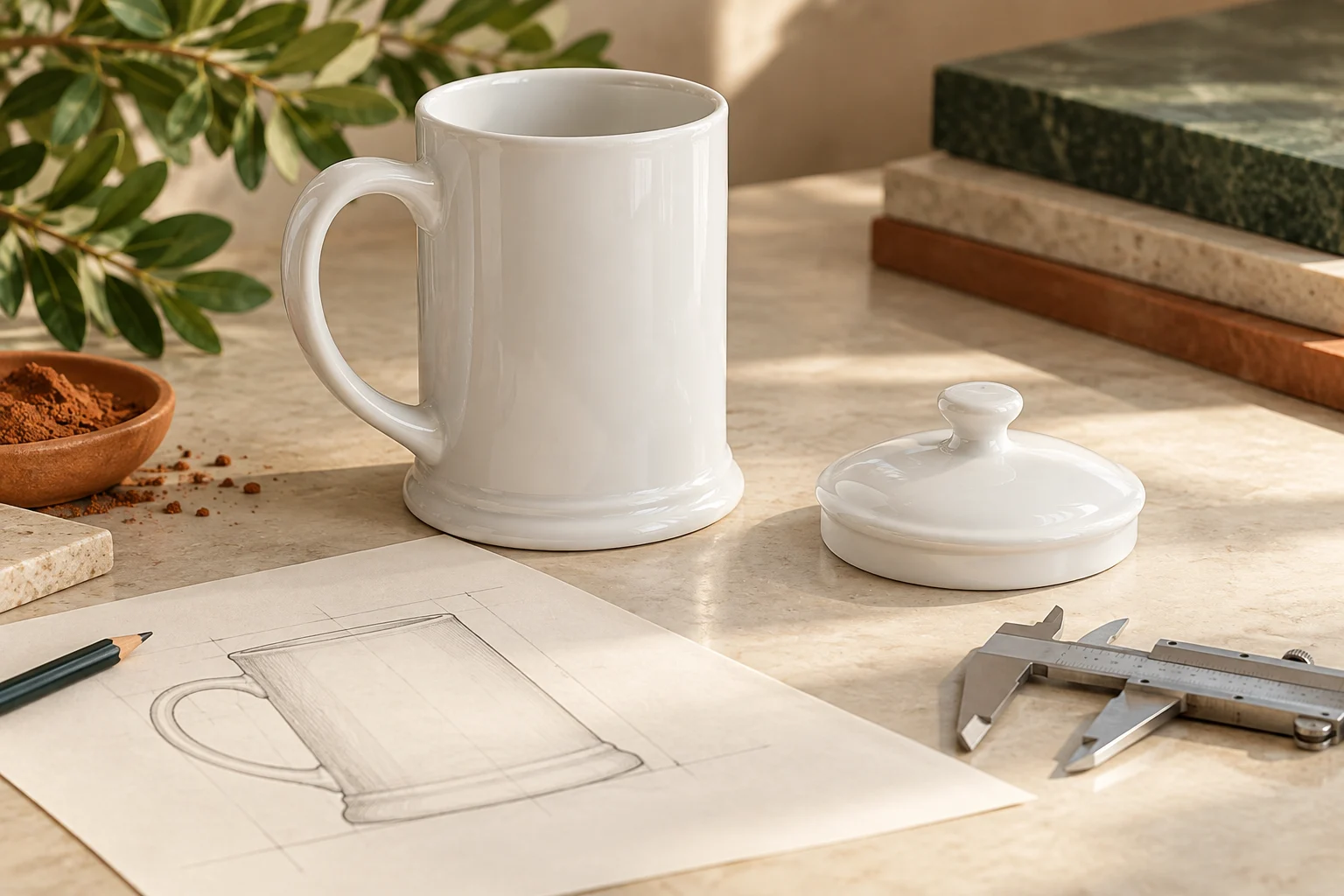
Illustrative tankard prototype: approve the body and lid as separate components.
Choose a form and a useful fill
Start with the intended drink and selling channel. A beer-service vessel, a coffee mug with a tankard-inspired profile, and a decorative gift piece can share a tall cylindrical body but need different capacities, rim shapes, and care instructions. Record both brim volume and a comfortable fill level. A catalog label such as “large tankard” cannot tell a buyer whether the last centimeter of capacity is practical once the mug is lifted or fitted with a cover.
The tall profile changes balance. Assess the filled center of mass, base diameter, and whether a customer can set the vessel down without wobble. Test grip with the intended fill and temperature: the opening must accept fingers comfortably, and the attachment should not create a pressure point. A heavy handle can make an empty sample feel premium yet tilt awkwardly when full. A thin decorative handle may be elegant but unsuitable for the target capacity. Decide which trade-off the brand wants before approving the mold.
Look closely at the rim. An open drinking tankard needs a lip that feels comfortable and does not trap liquid at a thick rolled edge. A lidded version also needs a measurable seating surface. A lid that looks aligned in a photograph may rock, scrape the glaze, or fall when the vessel is tilted. If a brand wants a wide mouth for cleaning or a narrow mouth for the traditional silhouette, record the dimension and evaluate it with a real brush or dishwasher rack. The finished use should lead the drawing.
|
Design route |
Product character |
Approval focus |
Main operational risk |
|---|---|---|---|
|
Open porcelain tankard |
Tall handled drinking mug without a cover. |
Useful fill, handle, rim, base stability. |
Oversized form and shipping weight. |
|
Removable porcelain lid |
Covered serving or gift presentation. |
Lid seat, grip, cleaning, replacement fit. |
Chipped contact points or loose parts. |
|
Hinged metal assembly |
Historic-inspired mixed-material vessel. |
Mount fit, hinge action, metals, assembly and care. |
Multiple suppliers and evidence scopes. |
|
Decorative collectible-style piece |
Display-led original artwork or relief. |
Rights, surface finish, use labeling and pack. |
Confusion between display and food use. |
The routes should not be quoted as though they differ only by one accessory. A metal hinge can require a new collar or mount, different handling during assembly, and a separate component test. A removable ceramic lid is simpler in some respects but still needs a fit tolerance and its own protective packaging. Ask for options against the same core design brief, then compare total program cost and schedule.
Engineer the body and handle as one system
The tankard’s broad sidewall provides room for artwork, but it also exposes variation in roundness, verticality, and glaze. Ask for a technical drawing with overall height, top and base diameters, useful fill, wall range, handle projection, and permitted variation. Decide which dimension controls the retail shelf, carton, or lid fit. A nominal capacity alone will not protect a brand from a taller, narrower revision that changes the product’s appearance.
Review the handle attachment at its top and bottom. The junction should be smooth enough for cleaning and strong enough for the agreed use. A decorative relief near the junction can create a difficult finishing area. The base should sit level after firing and should not scratch a table through rough unglazed contact. Check whether the underside can carry a legible brand or origin mark without disrupting stability. On a tall vessel, even small differences at the foot become noticeable when several pieces stand together on a shelf.
If the design includes a thumb rest or sculpted motif, test it with people who have different hand sizes. The detail should be evaluated in the user’s grip, not only in a close-up rendering. For a high-volume program, an original relief shape may need several mold revisions to preserve both appearance and release from the mold. Ask the factory which features are difficult to form, trim, glaze, or fire consistently. A candid manufacturability review is more useful than a quick approval of a complex digital model.
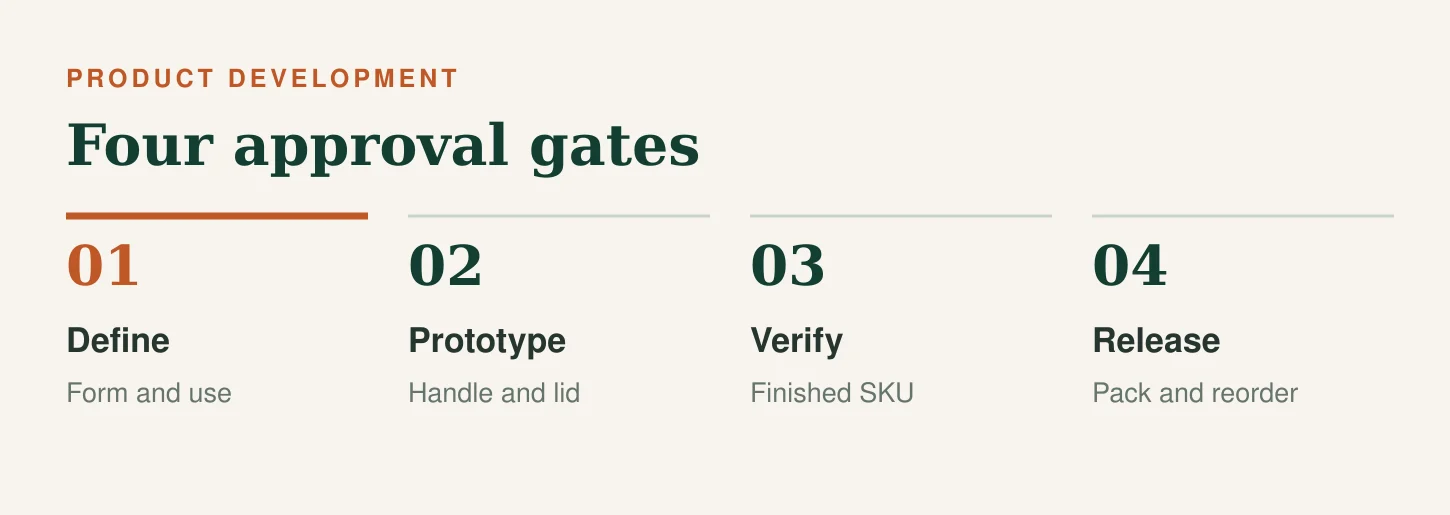
Approval gates for this product brief; the final steps depend on the project.
Treat the lid as a separate product decision
A removable porcelain cover can make a tankard feel ceremonial or suitable for a desk, but it should not be described as leakproof. Define how the user lifts it, where it rests when removed, and how it is cleaned. A knob that looks attractive may be slippery with wet fingers. The lid needs clearance for the rim and any decoration. Specify an acceptable rocking range and test multiple lid and body samples across a pilot batch rather than one carefully paired prototype.
A hinged metal cover is a different engineering project. Ask who supplies the hinge and mount, what material contacts the drink or lip, how the mount is fixed, whether the assembly can be disassembled for cleaning, and which components can be replaced. Evaluate pinch points, sharp edges, corrosion, heat transfer, and repeated opening under the intended use. The material and finish of a historical precious-metal mount should not be copied into a modern care or safety claim. A metal-lidded tankard may be unsuitable for microwave use; publish only instructions supported for the finished assembly.
Packaging must distinguish the variants. A loose porcelain lid needs a protective recess that prevents ceramic-on-ceramic impact. A hinged lid should not take the compression load of the carton. Test with the final body, handle, lid, and retail insert together. If the assortment contains open and covered SKUs, give each a distinct bill of materials, case-pack record, and inspection checklist. An accessory omitted at packing is not a minor cosmetic variation to the buyer.
Make decoration original and production ready
A tankard’s broad wall invites elaborate painting, crest-like marks, and relief. That can be a strength for an original collection, but a historical photograph can hide the ownership and production method of its decoration. Use original commissioned artwork or obtain a license with the relevant product, territory, channel, and term. A collector’s image of a named maker or dated work should not be traced into a commercial decal. The same caution applies to character handles, animal finials, and inscriptions that identify someone else’s product.
Send editable artwork with a clear front-facing datum, wrap limits, color references, and rules for the handle side, seam, lip, and base mark. Request a fired proof on the actual chosen body and glaze. Paper art will not demonstrate how a line bends around a cylinder or how a warm white body shifts an ink color. Photograph the fired approval under consistent light and retain a physical master for later production. If several decorative variants share a tankard mold, a common body standard can simplify reorders while each artwork still needs its own proof.
Do not describe a printed design as hand painted because it resembles a brushstroke. If a piece truly has hand-applied work, define which stage is done by hand and what variation is accepted. If the brand chooses a metallic-looking accent, confirm the actual material, placement, care, and food-contact evidence. A display-led object can carry richer decoration, but it still needs honest use labeling so a consumer does not assume it is suitable for drinking when that was never established.
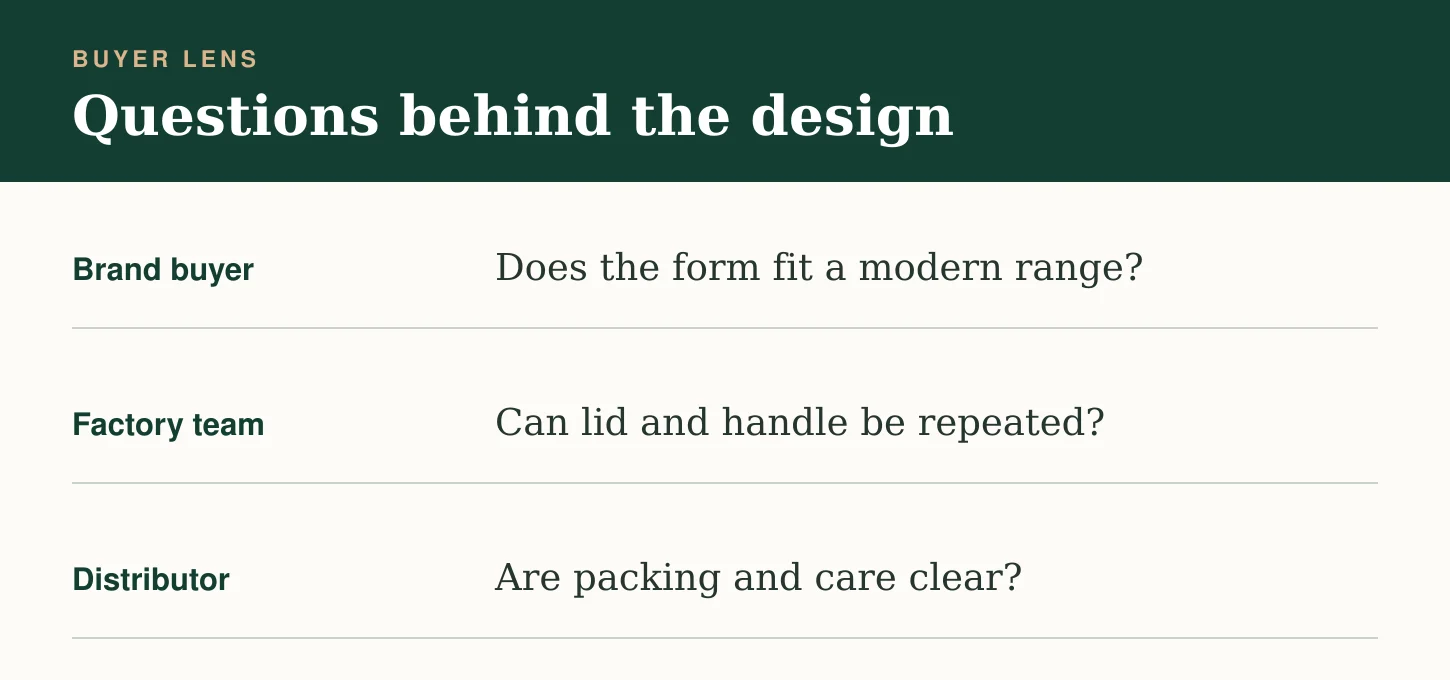
Buyer questions that should inform the approved product specification.
Verify safety, care, and destination-market evidence
For US sales, the FDA publishes compliance policy guides on lead and cadmium leaching from ceramicware. For EU sales, the European Commission explains the general food-contact framework and specific ceramic provisions. These sources do not constitute a blanket certificate for every mug from a supplier. Ask a qualified compliance specialist or laboratory to define the tests and declarations for the final tankard, its glaze and decoration, destination market, and intended contact conditions. A report for an undecorated sample cannot automatically stand for a new decorated body.
For a mixed-material assembly, map each component and its contact path. A metal lid may not touch liquid during normal use, but it could contact the lip or condensation. The conclusion depends on the actual design. Keep the evidence package attached to a versioned drawing and physical sample. If the product is sold as display-only, review how that use is communicated on the item and packaging; an ornamental description should not disguise a vessel that is marketed for drinks.
Care instructions also need product-specific support. Dishwasher use depends on the body, decoration, lid, and assembly. Microwave use is especially sensitive to metal and some decorative finishes. Thermal change, repeated washing, abrasion, and handle loading should be considered according to the actual consumer use. A supplier’s factory audit helps assess its organization, but it is not proof that a particular lidded tankard meets a food-contact or care claim. Write the final product page after the evidence is reviewed.
Build the RFQ around samples and reorders
An actionable request for quotation includes the use case, sales markets, target useful fill, silhouette reference, original art rights, open or covered route, expected first and annual quantities, packaging channel, care claims, and required evidence. Ask whether the supplier proposes an existing body, a modified form, or a new mold. Request separate lines for tooling, decoration, lid or metal hardware, sample rounds, testing, individual packing, inspection, and freight terms. There is no meaningful universal price for a “porcelain tankard” detached from those choices.
Approve in stages: form and handle, lid fit where relevant, fired decoration, complete packed sample, test evidence, then pilot production. State who signs each gate and which physical sample becomes the standard. For a covered SKU, test interchangeable fit from more than one body and lid, not only a matched pair. In inspection, check capacity, dimensions, base wobble, handle junction, glaze, artwork position, lid seating, and pack contents. Agree defect classifications and a remedy before bulk release.
Plan continuity. Who owns a new mold, who stores it, and can the buyer move it? Can a metal component be reordered if the hardware source changes? How will the factory control white shade, lid fit, and replacement stock across seasons? A one-time gift run may prioritize a delivery date, while a retail collection needs stable replenishment. Record the reasons behind the selected route so the next buyer does not compare a cheaper open mug quotation with the approved covered assembly as though they were identical products.
Daye Porcelain describes custom mug development, OEM and ODM services, and prototype and mold development. A buyer considering a tankard-inspired design can share drawings, artwork ownership, target market, lid route, quantity, and packaging through the project inquiry page. Ask the team to confirm feasibility, component sourcing, sampling, and market evidence for that specific project before presenting it as a production-ready Daye product.
Frequently asked questions
What is a porcelain tankard?
It is a handled drinking-vessel form made with a porcelain body. Historical examples can be open or have metal-mounted hinged lids; a modern commercial brief should define the exact body, capacity, cover system, decoration, and intended use rather than relying on the term alone.
Does every porcelain tankard need a lid?
No. A modern open tall mug can use tankard-inspired proportions. If a lid is part of the product promise, specify whether it is removable porcelain or a hinged mixed-material assembly, then approve fit and care for that configuration.
Who invented porcelain tankards?
A single inventor claim is not supported by the museum examples cited here. The tankard form has a European history, while porcelain bodies and later mounts could come from different makers and regions. Describe a specific historical object by its documented provenance rather than assigning the whole category one origin story.
Can an antique tankard be copied for a retail range?
Use historic pieces as research for proportions and construction, then create original art and review rights to any recognizable decoration, marks, or later design elements. An object being old or photographed online is not enough to establish the rights for a commercial reproduction.
Is a porcelain tankard safe for daily drinking and dishwashing?
That depends on the finished SKU and its intended market, including glaze, decoration, cover, and any metal components. Request product-specific food-contact evidence and supported care instructions. Do not transfer results from a different blank mug or an antique object.
References
The Metropolitan Museum of Art, Johann Berend Tankard · The Met, Meissen Porcelain Tankard · National Gallery of Victoria, China and Flanders Tankard.
US FDA, Lead in Ceramicware · US FDA, Cadmium in Ceramicware · European Commission, Food Contact Materials · Daye Porcelain, Custom Ceramic Mugs.