Table of Contents
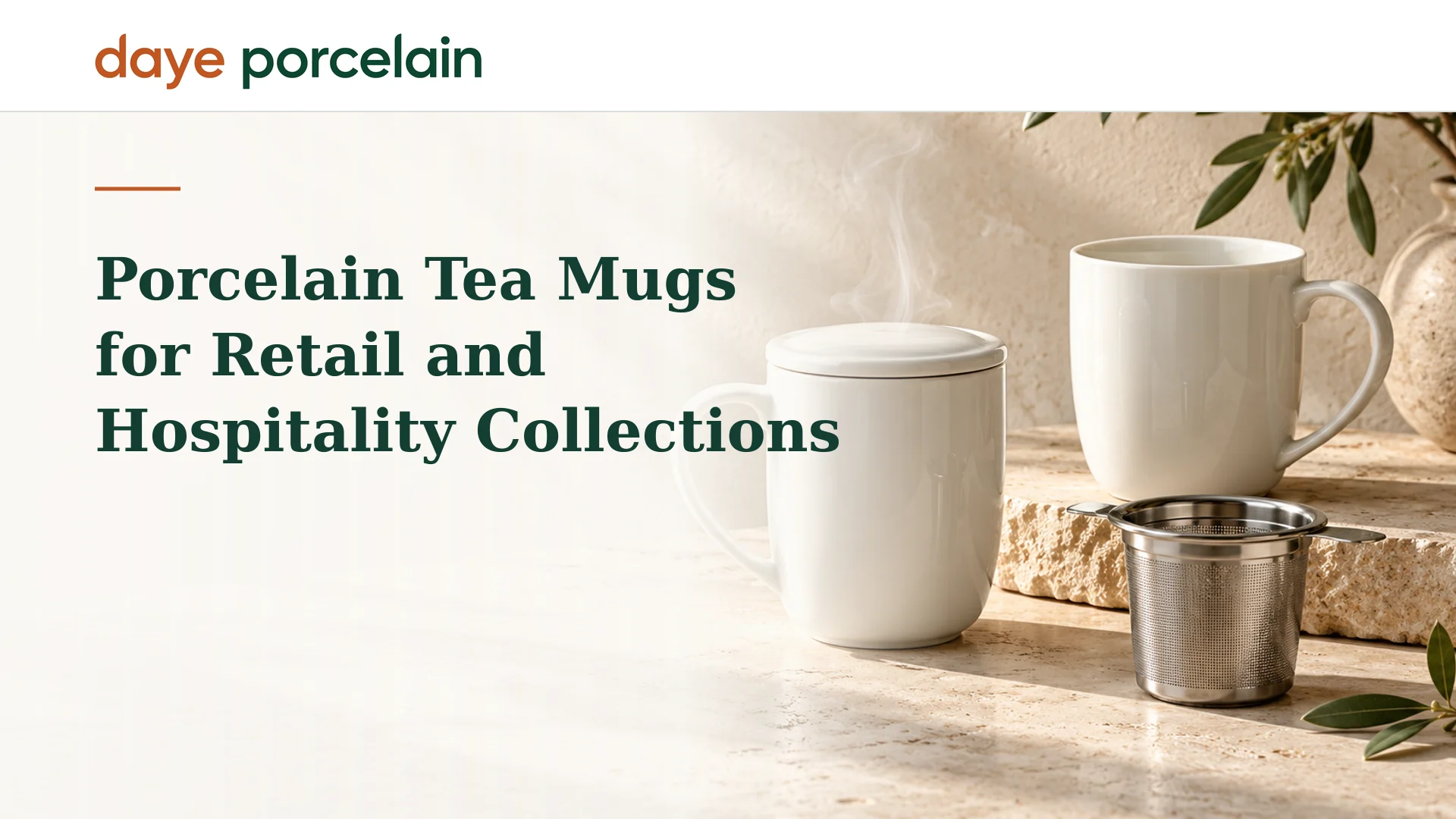
A tea mug has to make a simple ritual easy: add tea, lift a comfortable vessel, drink at a pleasant temperature, and clean it without fuss. For a retail brand or hospitality buyer, the design also has to survive a supplier handoff and a second production run. That is why “porcelain tea mug” is a brief to develop, not a complete specification.
This guide covers the choices that matter when building a private label tea mug range: capacity, infusers and lids, handle and rim design, surface decoration, care claims, packaging, and quality evidence. It is written for buyers planning a collection rather than consumers comparing individual ready-stock mugs. A tea mug can be part of Daye Porcelain’s custom drinkware work, but any particular feature or performance claim needs agreement for the specific project.
Key takeaways
- State practical tea volume with any infuser installed.
- A loose ceramic lid is a desk cover unless a stronger carrying claim is proven.
- Approve the mug, lid, infuser, care instructions, and pack as one set.
- Plan replacement components if the collection is meant for long-term retail or hospitality use.
Define the tea-drinking experience first
Loose-leaf tea, bagged tea, and milk tea create different demands. A loose-leaf mug may need an infuser with enough space for leaves to expand, a lid that doubles as a drip rest, and an opening large enough for cleaning. A café may prefer a simple, stackable cup that can be cleared quickly. A retail gift mug may spend more time in a display box than in a dishwasher, making presentation and damage prevention unusually important.
Write down the intended practical fill volume, not just a marketing capacity. Allow space for an infuser, leaves, and the person’s preferred headroom. If an infuser displaces liquid, test the assembled set at the target beverage volume. A 350 mL brim capacity does not mean it serves 350 mL comfortably with a basket in place. A wide, low mug and a narrow, tall mug with the same nominal capacity feel different to hold and drink from. Decide which experience fits the collection before approving a mold.
Tea presents a visual challenge: a light white glaze shows the drink color clearly, but it can also make stains and glaze inconsistency more noticeable. Dark or patterned interiors change that view and may affect how a shopper perceives the product. These are design observations, not guarantees about staining. Sample with the teas the target customer will use, and follow the proposed care instructions during evaluation.
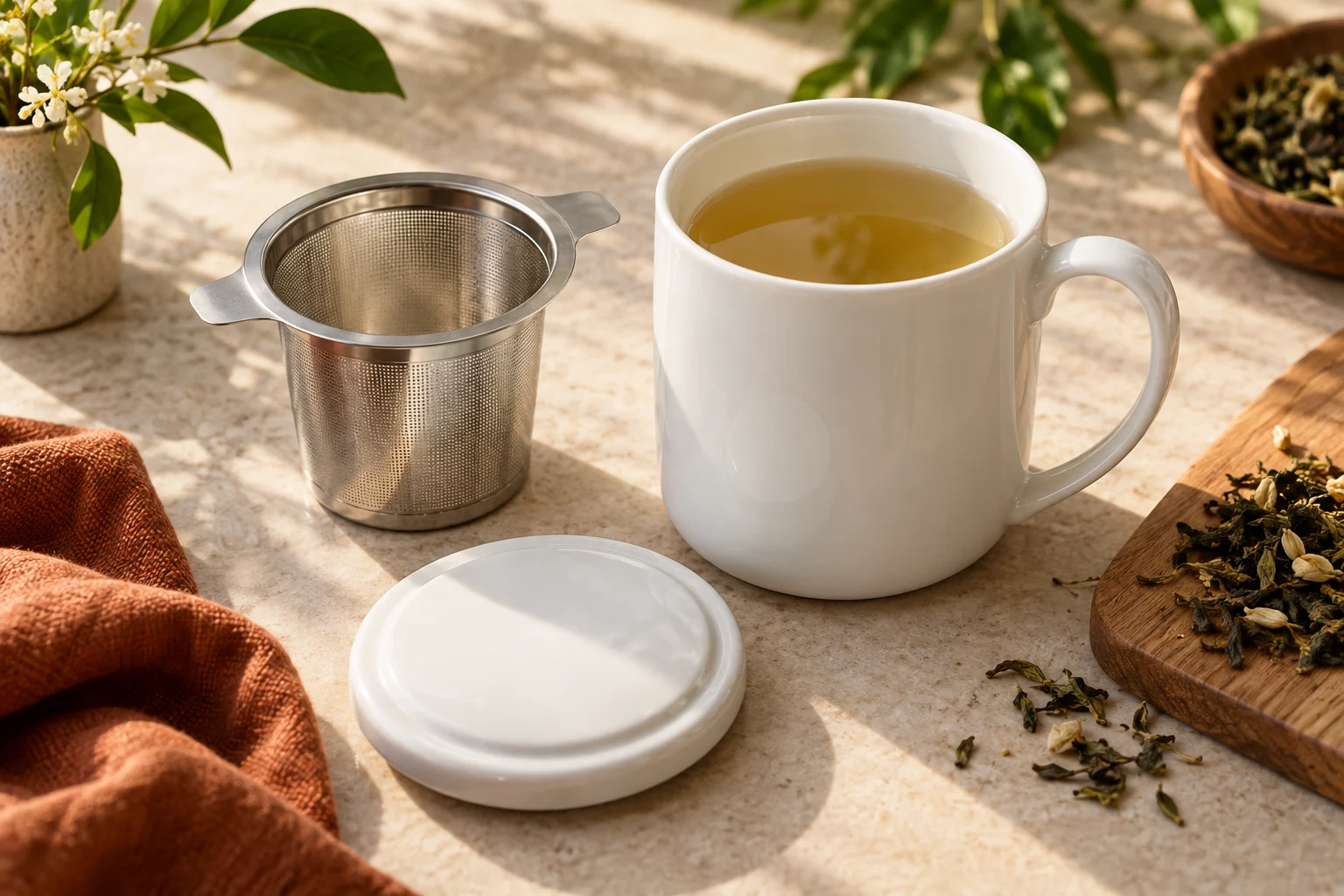
Illustrative tea service set: confirm fit and care for every component.
Choose between a mug, covered mug, and infuser set
A plain tea mug has fewer components and can be easier to pack, wash, and replace. A covered mug protects the drink from dust and offers a different visual identity, but its lid needs a stable resting position and a comfortable knob or edge. A mug with an infuser adds a functional part that must fit consistently. The opening cannot be judged from a rendering alone; test insertion, removal, drip behavior, and finger access when the set is hot.
If the lid is ceramic, check where it contacts the rim. An imperfect fit may rattle, trap drips, or chip during transit. If the infuser is another material, specify its food-contact surface, cleaning method, and supplier. The ceramic body and accessory may have different evidence requirements and different failure modes. A statement that the porcelain body is suitable for food contact does not automatically cover an added plastic or metal component.
Many covered tea mugs are designed for a desk, a hotel room, or an at-home ritual. That does not make them spillproof travel products. A loose ceramic lid may reduce heat loss or keep leaves covered but will not necessarily stay in place when the mug is tipped. Decide whether the product is a desk set or a carried vessel, and label it accordingly. If “travel” is part of the proposed claim, the lid, closure, and impact resistance require separate testing.
Handle, rim, and base for repeated use
Tea is often sipped over a longer period. A handle should feel secure even when the mug is near its practical fill level. Test it with several hand sizes and with the infuser in place. For a handleless tea cup, consider the outside temperature under the expected serving conditions and whether a saucer or sleeve is part of the system. A large handle can look inviting in a photograph yet make a mug awkward on a crowded tray.
The rim should allow comfortable sipping and should be checked for a clean, continuous glaze. If the design includes a very fine edge, test it under the intended cleaning and handling routine. The base needs to sit level on ordinary tables and on the supplied saucer if one is included. A taller covered mug places extra weight above the center of the vessel; assess stability when filled and when the lid is lifted one-handed.
These observations can be converted into approval criteria. Record the practical fill, overall height, base diameter, handle clearance, lid fit, infuser engagement, and acceptable glaze appearance. Physical samples should be retained for future orders. If a design is sold as a set, do not approve the mug body and accessories from separate photographs; approve the full set assembled, used, cleaned, and packed.
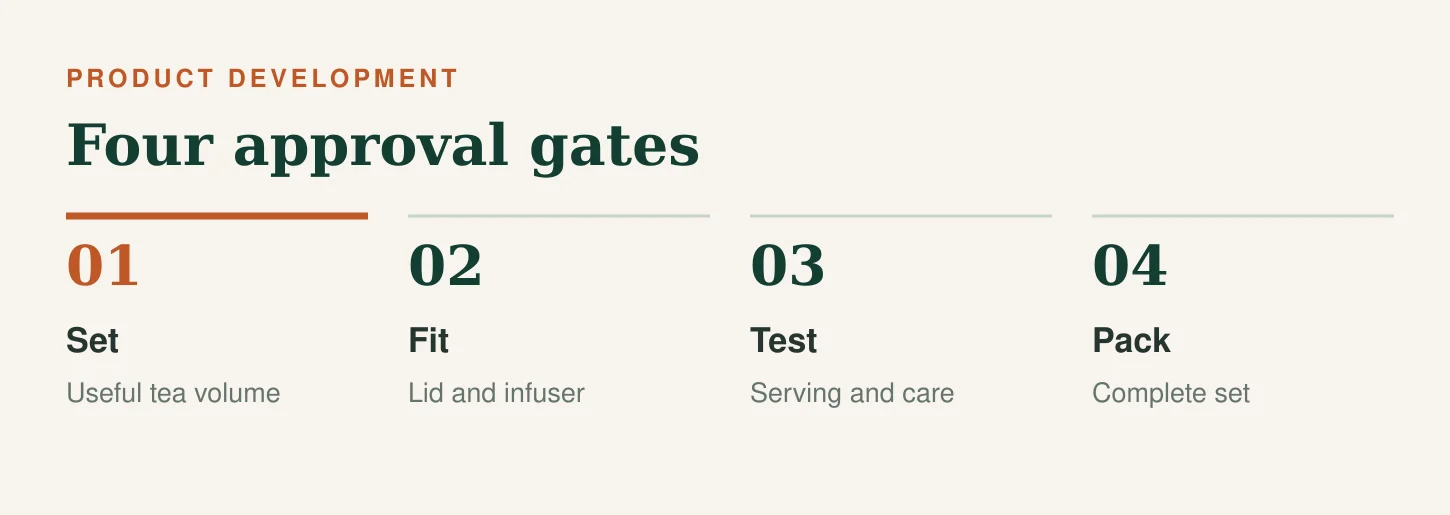
Approval gates for this product brief; the final steps depend on the project.
Decoration must work with the way the mug is held
Artwork placement affects both appearance and manufacturing. A wraparound motif can disappear under the handle. A logo placed too near the rim may compete with the drinking surface or require additional food-contact review. A blue-and-white pattern may be produced by a different method from a small overglaze brand mark; do not assume all decoration has identical washing instructions. Ask the factory to state the intended method and provide a fired sample on the final body.
Compare artwork across the range with a consistent orientation: handle right, handle left, front view, and top view. A repeating pattern may tolerate small positional changes; a centered emblem may not. Record an acceptable range for registration and shade. Review the inside as well as the outside, especially where a decoration approaches the lip or tea liquid. If a metallic accent is considered, establish care claims only after assessing the completed item.
|
Format |
Buyer benefit |
Extra approval work |
|---|---|---|
|
Plain tea mug |
Simple everyday use and fewer parts |
Rim, handle, capacity, glaze, and packing. |
|
Mug with ceramic lid |
Desk ritual and covered serving |
Lid seating, drip behavior, ceramic contact, and pack fit. |
|
Mug with infuser and lid |
Loose-leaf convenience |
Accessory fit, removal, cleaning, and component evidence. |
|
Cup and saucer set |
Hospitality presentation |
Cup-foot fit, tray handling, stacking, and matched shade. |
The best format depends on the intended channel. A gift buyer may value a complete infuser set; a hotel group may prioritize easy replacement of a simple mug. The table helps structure a sample review rather than declaring one format superior. When several sets share a mug body, define whether accessories can be reordered separately and how they are coded in the packaging and stock system.
Care, food contact, and test evidence
Porcelain is a ceramic material, but the word alone does not authorize a “dishwasher safe,” “microwave safe,” or “lead free” label. The complete finish and accessories matter. Ask for evidence on the actual product or a clearly justified representative construction. If the buyer’s sales market is the US, the FDA’s ceramicware guidance on lead and cadmium leaching is a useful starting point. For the EU, the general food-contact framework, good manufacturing rules, and ceramic-specific provisions need consideration. Other markets can add their own requirements.
Keep product performance separate from food-contact evidence. A thermal-shock or dishwasher test can be useful for the intended routine, but it is not a replacement for a migration report. Conversely, a migration report does not prove that a lid fits, a handle will survive repeated use, or a decoration will remain attractive after washing. Request the test method, conditions, date, tested sample identification, result, and any limitations. A report for a plain mug should not be attached to a decorated infuser set without a documented basis.
For hospitality buyers, cleaning procedures can be more demanding than home use. Specify the actual commercial washing context if it is important. In retail, write truthful consumer care instructions that match the tested product. Avoid broad claims such as “all porcelain mugs are safe in every dishwasher.” Glaze, metallic details, adhesives, and accessories can change the outcome.
Packaging and range architecture
A lidded mug is often three-dimensional in a way that raises packaging cost: the knob projects, the lid moves, and an infuser may rattle. Request a complete pack prototype, then test how a customer removes and replaces the pieces. The retail box should communicate what is included without showing a different colorway or volume. The shipping carton should keep ceramic surfaces from touching during ordinary handling.
Plan the line as a manageable set of SKUs. A white everyday mug, a blue-and-white covered version, and a loose-leaf gift set can share a design language while needing different specifications and test evidence. Decide which elements are common and which are exclusive. If a retailer later requests a seasonal pattern, update the artwork revision and check whether the test and care basis still applies. Consistent coding protects against the wrong lid or infuser being packed with a similar body.
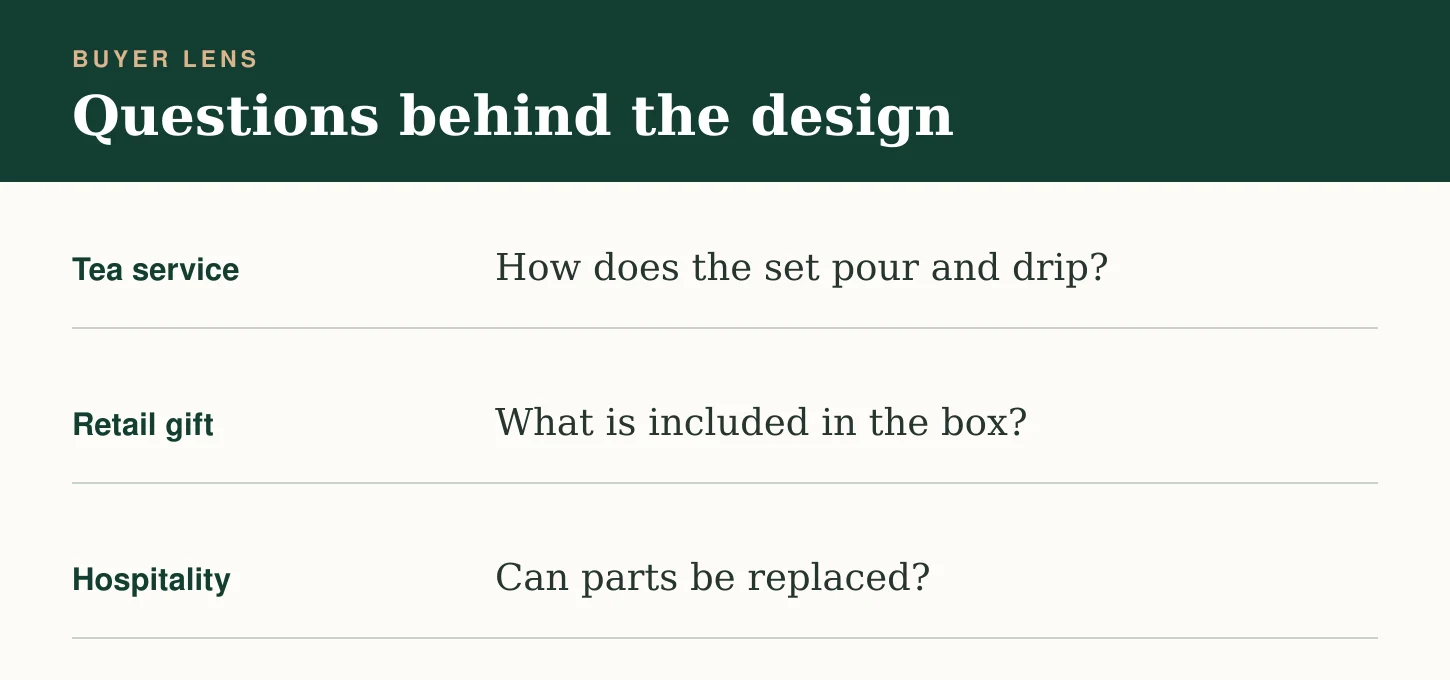
Buyer questions that should inform the approved product specification.
What to send to a manufacturing partner
Provide the intended user, tea format, practical fill, target dimensions, component list, artwork, desired care claims, sales markets, packaging channel, and order forecast. Identify whether you have a finished design for OEM production or need design development. Ask for a sample sequence that proves fit before decoration and proves packaging before mass production. A supplier should flag when a proposed ceramic lid is decorative rather than spill resistant.
Make replacement and cleaning practical
The most attractive infuser set can become frustrating if a small part is lost or difficult to wash. Ask whether lids and infusers will be available separately and whether parts from a later production run will fit the original mug within the approved tolerance. If the product is sold through hospitality, the operator may want a pool of replacement components rather than discarding a sound mug after a lid breaks. If sold as a gift, the brand should decide whether its customer service team can identify the exact replacement by SKU and color.
Cleaning instructions should be tested by someone who did not design the product. Can the infuser be removed without scraping the glazed rim? Do tea leaves collect under a lip or around a knob? Can the user place a wet lid on a table without leaving a puddle? Does a gift box allow the pieces to be repacked safely after a return? These mundane details are part of the experience and often separate a useful tea mug from a decorative one.
If a product includes an infuser in stainless steel or another material, establish which party is responsible for that component’s dimensional control and traceability. A supplier’s substitution may change fit or food-contact evidence. Keep a bill of materials, an approved sample of the whole assembly, and a rule for approving any replacement part. Clear after-sales support can also help a distributor justify a coordinated range to retailers without promising indefinite spare-part availability it has not negotiated.
For a café or hotel, ask staff to time the routine of serving, clearing, and washing the set. An extra component can make the guest experience feel considered and still slow a busy operation. A retail team should instead watch how a customer interprets the box: is it obvious whether the infuser and lid are included, and can the shopper understand the care method? These observations help select between a simple mug and a complete set without pretending that one is universally more premium.
Daye Porcelain presents custom mug development and ODM design support on its site. Its testing laboratory page describes in-house physical checks, which are useful topics for a project discussion but not a blanket claim that every configuration has passed. A buyer can submit the tea mug brief through the project inquiry page for a feasibility review and a project-specific response.
Frequently asked questions
Is a porcelain tea mug with a lid automatically suitable for travel?
No. A loose lid intended for desk use may not seal or remain attached when tipped. Define “travel” through the actual closure, spill test, carrying conditions, and packaging before using that claim.
What volume should be printed on a tea mug listing?
Use the measurement the buyer and customer can understand, with a clear method. Distinguish brim capacity from practical fill, especially when an infuser occupies space. Check the final physical sample rather than assuming the drawing predicts liquid volume exactly.
Can a mug and infuser share one material test?
Only if the test plan legitimately covers the full assembly. Different materials and contact surfaces may need different evidence. Request a component-level record and a report or declaration that matches the finished product and destination market.
What should we inspect on a blue-and-white tea mug?
In addition to general defects, check pattern position, blue shade, registration around curves and the handle, glaze coverage, lid match, and the inside contact surface. The decoration method and final use conditions determine appropriate care and food-contact review.