Table of Contents
ARTICLE 01 | CERAMIC BUYING GUIDES
CORE KEYWORD wholesale scented candles
Wholesale scented candles are sold as finished consumer products, but a branded candle begins as several coordinated components: vessel, wax, fragrance, wick, label, and pack. A retailer buying for resale needs one accountable party for the finished burn-tested SKU, even when separate specialists develop its parts. For a porcelain-led collection, the vessel can be the strongest visual asset. Daye Porcelain manufactures custom ceramic products in Chaozhou and can be considered for the vessel brief; its published product materials do not establish a wax-filling or finished-candle supply line. Confirm any additional services before describing Daye as the maker of a complete candle.
This guide helps home-fragrance brands, retailers, distributors, and procurement teams compare wholesale offers without confusing a beautiful sample with a proven retail-ready product. It focuses on product architecture, supplier roles, physical sampling, safety evidence, and repeat orders. The questions apply whether a brand buys finished candles from one supplier or commissions porcelain vessels from Daye and works with a specialist candle filler.
Key takeaways
- Decide whether the quotation is for finished scented candles, empty ceramic vessels, or a coordinated multi-supplier program.
- Compare the same wax fill, fragrance, wick configuration, vessel, label, pack, and quality evidence across suppliers.
- Test the complete candle system in its final vessel; a strong ceramic sample cannot validate the burn of an untested wax-and-wick combination.
- Build a retained specification for each scent and vessel SKU so a successful launch can be replenished.
Define the sales unit before requesting wholesale prices
The word “candle” can describe a bare filled vessel, a lidded candle in a retail box, a three-piece gift set, or a carton of unbranded units for a shop to relabel. Write down exactly what the store will sell. Include the net wax amount, vessel outside dimensions, useful fill line, wick count, fragrance variant, lid, dust cover, warning and ingredient label, retail box, master carton, and any insert or ribbon. If the wax weight is stated, keep it distinct from the gross weight of the ceramic vessel and pack.
Define the channel. A boutique may value a distinctive glaze, limited fragrance selection, and premium unboxing. A chain may emphasize barcode accuracy, shelf consistency, replenishment, and carton efficiency. A corporate program may add logo ownership and individual shipping. The target customer affects the number of variants and the kind of evidence a buyer should demand. It also affects whether empty vessels should be shipped to a local filling partner or whether finished goods will be imported.
Ask each bidder to label its scope in plain language. “Ceramic vessel only” should mean a formed, fired and inspected container with its specified finish and pack. “Finished candle” should include the fill, wick, fragrance, safety labels, testing, and final pack. If a coordinator combines two vendors, identify who owns final product approval, the complaint process, and the consumer-facing claims. An ambiguous quote can appear cheap because an essential service sits outside it.
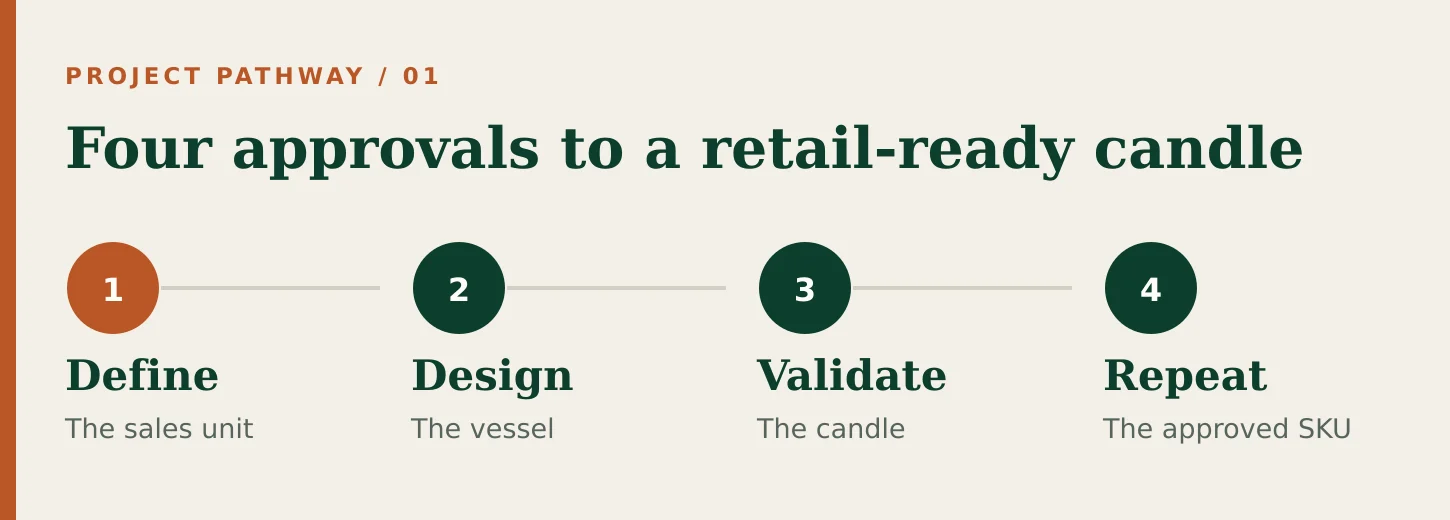
Illustrative approval sequence for the buyer, ceramic maker and finished-candle specialist.
Choose a vessel that works as a product component
The porcelain vessel is more than decoration. Its opening, wall, base, glaze, and overall geometry influence filling, wick placement, heat exposure, handling, and the way the candle burns. A narrow neck and a wide body can create a difficult wick plan. A heavy lid changes pack and freight costs. Raised relief or a very thick base can create a premium look but must still allow stable placement. Ask the filler to review the vessel drawing before approving molds, so the form and wax system are developed together.
Daye’s design development and prototyping and mold development resources describe how custom porcelain shapes and finishes move into sampling. Use that capability for a candle-vessel brief: desired inner opening, height, outer silhouette, wall expectations, base contact, lid relationship, glaze zones, logo method, forecast, and destination. The candle specialist should then decide the filling method and wick system and perform the finished-candle tests. Do not transfer food-contact mug claims automatically to a candle vessel; the relevant performance question is its behavior in the intended burn system.
Request several fired vessels from the proposed production route. Check inner volume, level base, rim finish, glaze defects, lid fit, and carton protection. Mark the intended wax fill line and label placement on a physical sample. A digital render cannot reveal how the glaze feels, whether the lid rocks, or whether the vessel varies enough to change the fill weight. A pilot of the completed candle must use representative production vessels rather than one hand-selected display piece.
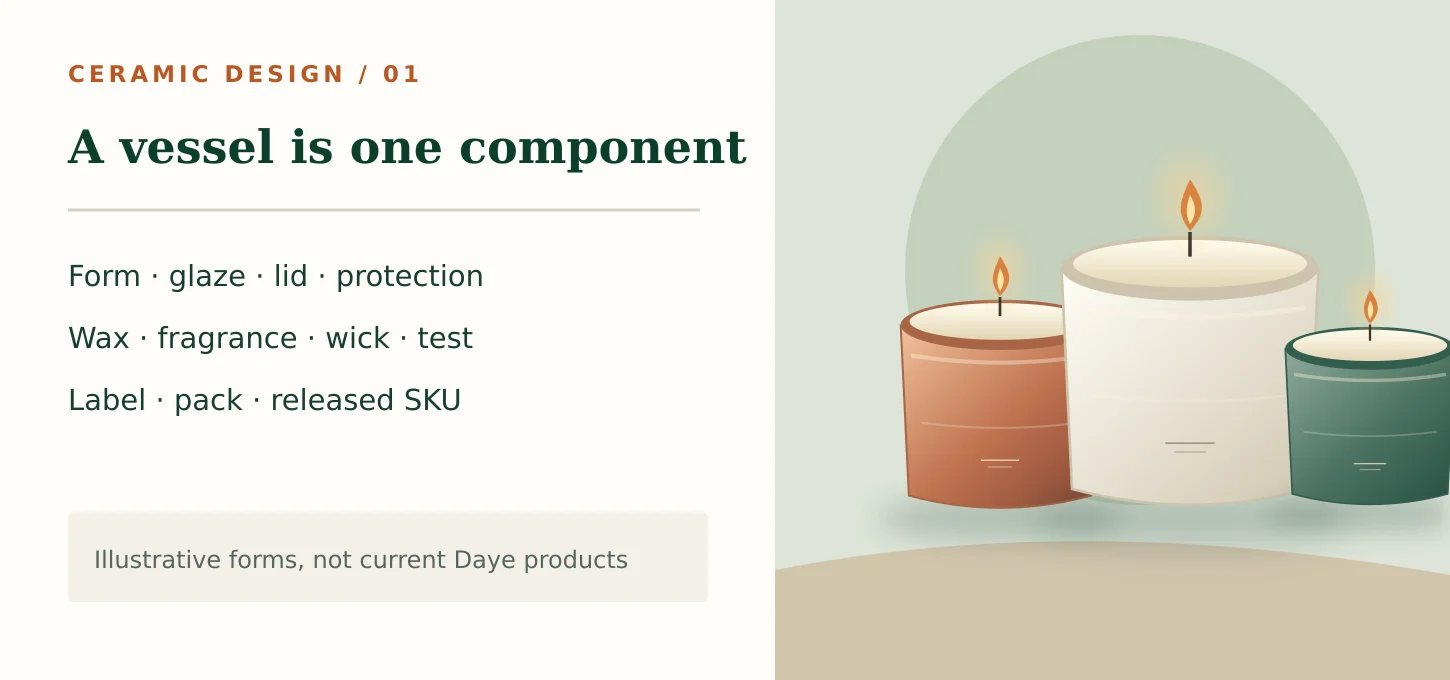
Conceptual porcelain candle-vessel illustration. These are not current Daye products.
Compare fragrance and wax as controlled inputs
A shopper may choose by scent name, but a buyer needs a formula and an approval record. The filler should identify the wax system, fragrance supplier and concentration range, wick specification, colorant if used, and any material changes that trigger retesting. A “soy,” “beeswax,” or “natural” description should match the actual composition and applicable market rules. Ask for a fragrance safety review appropriate to the candle application. IFRA publishes standards for fragrance ingredient use; a supplier’s compliance statement should identify the fragrance formula and the intended category, rather than serve as a general promise that every scent behaves identically.
Evaluate hot and cold fragrance performance as part of a controlled pilot, but avoid reducing quality to one subjective sniff. Assess scent character when unlit, scent during the intended burn, visible emissions, wax appearance, surface behavior, and consistency across several units. Fragrance families can help merchandise a range: citrus and herbal notes may suit one season; woods and warm spices another. Keep descriptive copy truthful and avoid unsupported health or therapeutic claims.
Wax, wick, fragrance, and vessel form an interacting system. Changing the scent can change how a candle burns even when the jar looks identical. A retailer should ask whether every fragrance-vessel-wick combination has been evaluated, which variants can share evidence, and who approves substitutions. A broad wholesale assortment is only valuable if its individual SKUs can be produced and documented consistently.
Check safety, labels and final product evidence
The U.S. Consumer Product Safety Commission lists candle-related voluntary standards, including fire-safety labeling and candle fire-safety specifications. The relevant version and market scope should be checked for the planned launch. In Europe and the UK, fragrance components can also affect chemical classification and labeling; Northern Ireland’s Health and Safety Executive has specific guidance on candles and CLP, while Great Britain has its own chemical classification regime. A qualified compliance adviser or test laboratory should review the actual formula, label, and destination, especially when a brand sells into multiple markets.
The filler should provide a burn-test plan for the final vessel, wax, fragrance, wick, and any decorative elements. Look for observations through the candle’s life, not only a brief first-light photo: flame behavior, container condition, wick stability, heat, soot, and end-of-life behavior. A new three-wick version or a different ceramic body needs its own assessment. Safety warnings should be present and legible on the sales unit according to the target market; do not print a label from a generic template before the formula is reviewed.
|
Purchase item |
What the buyer approves |
Who usually supplies the evidence |
|---|---|---|
|
Ceramic vessel |
Fired form, finish, dimensions and pack |
Vessel manufacturer |
|
Filled candle |
Wax, fragrance, wick and finished burn behavior |
Candle filler or finished-candle manufacturer |
|
Consumer label |
Warnings, ingredients where required, brand information |
Responsible finished-product party |
|
Shipped retail SKU |
Box, barcode, transit protection and count |
Program owner with pack suppliers |
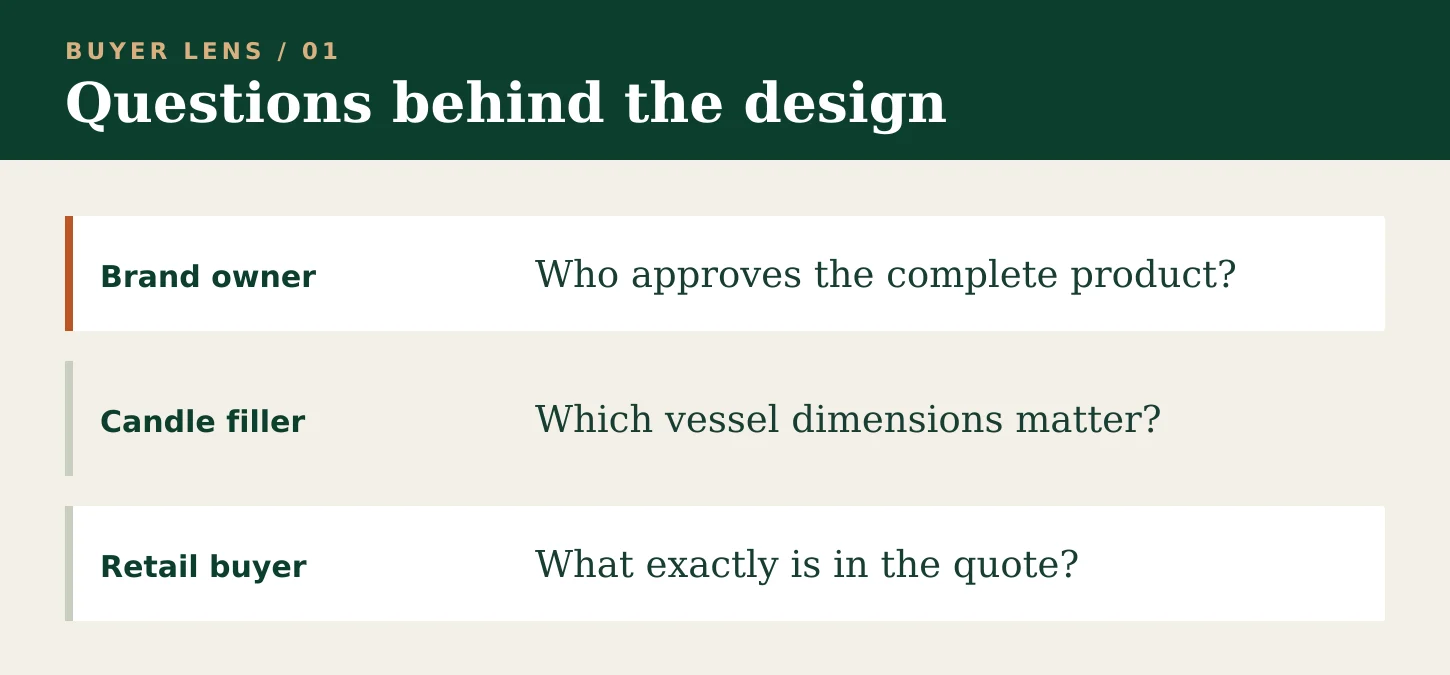
Buyer questions that guide scope, quality evidence and replenishment.
Calculate a comparable wholesale program
Compare offers on a landed and sellable unit rather than only a per-vessel or per-pour price. The quote should identify tooling, samples, vessel cost, filling, fragrance variants, lids, labels, retail boxes, testing, inspection, export or domestic freight, and breakage or replacement rules. A low unit price may exclude the expensive components that turn an empty jar into a finished candle. A large order also ties up cash and warehouse space; forecast by scent and channel rather than treating all variants as interchangeable.
Ask for minimum order quantities at each layer. A ceramic mold may have one economic threshold, a fragrance blend another, and a retail box printer a third. A project coordinator can propose a shared vessel across several scents to reduce tooling complexity, while using labels or sleeve color to distinguish SKUs. Confirm which components can be replenished independently and what lead time applies to a reorder. Local filling may simplify fragrance or labeling changes for a UK or U.S. brand, but the combined cost and quality responsibility must still be compared with a complete finished-goods offer.
Retailers should receive a specification sheet with product dimensions, wax weight, burn guidance supported by testing, scent notes, materials, care and warnings, carton configuration, and product images of the approved final item. Do not claim a precise burn time or “clean” emission profile from a concept sample. The commercial promise should be as controlled as the manufacturing file.
Build a repeatable porcelain-led collection
A useful first range may have one vessel form, two or three scents, and one gift presentation. That gives the buyer enough variety to test demand while keeping the burn and pack matrix manageable. Retain a finished candle master, an empty fired vessel master, a fragrance reference, approved artwork, a test file, and a carton sample for each SKU. If a glaze, fragrance, wick or wax source changes, decide in writing what must be reapproved before the next shipment.
Daye can be approached through its project inquiry with drawings, expected vessel quantity, target finish, intended filling location, lid and pack needs, and a request for ceramic sample and inspection criteria. A separate finished-candle specialist should own the wax-and-wick program unless Daye confirms another role in writing. This distinction lets a brand use Daye’s porcelain development expertise while giving consumers a finished product supported by the right tests and labels.
A final request-for-quote checklist
Before inviting suppliers to bid, send one controlled document containing the finished-unit definition, component responsibilities, desired ceramic drawing, fragrance count, destination markets, pack route, expected first order and reorder forecast. Ask bidders to identify assumptions, exclusions and sample charges in their reply. Compare their answers line by line, note every proposed substitute, and resolve gaps before approving tooling or printing retail labels. This small discipline makes price and capability discussions substantially more useful than an open-ended request for “best wholesale scented candles.”
For the first supplier call, request a sample schedule with dates for ceramic approval, filled pilot, label review, and a production-ready sales unit. Ask whether each stage has a charge and whether failed samples can be revised within the planned launch window. The buyer should also request a named contact for ceramic defects, finished-candle performance, and transport damage. When a complaint occurs, the brand can then direct it to the correct investigation while retaining one owner for communication with the retailer. This is particularly useful when a porcelain maker, filler, printer, and distributor each hold part of the product record. A clear escalation route is a practical wholesale capability, even if it is invisible in the product photograph.
FAQ
Does Daye sell finished wholesale scented candles?
Daye’s published product and manufacturing information establishes porcelain OEM and ODM capabilities, not a finished wax-filling line. Ask Daye directly about a particular project’s scope. A buyer should not assume that an empty vessel quote includes wax, fragrance, wicks or burn testing.
What should be included in a wholesale candle quote?
The quote should identify the exact finished sales unit or component scope, quantity by fragrance, vessel and finish, wax weight, wick count, decoration, labels, pack, tests, inspection, tooling, and delivery terms. Compare suppliers on the same basis.
Can I use the same burn test for every scent?
Do not assume so. Fragrance changes can affect the system. Ask the responsible candle manufacturer and laboratory which variants need separate evaluation and document that decision before launch.
Is a ceramic vessel automatically safe as a candle container?
No. It needs to be evaluated within the complete candle design. Review its construction and condition through the intended burn cycle, including heat and end-of-life behavior, with the selected wax and wick.
How many scents should a new retailer launch?
Start with a range that can be sampled, tested, stocked and replenished well. A small coherent group can reveal customer preference without multiplying unproven combinations and unsold inventory.