Table of Contents
ARTICLE 03 | CERAMIC BUYING GUIDES
CORE KEYWORD wholesale scented candles UK
Wholesale scented candles UK buyers look for may come from a domestic stockist, a private-label candle maker, or a coordinated supply chain with an overseas vessel manufacturer and a UK filler. These routes can lead to a similar-looking retail jar, but they give a buyer different control over fragrance, packaging, replenishment, and responsibility. A useful sourcing brief begins with the finished sales unit and its destination, then identifies each company that will make, import, label, and sell it.
Daye Porcelain is a custom ceramic manufacturer in China. Its published capabilities make it a potential source for porcelain candle vessels, not a verified supplier of filled scented candles. A UK brand can explore a Daye vessel and commission a candle specialist to select wax, fragrance, wick, filling, finished-product testing, and market labels. That division should be explicit in contracts, artwork approval, and the product file. The following guide is for commercial planning; a competent UK product-safety and chemical-classification specialist should assess the actual formula and market.
Key takeaways
- Decide whether a quote covers a finished UK retail candle or an empty porcelain vessel.
- Separate Great Britain from Northern Ireland in the regulatory review; one generic “UK compliant” label may not be adequate.
- Approve the complete vessel, wax, fragrance, and wick combination, then connect the test evidence to the production SKU.
- Model the cost and lead time of vessel import, local filling, pack, inspection, and replenishment before selecting a supply route.
Choose the supply route by commercial need
A UK wholesaler with stocked finished candles can be appropriate when a shop needs immediate availability and accepts an existing design. A specialist UK candle maker may offer a private-label collection with control over fragrance and pack. A porcelain-led brand may source a distinctive ceramic vessel from Daye, then arrange filling and finishing with a specialist. The last route can create a more recognizable product, but the buyer must coordinate specifications between two production stages and decide which party releases the finished SKU.
Ask for a written scope alongside a quotation. Does the supplier sell empty fired vessels, poured candles without boxes, or labeled and boxed retail units? Does the price include test work, import freight, duty, inland delivery, and rejected-unit replacement? Is a retailer buying ex-stock or commissioning a manufacturing run? “Wholesale” alone tells you little about the work behind the offer. A comparison sheet should put every bidder on the same finished-unit basis.
When a UK brand imports vessels for local filling, agree who inspects the ceramics on arrival and how nonconforming pieces are handled. A filler may reject jars with unstable bases, chipped rims, significant dimensional variation, or unsuitable interior finish. The original vessel supplier and filler should align on an approved physical sample and measurable acceptance limits before bulk shipment. The brand should budget for sample transport and a pilot rather than assuming a good photograph proves fill compatibility.
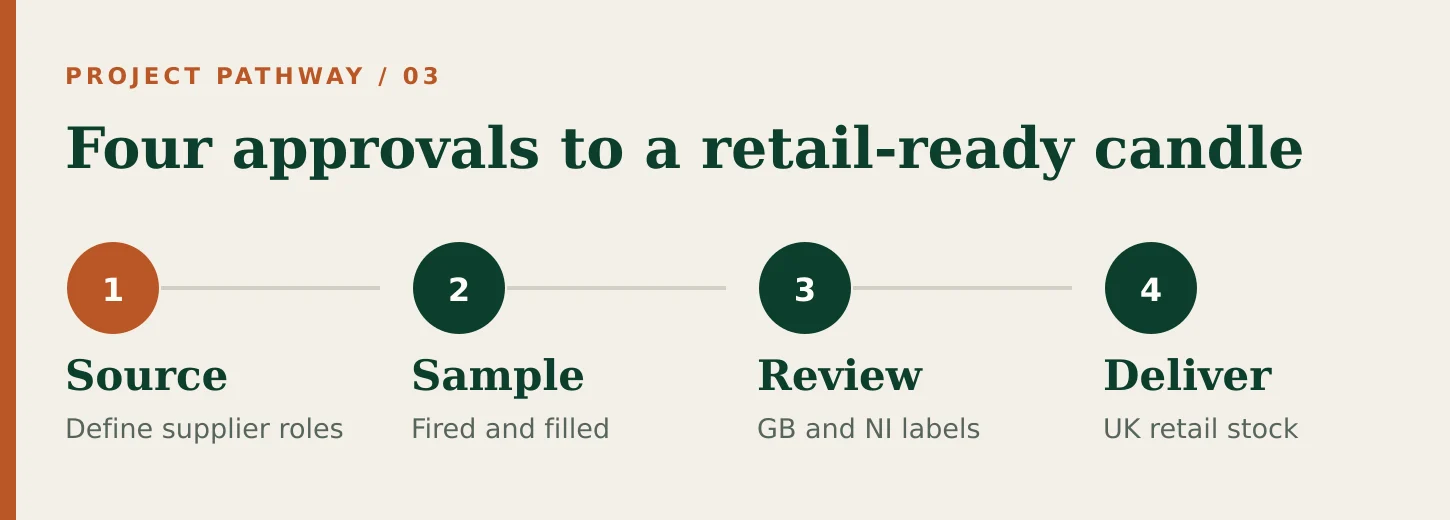
Illustrative approval sequence for the buyer, ceramic maker and finished-candle specialist.
Define the porcelain vessel around the fill process
Porcelain allows a brand to develop a specific silhouette, tactile glaze, embossed mark, or matching ceramic lid. Those features should support use, not only a mood board. A tall narrow vessel, an inward lip, or an irregular opening can complicate pouring and wick placement. A wide three-wick form creates a different heat and test problem from a single-wick jar. Ask the candle maker to review internal dimensions, wall and base form, nominal fill level, lid clearance, decoration location, and expected production variation before ceramic tooling is approved.
Daye’s design development and prototyping pages describe its custom ceramic sampling route. A UK buyer can send the vessel drawing, expected order size, finish reference, desired logo treatment, carton requirements, and filling partner’s constraints. Request fired samples from a representative process. The filler then needs to pour and evaluate its chosen wax, fragrance, and wick in those actual vessels. A cup sold for beverages is not automatically established as a safe candle container: it needs assessment for its intended candle system.
Make the approval chain visible. The vessel master establishes form and finish; the filled pilot establishes the complete candle; the printed sales unit establishes label and pack. Retain all three, along with revisions and dates. If the glaze, internal diameter, fragrance oil, wick, wax, or fill weight changes, the responsible candle manufacturer should decide what reapproval and testing are needed. Do not let a new scent or finish silently inherit an earlier SKU’s evidence.
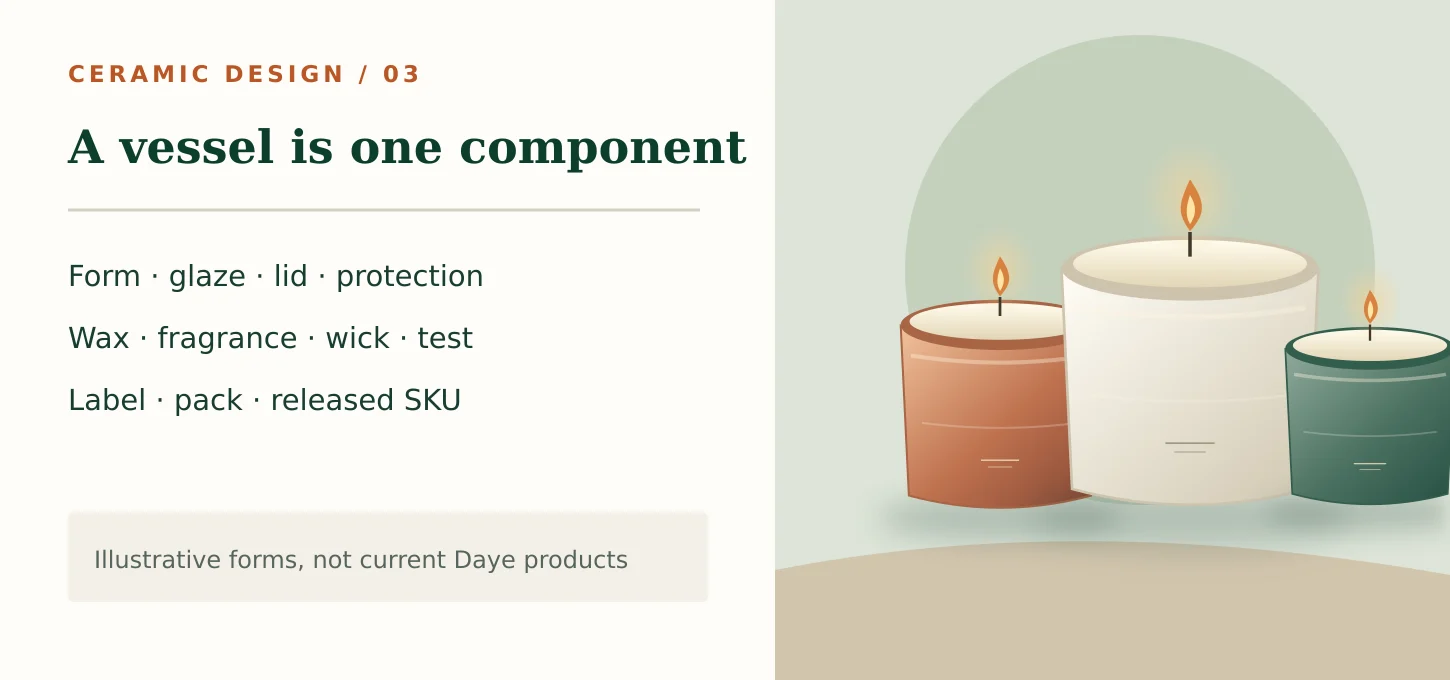
Conceptual porcelain candle-vessel illustration. These are not current Daye products.
Treat GB and Northern Ireland as separate reviews
The UK includes Great Britain and Northern Ireland, but product-safety and chemical-classification arrangements are not identical. UK government product-safety guidance says businesses placing consumer products on the UK market must ensure their safety and follow applicable labeling requirements, with provisions applied differently in GB and NI. Northern Ireland’s Health and Safety Executive specifically describes candles under CLP in its guidance. Great Britain has its own GB chemical classification framework. A buyer shipping to both destinations should ask a specialist to check the exact fragrance formula, classification, wording, supplier identity, and placement of labels for each market.
The warning and ingredient information cannot be finalized from the vessel artwork alone. Fragrance composition and concentration can affect classification. Ask the candle filler for the formula-specific safety information, fragrance documentation, appropriate classification assessment, and proposed label artwork. Check that warnings remain legible on the actual jar or outer packaging as required for the sales unit. A retail photograph should match what the consumer receives. A draft label borrowed from a different scent is not a safe shortcut.
Candle fire-safety information also matters. The applicable current standards and test methods should be checked for the intended market and product configuration. A burn program should observe the candle through its life, including flame behavior, wick position, container condition and end-of-life conditions. A new three-wick vessel or a decoration near the flame can require a separate assessment. Avoid a blanket “meets all UK standards” claim until the relevant standards, reports, and responsible party are recorded in the product file.
|
UK buyer question |
Evidence to request |
Owner to confirm |
|---|---|---|
|
What exactly arrives? |
Approved sales-unit specification and packed sample |
Seller and brand |
|
Is the vessel suitable? |
Fired sample, dimensional limits, condition criteria |
Vessel maker and filler |
|
Does the candle perform safely? |
Finished configuration test plan and results |
Candle specialist |
|
Is the label market-ready? |
Formula-based GB/NI review and final artwork |
Responsible UK business |
|
Can it be reordered? |
SKU file, retained masters, change-control rules |
Program owner |
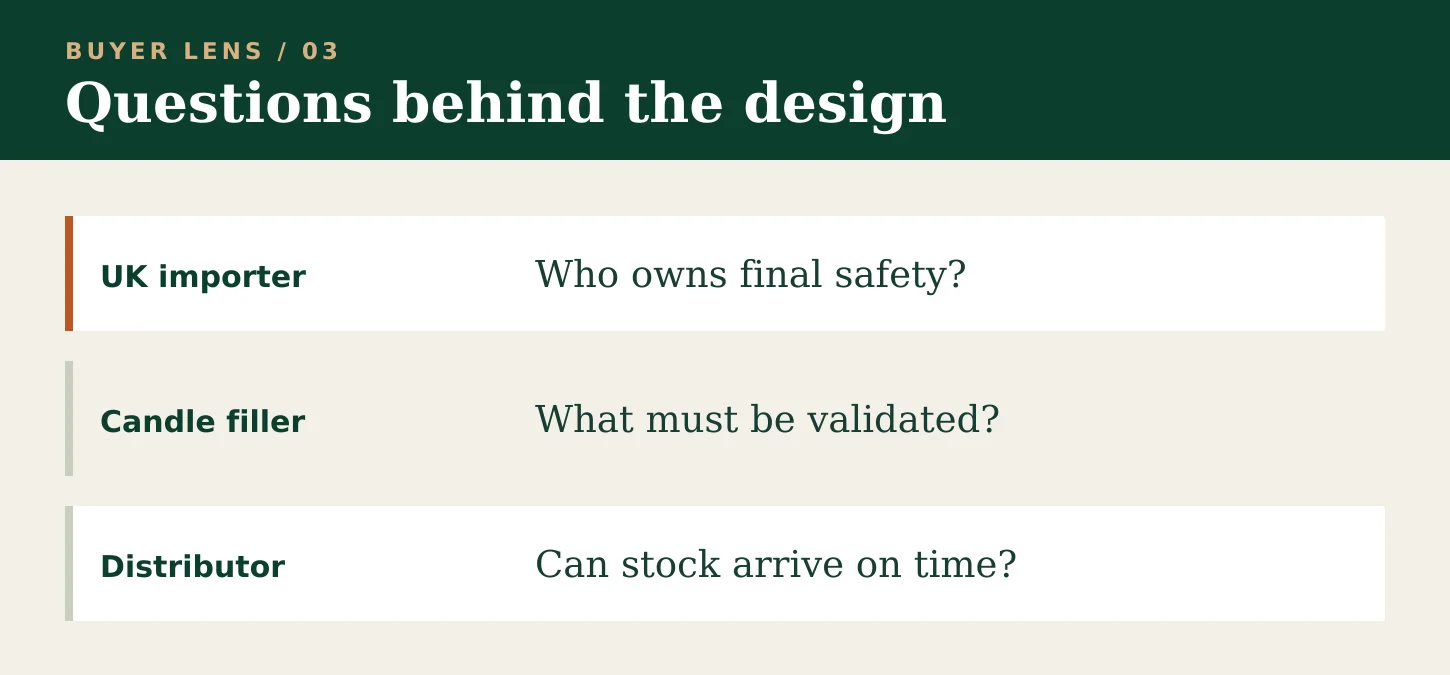
Buyer questions that guide scope, quality evidence and replenishment.
Build a landed cost that reflects UK operations
For a locally filled candle using imported ceramic vessels, the complete cost includes vessel tooling and samples, production, ceramic protection, international freight, customs handling, inland transfer, wax, fragrance, wick, pouring, testing, lids, labels, retail boxes, inspection, storage, and delivery to retailers. The commercial parties should calculate duties and taxes for their actual transaction and commodity classification rather than rely on an online estimate in an article. Freight method and carton density can materially change the cost of a heavy porcelain vessel.
Compare alternatives at the same retail-ready stage. A UK stocked candle may have a higher quoted unit but include local inventory, labels, and smaller replenishment quantities. An imported empty jar may offer a distinctive design at a component price, while the brand funds filling, testing, and storage. A premium gift box can lift shelf presence but increases space, handling and shipping cost. A discount on ceramic quantity is useful only if the resulting finished collection can sell through at an acceptable margin.
Ask for minimums by component. The vessel forming run, glaze color, printed box, fragrance batch, and finished-candle fill may each have different minimums. A shared vessel across several scents can simplify ceramic replenishment, but each finished scent remains its own tracked SKU. Agree on who holds extra vessels, packaging, or fragrance stock and what happens to them if the collection is discontinued. A UK distributor will also want reliable carton counts, barcode data, outer dimensions, and a predictable replacement process.
Plan samples and delivery around a real retail date
Work backward from the date stock must reach the retailer, allowing time for artwork, ceramic development, fired samples, transit to the filler, formula and wick development, burn evaluation, final label review, bulk vessel production, filling, quality checks and distribution. Some tasks can overlap, but a final box insert should not be printed before the vessel and lid fit are stable. Agree on decision dates and identify who signs off each stage; otherwise delays are attributed vaguely to “production.”
Do a packaging trial using the intended finished candle and the actual delivery route. A gift box that looks excellent in a studio can fail when several heavy ceramics share a master carton. Inspect lids for rubbing, glaze scuffs, wax smearing, label damage, and broken rims after a representative transit exercise. Parcel delivery to individual customers may need a different protective structure from pallet delivery to a UK warehouse.
A first wholesale purchase order should name the exact SKU, fragrance variant, vessel master, label revision, retail box, master carton, inspection criteria, delivery terms and evidence file. State what happens if a supplier wants to substitute a fragrance, wax, wick, glaze or pack material. Replenishment should use the same controlled information, not a memory of the first approved sample. This matters most when an account needs a seasonal reorder quickly.
Position the offer for UK buyers honestly
“Luxury scented candles wholesale UK” and “cheap wholesale scented candles” describe different buying priorities, but both need honest scope and safe finished goods. A premium buyer may care about glaze depth, substantial lid, tactile pack and scent story. A value buyer may prefer a standard vessel and efficient carton. In either case, the final candle’s performance and accurate label must be supported. Do not imply that a porcelain manufacturer poured a candle without written confirmation of that service.
A page on Daye’s site can accurately invite UK brands to develop a custom porcelain candle vessel for a wholesale range. It can explain the handoff to a qualified filling partner and give buyers a practical brief to submit. This attracts relevant B2B prospects while setting expectations the procurement team can verify. The contact request should ask for vessel dimensions, annual forecast, target finish, lid concept, target market, filling location, and any filler specifications already available. Daye’s project inquiry is a suitable next step for that vessel discussion.
A UK buyer should keep a versioned product file accessible to its sales and operations teams. It can include the filled product photograph, approved description, formula reference held by the candle specialist, label versions for each intended territory, supplier declarations, test results, shipment records and complaint route. The file need not expose a fragrance house’s confidential recipe to every retailer, but the responsible business must have enough information to support its claims and obligations. If a wholesaler asks for evidence before listing, a prepared summary and the correct contact will save time. Revisit the file when the fragrance, pack, destination or responsible business changes.
FAQ
Can Daye ship finished scented candles to the UK?
Daye’s public materials establish ceramic OEM and ODM capabilities. They do not establish a finished candle filling service. Ask Daye to confirm any broader project scope in writing. A UK brand can separately arrange a candle specialist to fill and approve a Daye ceramic vessel.
Does a single label work for Great Britain and Northern Ireland?
Do not assume it does. The relevant product-safety and chemical-classification arrangements differ. Have the actual formula and label reviewed for each destination and sales channel before printing.
Should the candle be tested after changing only the scent?
A fragrance change can affect both the burn system and chemical classification. The finished-product specialist should assess the change and decide what tests, documentation, and label revisions are required.
What should a UK retailer ask a wholesale supplier first?
Ask whether the quote is for a complete labeled and boxed retail candle, what evidence supports its safety and claims, who is responsible in the UK, what the landed delivery terms are, and how identical stock can be replenished.
Is local filling always faster?
It can improve flexibility, but the total timetable still includes vessel sampling, international shipping if applicable, formula work, testing, label approval and filling capacity. Compare dated plans from suppliers rather than a general promise.